













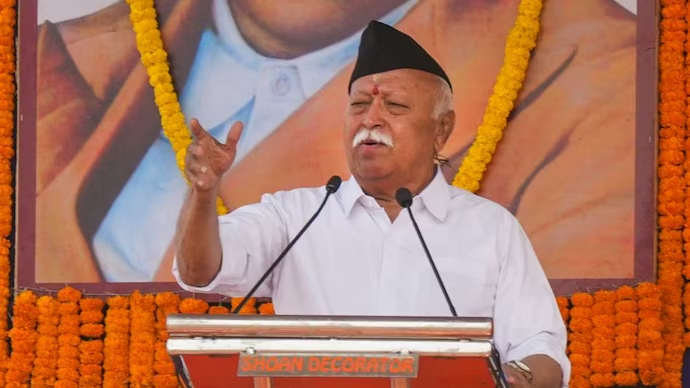
RSS Chief Mohan Bhagwat has made a powerful call to revive India’s cultural soul by promoting Sanskrit as a daily communication language. Speaking at the inauguration of the Abhinav Bharti International Academic Building at Kavi Kulguru Kalidas Sanskrit University in Ramtek, Nagpur, Bhagwat urged the people of India to embrace Sanskrit not just as a classical or academic language, but as a living, breathing mode of daily interaction. Declaring Sanskrit as the mother of all Indian languages, he emphasized that the ancient language is key to understanding Bharat’s intellectual and emotional identity. The event also saw the presence of Maharashtra Chief Minister Devendra Fadnavis, who assured the state government’s full support for the development and dissemination of Sanskrit.
Sanskrit: More Than Just a Language, It’s an Emotion
Mohan Bhagwat spoke passionately about how Sanskrit is not merely a language but a medium that enhances one’s inner emotions, or bhav. He acknowledged the difference between knowing Sanskrit and being able to speak it fluently, adding that even though he had learnt the language, fluency remained a challenge. Nevertheless, he insisted that speaking Sanskrit in daily life should be encouraged at all levels. “Sanskrit needs to reach every household,” he said, adding that if India truly wants to preserve its cultural ethos and self-identity, Sanskrit must be lived, not just learned.
Highlighting its ancient wisdom, Bhagwat noted that Sanskrit is intricately linked to India’s civilizational continuity. Unlike Western languages that are often rooted in commercial or colonial contexts, Sanskrit, he said, carries with it the emotion of swatwa – selfhood. “Swatwa is not materialistic but reflects individuality, and this individuality is conveyed through language,” he added.
Self-Reliance Through Cultural Confidence
Mohan Bhagwat’s speech was not just about language—it was a deeper message about atmanirbharta (self-reliance) and swabal (self-strength). He pointed out that while the nation is united in its ambition to be self-reliant, this cannot happen in a vacuum. Cultural self-awareness, intellectual development, and emotional clarity are essential parts of this journey, and language is the vessel that carries these qualities. “Knowing Sanskrit is like understanding the country,” Bhagwat remarked, underlining the role of the language in connecting citizens with their cultural roots.
He emphasized that true development is not just technological or economic but also intellectual and spiritual. Sanskrit, being a language that encapsulates ancient wisdom and moral clarity, plays a pivotal role in this transformation. He argued that without Sanskrit, India would be disconnected from its civilizational identity.
The Role of Institutions and the People
While Mohan Bhagwat appreciated the government’s support in promoting Sanskrit, he made it clear that people’s participation was even more crucial. Institutions like the Kavi Kulguru Kalidas Sanskrit University can only achieve their vision if there is societal backing. “The Sanskrit university will receive government patronage, but people’s support is also necessary,” he stated, urging citizens to begin using Sanskrit in simple, everyday interactions.
He praised the efforts of the university in building world-class infrastructure and academic platforms, such as the Abhinav Bharti International Academic Building, for global-level Sanskrit research and education. However, he reminded the audience that Sanskrit cannot thrive merely within academic walls—it must live in the homes, streets, and conversations of India.
India’s Civilizational Message: From Global Market to Global Family
In contrast to the Western narrative of economic globalization, Mohan Bhagwat’s reinforced India’s civilizational vision of Vasudhaiva Kutumbakam—the world is one family. “The Western world built the idea of a ‘global market’, which has now failed. India, on the other hand, has always believed in a global family,” he said, referring to India’s G20 Presidency in 2023, which embraced this very theme.
This philosophical outlook, he argued, originates from Sanskrit texts and Vedic thought, which view the world as interconnected and harmonious rather than competitive and profit-driven. He suggested that Sanskrit is not just relevant to Indian culture but holds the potential to shape global discourse rooted in peace, wisdom, and shared values.
A National Revival Begins with Language
Mohan Bhagwat’s call to make Sanskrit a household language is more than a cultural campaign it is a civilizational revival. In an era where India is asserting itself globally in economics, defense, and technology, it must also reclaim its linguistic and spiritual heritage. Sanskrit offers a unique bridge between India’s ancient wisdom and modern aspirations. With government support, academic institutions, and active public participation, Sanskrit can be more than a ceremonial tongue—it can become a living language of unity, intellect, and identity. The RSS chief’s message is clear: only when Sanskrit returns to our homes will Bharat truly stand tall on the global stage.