























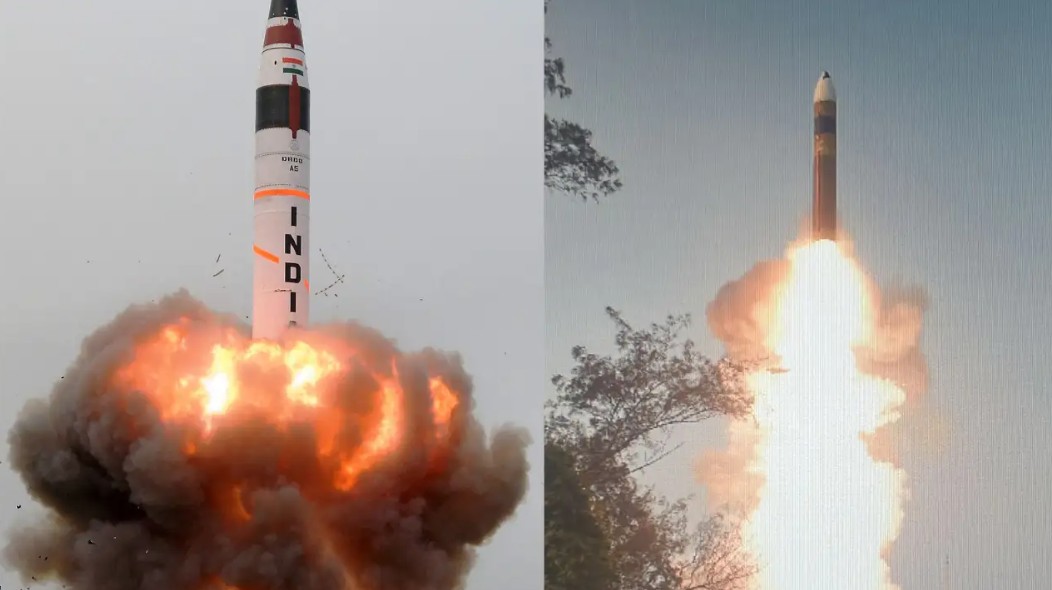
India on Wednesday successfully test-fired its most advanced nuclear-capable ballistic missile, Agni-5, from the Integrated Test Range at Chandipur in Odisha.
Conducted under the Strategic Forces Command, the test met all mission objectives, reaffirming India’s commitment to maintaining a credible minimum deterrence, the Ministry of Defence said.
Developed by the Defence Research and Development Organisation (DRDO), the Agni-5 has now been upgraded with MIRV (Multiple Independently Targetable Re-entry Vehicle) technology — enabling a single missile to carry and deliver multiple nuclear warheads to different targets. This marks a significant leap in India’s strategic and nuclear delivery capabilities.
What Is Agni-5?
The Agni-5 is an intermediate-range ballistic missile (IRBM) designed for long-range nuclear delivery. It features a three-stage, solid-fuel propulsion system and is launched from a road-mobile, canisterised platform, allowing for greater mobility, storage safety, and quicker deployment.
The missile is capable of carrying a nuclear payload of up to 1.5 tonnes. Built with lightweight composite materials, Agni-5 combines efficiency with durability.
It is guided by an advanced system that includes gyroscopic sensors and satellite navigation tools such as NavIC (India’s regional GPS) and the American GPS network, ensuring high accuracy over extended ranges.
Why This Test Is Significant
The key highlight of this latest launch is the continued validation of MIRV technology, which allows a single Agni-5 missile to strike multiple targets simultaneously with independent warheads.
India first demonstrated this capability in March 2024, with a successful test from Kalpakkam, Tamil Nadu. According to reports, the system is capable of carrying up to three nuclear warheads.
The August 2025 test takes it one step closer to full operational deployment, enhancing India’s ability to penetrate missile defence systems and deliver a more flexible and effective nuclear response.
Agni-5’s Range and Strategic Reach
With a declared range exceeding 5,000 km, Agni-5 can strike targets across much of Asia, including northern China, and parts of Europe. Reports suggest that DRDO is working on a variant with a range of up to 7,500 km, which would further expand India’s strategic footprint.
How It Compares Within the Agni Series
India’s Agni missile family forms the backbone of its land-based nuclear arsenal:
- Agni-1: Short-range (700–900 km), primarily targeting Pakistan
- Agni-2: Medium-range (~2,000 km), for wider regional coverage
- Agni-3 and Agni-4: Long-range (2,500–3,500 km), designed to deter China
- Agni-5: Longest-range variant (5,000+ km), now equipped with MIRV for multi-target nuclear deterrence
What Powers Agni-5?
Key technological features of Agni-5 include:
- MIRV capability, allowing multiple warheads per missile
- Three-stage, solid-fuel propulsion for extended range and high reliability
- Lightweight composite structure for improved performance
- Advanced guidance using gyroscopes and satellite navigation (NavIC & GPS)
- Canisterised launch system, enhancing mobility and reducing launch time
Upgrades in avionics, heat shielding, and guidance systems have further enhanced the missile’s resilience and precision, making it combat-ready under various scenarios.
Pakistan Reacts With Concern
The missile test has reportedly alarmed Pakistan. According to The Times of India, the Strategic Vision Institute (SVI), an Islamabad-based think tank, warned the Pakistani leadership about the growing reach and sophistication of India’s missile programme.
The SVI expressed concerns over India’s post-MTCR (Missile Technology Control Regime) advancements and raised the possibility of future Agni variants reaching ranges of 8,000 km, potentially bringing cities like Washington, Moscow, and Beijing within reach.
It also flagged India’s expanding sea-based nuclear arsenal, including submarine-launched missiles, as a challenge to regional stability.
What Lies Ahead for India’s Missile Programme
As per media reports, DRDO is now focused on next-generation upgrades to the Agni line, which may include:
- Extended ranges beyond 7,500 km
- Increased MIRV capacity for more warheads per missile
- Bunker-buster capabilities for hardened or underground targets
These upgrades aim to enhance India’s second-strike capability under its No First Use (NFU) policy, ensuring credible deterrence in a rapidly evolving geopolitical landscape.
With the successful MIRV-enabled test, Agni-5 stands as India’s most advanced missile and a key pillar of its strategic deterrence architecture.
The launch not only showcases India’s technological prowess but also sends a clear message about its preparedness to safeguard national security through credible and capable defence systems.