
























In a clear directive aimed at public safety and humane animal care, and tackling the growing menace of stray dog attacks and rabies deaths the Supreme Court on Monday ordered that all stray dogs across the Delhi-NCR region be relocated to designated shelters.
The court instructed authorities in Delhi, Noida, Gurugram, and Ghaziabad to begin relocating all stray dogs—sterilised or not—from residential areas to professionally managed shelters.
Yet, instead of complying with the law and supporting a structured, compassionate solution, a section of so-called animal lovers and activists have chosen protest and defiance over reason and responsibility.
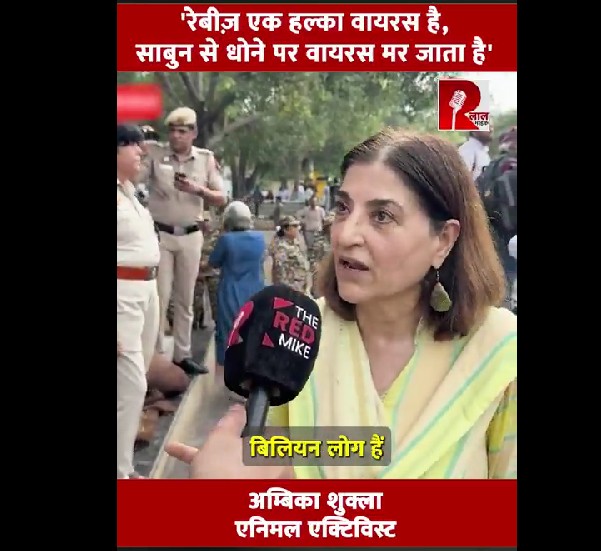
One such voice, animal activist Ambika Shukla, speaking to The Red Mike, downplayed the severity of rabies and the risks posed by stray dogs. According to her, rabies is “a very rare disease” that “dies with soap” and is “not contagious,” adding that “stray dogs do not bite as much as is shown.”
“Rabies is transmitted only when an infected animal’s saliva comes into direct contact with human blood, typically through a bite. The virus itself is extremely fragile and can be neutralised simply by thoroughly washing the wound with soap and water. India — despite its population of 1.5 billion — reports relatively few rabies cases. Rabies is a rare, non-contagious disease and that the threat posed by stray dogs is often exaggerated,” Shukla stated.
The remark from the activist reflects a deeply flawed and misleading narrative — one that conveniently ignores public health data, the suffering of bite victims, and the real dangers faced by communities across urban India.
If we speak on facts, rabies, though preventable, remains a fatal disease. India accounts for nearly a third of global rabies deaths annually, with stray dog bites being the leading cause. Children are often the worst affected.
The problem isn’t only about rabies — it’s about safety, sanitation, and the mental toll on people who live in fear of aggressive strays near homes, schools, and hospitals. It’s about senior citizens who avoid walks, children who carry sticks to school, and residents who must alter their lives around hostile, unsupervised animals.
The Supreme Court’s order is not about cruelty; it is about order, safety, and care — for both humans and animals.
According to Municipal Corporation of Delhi (MCD) data, 49 rabies cases and over 35,000 dog bite incidents were reported in the capital between January and June 2025.
India accounts for nearly 36 per cent of global rabies deaths, according to the World Health Organization, with an estimated 60,000 fatalities annually.
The Supreme Court has called the situation “grim” and stressed that immediate, uncompromised action is essential to protect public health and safety.
Sending stray dogs to shelters allows for proper medical treatment, vaccinations, feeding, and humane care, none of which is possible when dogs are left to fend for themselves on the streets.
It also removes them from an environment where territorial aggression, starvation, and road accidents are daily threats.
Those who truly care for animals should welcome this change. Sheltering strays is not an act of oppression — it is the beginning of a more compassionate and civilised approach.
Protesting against a lawful and welfare-centric directive, while ignoring the real and ongoing human suffering, exposes the dangerous blind spot in the rhetoric of so-called activism.
The way forward is not emotional obstructionism but responsible action — one that prioritises both public safety and animal welfare through structured sheltering, sterilisation, and rehabilitation.
It’s time for activism to be rooted in compassion and common sense, not misplaced sentiment and legal defiance.
Meanwhile, the Supreme Court on Thursday (August 14, 2025) reserved its order on pleas challenging its August 11 directive to round up all stray dogs from the capital’s streets and confine them in shelters within six to eight weeks, with a stipulation that they must never be released into public spaces again.
A bench comprising Justices Vikram Nath, Sandeep Mehta, and NV Anjaria, however, declined to grant a stay on the directions issued to municipal authorities.
In its August 11, 2025, order, the Bench of Justices Pardiwala and R. Mahadevan directed that authorities “at the earliest start picking up stray dogs from all localities, more particularly the vulnerable localities of the city, as well as areas on the outskirts. How to do it is for the authorities to look into. For this, if they have to create a force, they shall do it at the earliest… There should not be any lethargy or compromise in undertaking this exercise.”
The order was passed in a suo motu case concerning the increasing number of stray dog attacks on children, including infants.