













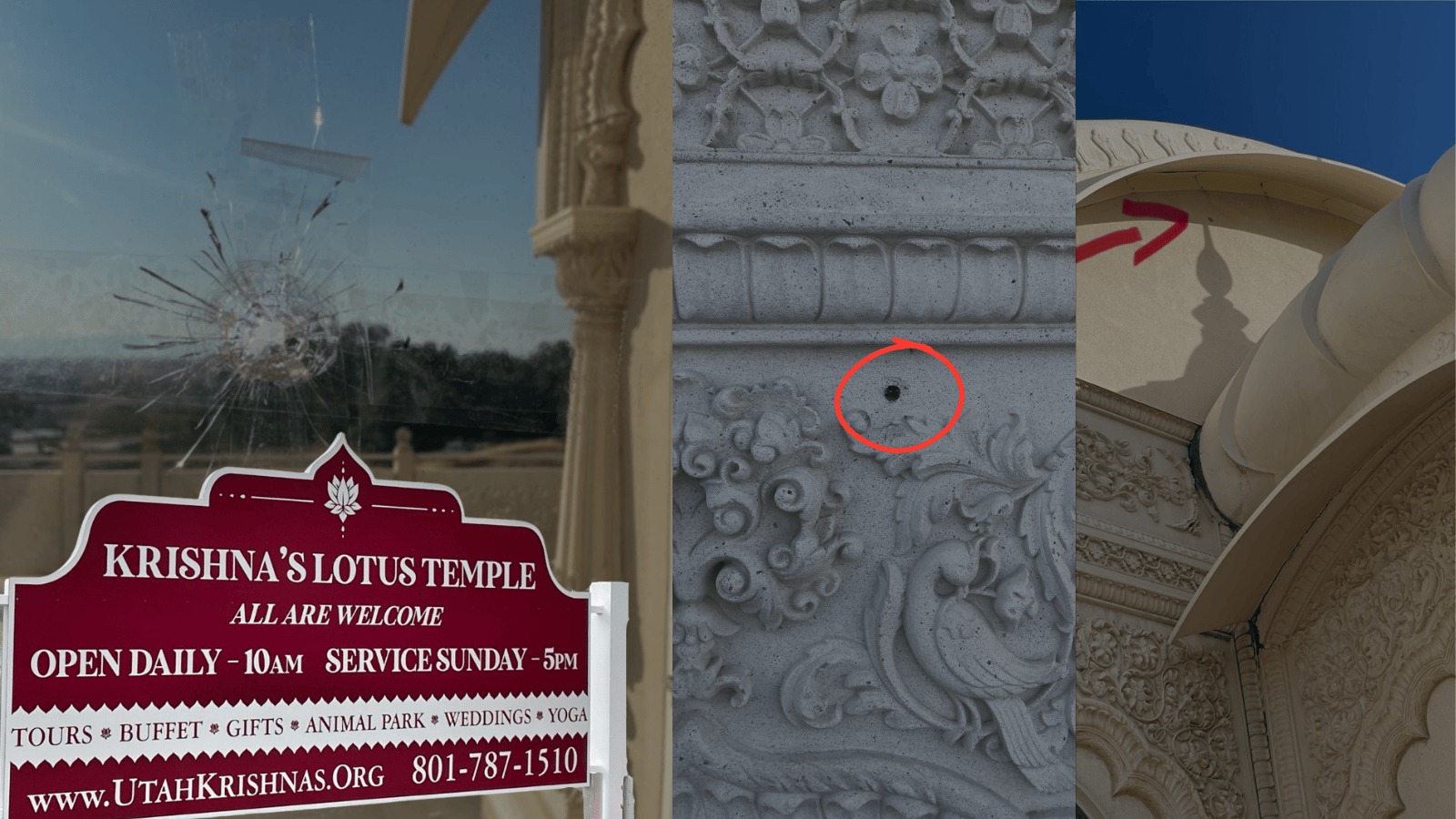
Attacks on Hindu temples and institutions have become a rising concern across the Western world, and the recent spate of violence targeting the ISKCON Sri Sri Radha Krishna Temple in Spanish Fork, Utah, is the latest unsettling example. Known globally for its peaceful teachings and the popular Holi Color Festival, the temple has suffered from what temple leaders describe as a series of targeted hate crimes. In a country that prides itself on religious freedom, these acts not only threaten physical structures but shake the very foundation of multicultural coexistence.
Temple Under Fire: 30 Bullets, Structural Damage, and Shock
In a deeply troubling incident, over 20 to 30 bullets were reportedly fired at the ISKCON Sri Sri Radha Krishna Temple in Spanish Fork, Utah, within the span of a few nights. These attacks occurred while devotees were inside the temple complex. One of the bullets pierced a window and lodged into a wall within the main worship hall. Several hand-carved arches were also hit, causing thousands of dollars in damages.
Vaibhavi Devi Dasi, co-founder of the temple, described the financial and emotional toll, stating, “Those arches are about $10,000 each. We’re grateful the bullets only caused holes or ricocheted off parts of the structure. But any direct hit to one of the domes or intricate carvings could have caused irreparable damage.”
Temple officials initially suspected fireworks when a loud bang and smoke emerged from the rooftop on June 18. However, further investigation revealed a bullet hole in the radio station roof and casings strewn near the temple perimeter.
Security Footage and Ongoing Police Investigation
Surveillance footage from the night of the shootings captured a pickup truck parked suspiciously near the temple. While no suspect has yet been identified, approximately 20 bullet casings were recovered from the road outside the security fence. The Utah County Sheriff’s Office is actively investigating the case and has stepped up patrols around the temple.
Sgt. Raymond Ormond of the Sheriff’s Office confirmed that multiple calls had been received regarding the attacks, and law enforcement is pursuing leads. Meanwhile, a local security company, GARD, has volunteered surveillance support for two weeks at no cost to the temple. Additionally, a $1,000 reward has been offered for information leading to an arrest and conviction.
Community Solidarity and Support from LDS Leaders
The Hare Krishna community has long enjoyed a harmonious relationship with its neighbors in Utah County. Members of the local chapter of The Church of Jesus Christ of Latter-day Saints (LDS) have shown their solidarity in this time of distress.
Monica Bambrough, Assistant Director of the Mount Nebo Communication Council of the LDS Church, condemned the attacks: “These senseless acts have no place in our communities. We stand in solidarity with the Krishna Temple and will continue fostering dialogue, love, and understanding.”
This interfaith support has been a vital morale boost for the temple’s community, which is reeling from the violence yet committed to peaceful resistance.
Leadership Raises Alarm Over Rising Hate
Temple co-founder Vai Warden did not mince words in calling the incident a form of “religious persecution.” She added, “This is terrible. What can we do? The Hindu community is closing ranks. It’s deeply saddening.”
Warden believes the attacks may be politically motivated rather than purely religious: “We don’t follow the status quo. We live simply and peacefully, and that may rub certain sections of society the wrong way.”
Despite decades of peaceful engagement with the community, including large-scale cultural events like the Festival of Colors, temple leaders now face the grim task of fortifying their sacred space against threats of violence.
A Call to Conscience and Unity
The attack on the Krishna Temple in Spanish Fork is more than an isolated act of vandalism; it’s a wake-up call to confront the growing tide of intolerance in societies that promise religious liberty. While no one was physically harmed, the symbolic and psychological damage is undeniable. When bullets shatter sacred spaces, they fracture communal trust and shared values.
It’s now imperative for local authorities, communities, and leaders—across all faiths—to rise in unity. Religious spaces should be sanctuaries, not targets. As investigations continue, the hope is not just for justice, but for renewed commitment to harmony and respect in an increasingly diverse America.