




















In a strong diplomatic endorsement of India’s counter-terrorism stance, the foreign ministers of the Quad grouping comprising India, the United States, Japan, and Australia issued a sharp joint condemnation of the April 22 terrorist attack in Pahalgam, Jammu and Kashmir. The brutal assault, which claimed the lives of 26 civilians, mostly tourists, triggered global outrage and firm action from India under ‘Operation Sindoor.’
This rare joint declaration by the Quad ministers is being seen as a significant geopolitical win for New Delhi. The statement not only condemned the terror strike but also called on all UN member states to assist in bringing the perpetrators, organisers, and financiers to justice. The move sends a strong message to state actors enabling terrorism, particularly Pakistan, whose role in harboring terror groups has come under renewed scrutiny.
Unified Condemnation from the Quad
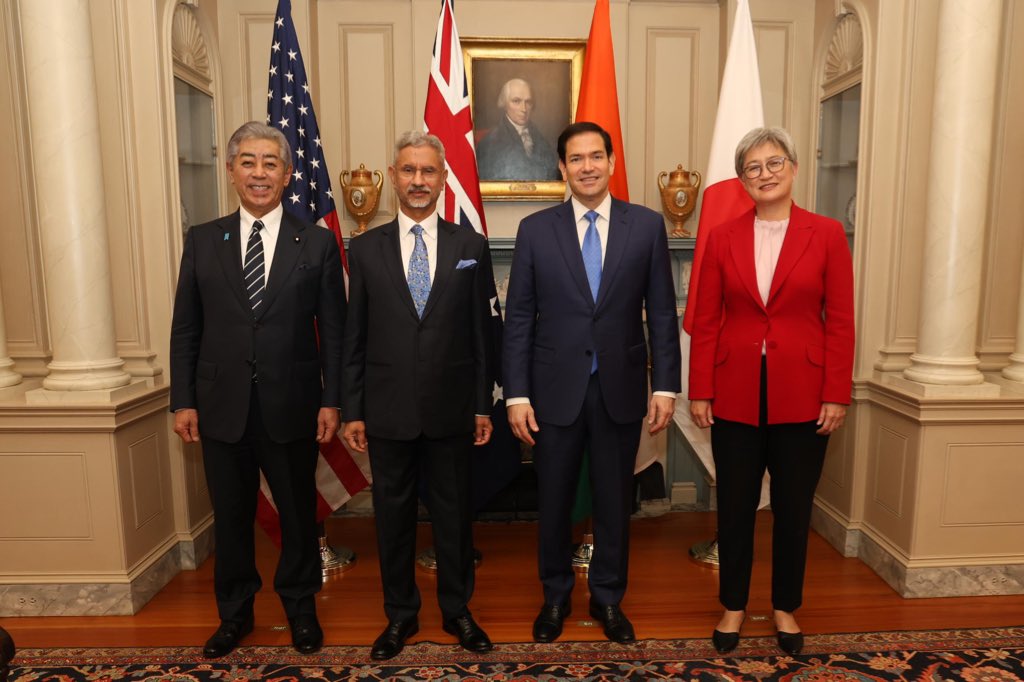
Meeting in Washington D.C., the foreign ministers of the four major Indo-Pacific democracies strongly denounced the Pahalgam massacre and reiterated their united stand against terrorism. The joint statement read, “We condemn in the strongest terms the terrorist attack in Pahalgam. We call for the perpetrators, organisers, and financiers of this reprehensible act to be brought to justice without delay and urge all UN member states to cooperate in accordance with international law and relevant UNSC resolutions.”
This powerful statement, while not naming Pakistan explicitly, condemned cross-border terrorism—a thinly veiled reference to Pakistan-based terror networks believed to be behind the Pahalgam attack. The ministers also extended their condolences to the families of victims and wished the injured a speedy recovery.
External Affairs Minister S. Jaishankar, who attended the meeting alongside US Secretary of State Marco Rubio, Japan’s Foreign Minister Takeshi Iwaya, and Australian Foreign Minister Penny Wong, emphasized that terrorism must not be tolerated under any circumstance.
Jaishankar Asserts India’s Right to Respond
In his remarks during the Quad meet, Jaishankar made it clear that India would exercise its right to defend its citizens from acts of terrorism. “Victims and perpetrators must never be equated,” he said. “India has every right to defend its people against terrorism, and we will exercise that right. We expect our Quad partners to understand and appreciate that.”
Jaishankar also held bilateral meetings with Rubio and US Secretary of Defence Pete Hegseth. Discussions focused on enhancing the India-US strategic and defence partnership, with special attention to counter-terrorism cooperation, critical technologies, and regional security.
His meetings reaffirmed India’s growing influence and credibility as a strategic partner, particularly in times of crisis. The Quad’s unanimous backing highlights India’s leadership in the Indo-Pacific and its role as a responsible democratic power.
India’s Swift Retaliation: Operation Sindoor
In response to the April 22 attack, the Indian government launched a decisive military operation dubbed ‘Operation Sindoor’ on May 7. Precision strikes were carried out by the Indian armed forces across the Line of Control (LoC), targeting nine terror infrastructure hubs inside Pakistan and Pakistan-occupied Kashmir (PoK). These included safehouses, training camps, and logistics hubs operated by Pakistan-based groups.
The operation, while calibrated to avoid civilian casualties, demonstrated India’s increasing reliance on proactive deterrence rather than passive diplomacy. Equipped with precision weaponry and real-time satellite surveillance, the Indian Air Force and artillery units conducted strikes with pinpoint accuracy. The offensive reportedly neutralized dozens of militants and crippled Pakistan’s cross-border terror infrastructure.
Pakistan retaliated the next night using drone swarms and long-range artillery, but Indian forces effectively repelled the attacks. Despite Pakistan’s escalation, India held its ground, forcing Islamabad to call for a ceasefire after three days of intense exchange.
Pakistan’s Duplicity Exposed
While Pakistan attempted to deny involvement in the Pahalgam attack, Indian intelligence traced clear links between the perpetrators and known Pakistan-based groups. The Quad’s statement though diplomatically worded underscored international frustration with Pakistan’s duplicity.
This isn’t the first time Islamabad has faced global condemnation. However, the presence of a unified front among four major democracies India, the US, Japan, and Australia sends an unmistakable signal. With calls for the perpetrators and financiers to face justice, Pakistan finds itself increasingly isolated on the world stage.
Furthermore, Jaishankar took the issue to the United Nations, accusing Pakistan of turning its territory into a sanctuary for terror groups and reminded the international community of its obligation to act. This assertiveness is in sharp contrast to India’s historically defensive diplomatic approach, highlighting the Modi government’s firm stance against terrorism.
A Victory for India’s Diplomacy and Global Counterterrorism
The Quad’s joint statement is more than a symbolic gesture. It is a diplomatic victory for India and a direct rebuke to Pakistan’s ongoing support for cross-border terrorism. By bringing together four powerful nations in a unified call for justice, the Modi government has succeeded in internationalising the issue without compromising on sovereignty.
Operation Sindoor demonstrated India’s military resolve, while the diplomatic follow-up showcased its strategic foresight. Together, they present a formidable two-pronged response to terrorism: deterrence on the ground and diplomacy in the global arena.
At a time when the world is dealing with increasing instability, India has emerged as a voice of clarity and strength. The Quad’s condemnation not only vindicates India’s security concerns but also paves the way for stronger counterterrorism collaboration among democratic nations. With growing partnerships and resolute leadership, New Delhi has sent a clear message: terrorism, in any form, will not go unpunished.