

















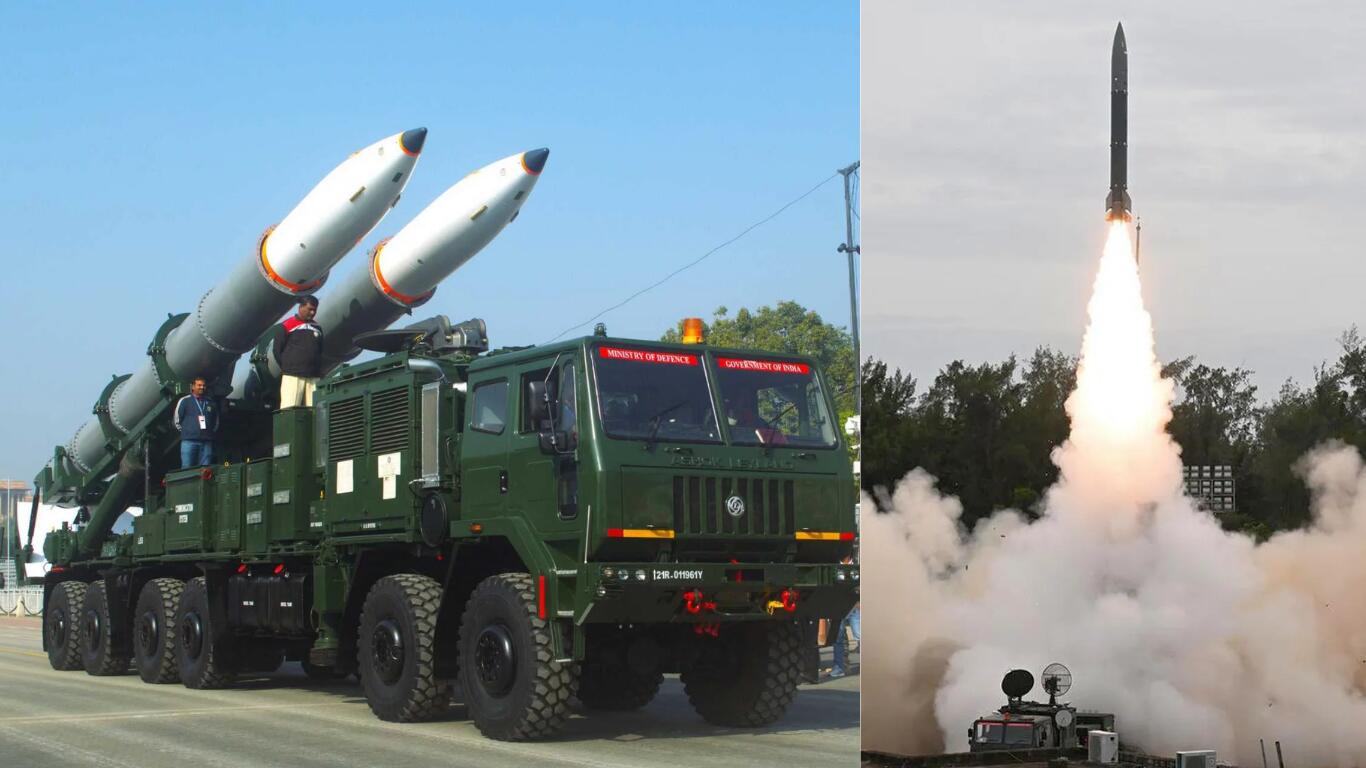
India’s defence capabilities took a giant leap forward with the successful back-to-back testing of its indigenous quasi-ballistic missile Pralay on July 28 and 29. These launches, conducted from Dr. APJ Abdul Kalam Island off the Odisha coast, were not routine drills they were a clear signal to adversaries and allies alike. India is no longer playing catch-up; we are setting the rules of future warfare.
The missile tests validated both the maximum and minimum range envelopes, officially concluding Phase-1 user trials. From propulsion to guidance systems, from sensors to structural integrity every component worked flawlessly. These achievements are not just scientific milestones; they reflect the true spirit of Atmanirbhar Bharat, with deep collaboration between the Indian Army, Air Force, DRDO, and domestic MSMEs.
What is Pralay and Why Was It Developed?
Pralay is a solid-fuel, quasi-ballistic, surface-to-surface missile designed to fulfill India’s conventional strike requirements. Weighing approximately 5,000 kg, the missile can carry a warhead of up to 1,000 kg and strike targets within a range of 150 to 500 km at speeds between Mach 1 and 1.6.
It is powered by a two-stage solid rocket motor and features a third-stage MaRV (Maneuverable Reentry Vehicle), paired with inertial navigation and advanced electronics. Its agility is complemented by its low radar cross-section, making it difficult for enemy air defences to intercept.
Deployed via an 8×8 BEML Tatra Transporter-Erector-Launcher, Pralay’s rapid mobility allows India to project firepower quickly and precisely, even in mountainous or border environments.
The missile’s name Pralay, meaning “catastrophic destruction” isn’t just symbolic. It represents a powerful deterrent in India’s conventional arsenal, tailored to strike deep behind enemy lines with near-zero reaction time.
Pralay a Quasi-Ballistic Missile and Why It Matters
Unlike traditional ballistic missiles that follow a predictable high-arching trajectory, quasi-ballistic missiles like Pralay travel on a flatter, low-altitude path. Crucially, they can maneuver during flight, making interception by enemy air defence systems extremely challenging.
This design gives India a critical tactical advantage. In the fog of modern war, where speed and unpredictability are game-changers, a missile that can evade radars and change direction mid-air brings enormous strategic value.
The capability to deliver a swift, accurate, and unstoppable strike in a short time window adds a new layer to India’s conventional deterrence, especially in volatile regions like the Line of Control (LoC) and Line of Actual Control (LAC).
From Prithvi to Pralay: A Technological Leap
While India’s Prithvi missile served the nation well for decades, it relied on liquid fuel, making it cumbersome and risky to handle. Liquid-fueled missiles require fueling just before launch, are harder to store, and degrade over time due to the corrosive nature of the fuel.
Pralay solves all these problems. Being solid-fueled, it is combat-ready 24/7, easier to transport, safer to store, and can be launched at a moment’s notice. It embodies the evolution from 1990s-era defence tech to modern 2025-ready warfare systems.
This makes Pralay not just a replacement, but a revolution—a smarter, faster, more reliable successor to older missile platforms.
India’s Future Integrated Rocket Force (IRF)
Pralay is set to become a cornerstone of India’s upcoming Integrated Rocket Force (IRF)—a new military wing focused on conventional fast-strike capabilities. While the Strategic Forces Command deals with India’s nuclear arsenal, the IRF will be built for quick, precision-based tactical strikes in conventional warfare scenarios.
With Pralay in its arsenal, India will be capable of hitting enemy command centres, airbases, bunkers, and radar installations before they even mount a response. It aligns perfectly with India’s proactive defence posture, ensuring that the country no longer waits to respond—but leads with decisive force.
This marks a doctrinal shift in India’s military thinking: the move from defence to deterrence through dominance.
Pralay Is Not Just a Missile It’s a Message
Pralay represents much more than just a weapon. It is the culmination of India’s resolve to become self-reliant in defence technology. Developed entirely within India by DRDO, and supported by agencies like ARDE, HEMRL, DRDL, DMRL, and private industry, Pralay is Indian in soul, spirit, and steel.
At a time when some question the need for missiles, India replies with clarity: We do not build weapons to provoke war, but to prevent one. We do not seek dominance, but we refuse submission. While critics at home cry war-mongering, and foreign lobbies try to shame our defence efforts, India answers with innovation, self-reliance, and unstoppable resolve.