






















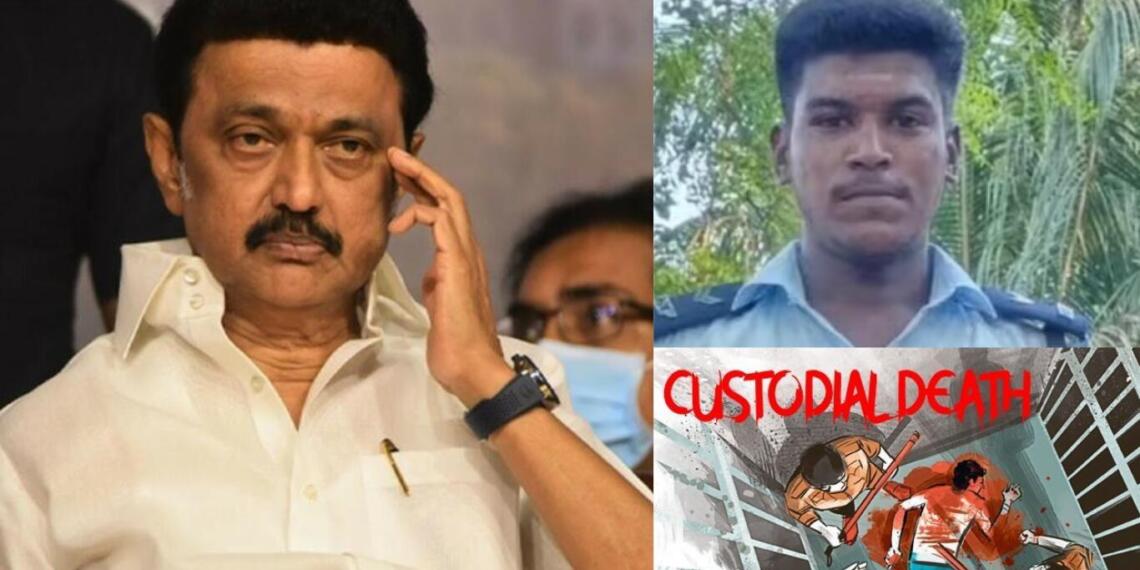
In yet another stinging indictment of the DMK government’s law-and-order failure, the Madras High Court has set a clear precedent by ordering an interim compensation of Rs 25 lakh to the family of Ajith Kumar, a 27-year-old temple security guard who died in police custody in Sivaganga under suspicious circumstances. The case has once again exposed the alarming levels of custodial violence in Tamil Nadu and the administrative silence that surrounds it until the judiciary intervenes. While Chief Minister M K Stalin has scrambled to shift blame and save face by transferring the case to the CBI, the damage to the government’s credibility is glaring. The court’s scathing remarks and firm stance have shown that the judiciary, not the DMK government, is truly upholding justice in the state.
Officers Arrested, But Systemic Reform Still Missing
So far, five police personnel involved in Ajith’s torture have been arrested. A DSP has been suspended, and the SP of Sivaganga has been placed under compulsory wait. These developments, however, came only after sustained public and judicial pressure—not as part of any serious systemic reform. The High Court has directed the CBI to appoint a special investigating officer within a week and to submit its final report by August 20. While the judiciary has done its part to bring temporary relief and a semblance of justice, the DMK government’s systemic rot remains unaddressed.
The initial offer of Rs 7.5 lakh compensation by the Tamil Nadu government was nothing short of an insult, prompting the judiciary to step in and declare Rs 25 lakh as interim compensation, with more relief possible after the criminal trial concludes.
HC’s Scathing Rebuke to State Machinery
The Madras High Court took a grim view of the custodial killing and, relying on a detailed report by a Sessions Court Judge, confirmed that Ajith’s death was a result of physical abuse by the police. In strong words, the court declared that such brutality has no place in a civilised society and must be punished with iron hands. The court added that “even a murderer wouldn’t have inflicted such brutality,” a remark that struck at the heart of police barbarity allowed under the DMK’s nose.
This was not just a compensation ruling—it was a loud and clear reminder that the judiciary won’t let state authorities escape accountability when citizens suffer due to official violence.
Stalin’s Delayed Response and CBI Firefighting
Facing public outrage, CM Stalin finally announced a CBI probe into the matter, claiming he wanted “no questions over the investigation.” But the timing of his action revealed the government’s reactive rather than proactive approach. Only after media uproar and court scrutiny did the administration act—long after Ajith had died and his family had suffered unspeakable loss.
The CBI has since filed an FIR against the concerned Sivagangai police officers and is now set to probe the original theft complaint as well. However, this central intervention only came after the High Court’s relentless pressure—highlighting the complete absence of initiative from the state government. Instead of protecting citizens, the DMK regime stood exposed for enabling a system of unchecked brutality.
A Tragic Turn in Sivaganga
Ajith Kumar, a young security guard at Madapuram Temple in Sivaganga district, was taken into custody by the police last month over a bizarre and unverified complaint. A devotee alleged that cash and gold were missing from her car, which Ajith had merely asked someone else to park because he did not know how to drive. Without due inquiry or proof, the police dragged Ajith into custody. Days later, he was found dead—brutally tortured, as confirmed by a post-mortem report citing over 40 injuries on his body.
This wasn’t an isolated incident, but a shocking example of what happens when law enforcement operates without oversight and state leadership turns a blind eye. Instead of ensuring justice or protecting citizens, the police allegedly turned perpetrators—with fatal consequences.
A Government Repeatedly Taught by the Courts
This case is not just about one man’s tragic death in custody—it is about a pattern of governance failure that continues to plague Tamil Nadu under the DMK. From custodial deaths to police brutality, the state machinery under Stalin seems ill-equipped or unwilling to prevent abuse of power. Once again, it was the Madras High Court that rose to the occasion, setting the record straight and forcing the state to compensate the victim’s family with dignity and urgency.
As long as the judiciary has to repeatedly “teach” lessons to the state government on compassion, rule of law, and accountability, the people of Tamil Nadu must ask themselves: who is truly protecting their rights? Certainly not the DMK government