

















TFIPOST हिन्दी
TFIPOST Global
Tfipost.com
Tfipost.com
No Result
View All Result
  • Premium
  • Politics
    • All
    • Analysis
    • Opinions
    • Trending
    Why a Rafale Landing on INS Vikrant Is Harder Than It Looks

    Time in the Sky: Can India’s Home-Built Atomic Clocks Keep NavIC Alive?

    A World Rehearsing for the Worst: War Talk Rises, but Is It a Warning or a Warm-Up?

    A World Rehearsing for the Worst: War Talk Rises, but Is It a Warning or a Warm-Up?

    Tata v Tata: A Century-Old Partnership Under Strain

    Tata v Tata: A Century-Old Partnership Under Strain

    Leftists Attacked After SFI Victory at Calicut University

    Leftists Attacked After SFI Victory at Calicut University

    • Analysis
    • Opinions
    • Trending
  • Economy
    • All
    • Business
    • Economy1
    • Finance
    Jio Lists, and the Ledger Changes: What the Debut Did and Didn’t Do

    Jio Lists, and the Ledger Changes: What the Debut Did and Didn’t Do

    Crypto News: Bitcoin Falls Below $80,000 With the Fed Meeting in Focus

    Crypto News: Bitcoin Falls Below $80,000 With the Fed Meeting in Focus

    Earn Better Returns on Your Fixed Deposit with the JioFinance App

    Earn Better Returns on Your Fixed Deposit with the JioFinance App

    How instant challan status visibility is cutting late fees and disputes

    How instant challan status visibility is cutting late fees and disputes

    • Business
    • Finance
  • Defense
    • All
    • Defence
    • Strategy
    • Weaponry
    The Air Chief Who Stood His Ground: AP Singh’s Legacy from Operation Sindoor to the Tejas Debate

    The Air Chief Who Stood His Ground: AP Singh’s Legacy from Operation Sindoor to the Tejas Debate

    Why a Rafale Landing on INS Vikrant Is Harder Than It Looks

    Why a Rafale Landing on INS Vikrant Is Harder Than It Looks

    India’s shipbuilding push finds a new berth as Miniratna HSL and Kakinada Seaports sign MoU

    India’s shipbuilding push finds a new berth as Miniratna HSL and Kakinada Seaports sign MoU

    Closed gates, cancelled tee-off: IAF chief’s farewell round falls casualty to Centre’s land drive

    Closed gates, cancelled tee-off: IAF chief’s farewell round falls casualty to Centre’s land drive

    • Defence
    • Strategy
    • Weaponry
  • Geopolitics
    • All
    • Africa
    • Americas
    • Asia Pacific
    • Europe
    • South Asia
    • West Asia
    The Cuba Embargo: Why the World Votes Every Year, and Why the Vote Is Slipping

    The Cuba Embargo: Why the World Votes Every Year, and Why the Vote Is Slipping

    Caught in the crossfire: why India, a bystander to the West Asia war, keeps burying its own

    Caught in the crossfire: why India, a bystander to the West Asia war, keeps burying its own

    UAE Confers Order of Zayed II on Indian Pilot and Flydubai Crew for Courage During Mid-Air Attack

    UAE Confers Order of Zayed II on Indian Pilot and Flydubai Crew for Courage During Mid-Air Attack

    Rajnath Singh, Hegseth Review Defence Framework in Cebu, Call for Zero Tolerance on Terror Sponsors

    Rajnath Singh, Hegseth Review Defence Framework in Cebu, Call for Zero Tolerance on Terror Sponsors

    • Africa
    • Americas
    • Asia Pacific
    • Europe
    • South Asia
    • West Asia
  • Knowledge
    • All
    • Culture
    • Education
    • History
    • Indology
    Delhi Ramlila to burn 30-foot cockroach effigy alongside Ravana amid CJP protests

    Delhi Ramlila to burn 30-foot cockroach effigy alongside Ravana amid CJP protests

    How to Choose the Right Online Degree at Apna Advantage for Your Career Goals

    How to Choose the Right Online Degree at Apna Advantage for Your Career Goals

    What Skills Will You Gain from a Strategic Leadership Course

    What Skills Will You Gain from a Strategic Leadership Course

    Young Indian Gen Z exploring Sanatan Dharma through smartphones, social media and the Bhagavad Gita

    Ancient Roots, Digital Minds: The Rise of Sanatani Gen Z

    • Culture
    • History
    • Indology
  • Law
  • Lounge
    • All
    • Books
    • Cinema
    • Entertainment
    • Food
    • Games
    • Health
    • Lifestyle
    • Satire
    • Sports
    • technology
    • Travel
    The Quiet Front: How Cyberattacks Became a Tool of Economic and State Power

    The Quiet Front: How Cyberattacks Became a Tool of Economic and State Power

    “Ravana is not all bad”: Sai Pallavi’s Ravana remark puts ‘Ramayana’ in the spotlight

    “Ravana is not all bad”: Sai Pallavi’s Ravana remark puts ‘Ramayana’ in the spotlight

    Solar Hybrid Inverter for Homes with Frequent Power Cuts: How Does It Work?

    Solar Hybrid Inverter for Homes with Frequent Power Cuts: How Does It Work?

    What Is Heel-to-Toe Drop in Running Shoes, and Does It Affect Your Running?

    What Is Heel-to-Toe Drop in Running Shoes, and Does It Affect Your Running?

    • Books
    • Cinema
    • Food
    • Health
    • Sports
    • technology
    • Travel
    • Satire
Tfipost.com
  • Premium
  • Politics
    • All
    • Analysis
    • Opinions
    • Trending
    Why a Rafale Landing on INS Vikrant Is Harder Than It Looks

    Time in the Sky: Can India’s Home-Built Atomic Clocks Keep NavIC Alive?

    A World Rehearsing for the Worst: War Talk Rises, but Is It a Warning or a Warm-Up?

    A World Rehearsing for the Worst: War Talk Rises, but Is It a Warning or a Warm-Up?

    Tata v Tata: A Century-Old Partnership Under Strain

    Tata v Tata: A Century-Old Partnership Under Strain

    Leftists Attacked After SFI Victory at Calicut University

    Leftists Attacked After SFI Victory at Calicut University

    • Analysis
    • Opinions
    • Trending
  • Economy
    • All
    • Business
    • Economy1
    • Finance
    Jio Lists, and the Ledger Changes: What the Debut Did and Didn’t Do

    Jio Lists, and the Ledger Changes: What the Debut Did and Didn’t Do

    Crypto News: Bitcoin Falls Below $80,000 With the Fed Meeting in Focus

    Crypto News: Bitcoin Falls Below $80,000 With the Fed Meeting in Focus

    Earn Better Returns on Your Fixed Deposit with the JioFinance App

    Earn Better Returns on Your Fixed Deposit with the JioFinance App

    How instant challan status visibility is cutting late fees and disputes

    How instant challan status visibility is cutting late fees and disputes

    • Business
    • Finance
  • Defense
    • All
    • Defence
    • Strategy
    • Weaponry
    The Air Chief Who Stood His Ground: AP Singh’s Legacy from Operation Sindoor to the Tejas Debate

    The Air Chief Who Stood His Ground: AP Singh’s Legacy from Operation Sindoor to the Tejas Debate

    Why a Rafale Landing on INS Vikrant Is Harder Than It Looks

    Why a Rafale Landing on INS Vikrant Is Harder Than It Looks

    India’s shipbuilding push finds a new berth as Miniratna HSL and Kakinada Seaports sign MoU

    India’s shipbuilding push finds a new berth as Miniratna HSL and Kakinada Seaports sign MoU

    Closed gates, cancelled tee-off: IAF chief’s farewell round falls casualty to Centre’s land drive

    Closed gates, cancelled tee-off: IAF chief’s farewell round falls casualty to Centre’s land drive

    • Defence
    • Strategy
    • Weaponry
  • Geopolitics
    • All
    • Africa
    • Americas
    • Asia Pacific
    • Europe
    • South Asia
    • West Asia
    The Cuba Embargo: Why the World Votes Every Year, and Why the Vote Is Slipping

    The Cuba Embargo: Why the World Votes Every Year, and Why the Vote Is Slipping

    Caught in the crossfire: why India, a bystander to the West Asia war, keeps burying its own

    Caught in the crossfire: why India, a bystander to the West Asia war, keeps burying its own

    UAE Confers Order of Zayed II on Indian Pilot and Flydubai Crew for Courage During Mid-Air Attack

    UAE Confers Order of Zayed II on Indian Pilot and Flydubai Crew for Courage During Mid-Air Attack

    Rajnath Singh, Hegseth Review Defence Framework in Cebu, Call for Zero Tolerance on Terror Sponsors

    Rajnath Singh, Hegseth Review Defence Framework in Cebu, Call for Zero Tolerance on Terror Sponsors

    • Africa
    • Americas
    • Asia Pacific
    • Europe
    • South Asia
    • West Asia
  • Knowledge
    • All
    • Culture
    • Education
    • History
    • Indology
    Delhi Ramlila to burn 30-foot cockroach effigy alongside Ravana amid CJP protests

    Delhi Ramlila to burn 30-foot cockroach effigy alongside Ravana amid CJP protests

    How to Choose the Right Online Degree at Apna Advantage for Your Career Goals

    How to Choose the Right Online Degree at Apna Advantage for Your Career Goals

    What Skills Will You Gain from a Strategic Leadership Course

    What Skills Will You Gain from a Strategic Leadership Course

    Young Indian Gen Z exploring Sanatan Dharma through smartphones, social media and the Bhagavad Gita

    Ancient Roots, Digital Minds: The Rise of Sanatani Gen Z

    • Culture
    • History
    • Indology
  • Law
  • Lounge
    • All
    • Books
    • Cinema
    • Entertainment
    • Food
    • Games
    • Health
    • Lifestyle
    • Satire
    • Sports
    • technology
    • Travel
    The Quiet Front: How Cyberattacks Became a Tool of Economic and State Power

    The Quiet Front: How Cyberattacks Became a Tool of Economic and State Power

    “Ravana is not all bad”: Sai Pallavi’s Ravana remark puts ‘Ramayana’ in the spotlight

    “Ravana is not all bad”: Sai Pallavi’s Ravana remark puts ‘Ramayana’ in the spotlight

    Solar Hybrid Inverter for Homes with Frequent Power Cuts: How Does It Work?

    Solar Hybrid Inverter for Homes with Frequent Power Cuts: How Does It Work?

    What Is Heel-to-Toe Drop in Running Shoes, and Does It Affect Your Running?

    What Is Heel-to-Toe Drop in Running Shoes, and Does It Affect Your Running?

    • Books
    • Cinema
    • Food
    • Health
    • Sports
    • technology
    • Travel
    • Satire
No Result
View All Result
Tfipost.com
Tfipost.com
No Result
View All Result
  • Premium
  • Politics
  • Economy
  • Defense
  • Geopolitics
  • Knowledge
  • Law
  • Lounge

After unleashing coronavirus in the world, China is preparing to starve Laos, Vietnam and Cambodia

This is worse than nuclear war

Yash Joshi by Yash Joshi
10 May 2020
in South Asia
China, Mekong River, Xi Jinping, Laos
Share on FacebookShare on X

Any sane government after unleashing a pandemic of gigantic proportions would apologise and mend its ways. However, China under Xi Jinping is showing no signs of any remorse whatsoever and is continuing with its aggressive expansionist policies at the expense of smaller and poorer countries who have focused all their resources on battling China made pandemic. While the Chinese Communist Party owns no explanation or responsibility to its citizens, the democratic nations fighting the pandemic have put their people first and sacrificed the economy to prevent mass-scale loss of lives. While the CCP continues to claim almost the entire South China Sea despite a tribunal judgement against it, it has now “banned” fishing in the South China Sea as if the entire sea belonged to China. This move would effectively have a devastating impact on the other countries who also have a right on the South China Sea. China has also severely reduced the flow of the Mekong river which has the potential to completely starve off Laos, Vietnam and Cambodia.

In a move that will only compound the tensions in the already volatile South China Sea, Beijing orders that it would prohibit fishing activities in the disputed waters which China has claimed above the 12th parallel in a bid to conserve stocks. The move has invited fierce criticism from the rival claimants as the nations heavily rely on fishing for feeding their population. The ban will run till August 16 with China threatening to take “strictest measures” against any “illegal fishing activities”.

RelatedPosts

Dealing with China is not easy, but India’s real problem lies elsewhere

What the ITBP chief said about face-offs with China in Arunachal, and why it matters

“Not an Inch”: Leh Apex Body Rejects China’s Claim on Western Ladakh, Asks Centre for a Firm Reply

Load More

Vietnam has already rejected China’s bizarre decision as its foreign minister said in a statement, “Vietnam asks China not to further complicate the situation in the South China Sea.” The move has also backfired in the Philippines as the chairman of the National Federation of Small Fisherfolk Organisations Fernando Hicap said, “The Philippine government should not waste time and wait for Chinese maritime officers to arrest our fishermen. They have no right and moral ascendancy to declare a fishing ban in the guise of conserving fish stocks in marine waters that they have no legal claim, and they have massively destroyed through reclamation activities.”

Millions of people rely on the South China Sea for their livelihoods which China is threatening to uproot. The United Nations has estimated that due to the pandemic, around 265 million people will face acute food shortages by the end of the year. The number will likely be exacerbated by China’s aggressive expansionist policies with its actions in the Mekong river threatening to starve off Laos, Vietnam and Cambodia.

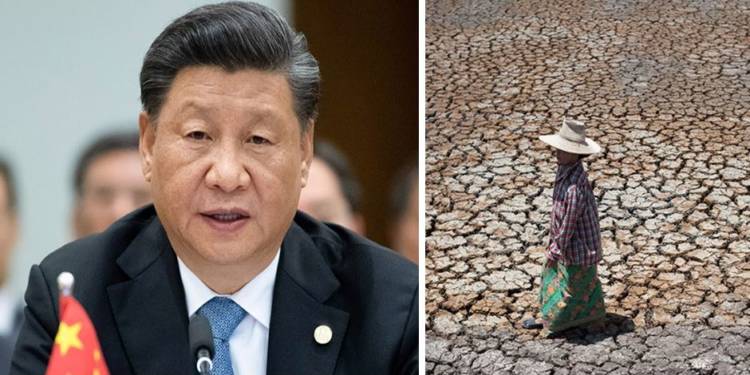
A US-government funded study about the last year’s droughts in the Lower Mekong Basin countries – Laos, Vietnam, Cambodia and Thailand finds the water levels in the river receding to a 50-year low, causing devastation for the farmers and fishermen alike, apart from receding to the level of exposing sandbanks along some stretches.

In some places, the water in the largest South Asian river the Mekong turned bright blue from its usual murky brown, because of the shallow waters lacking in a sedimentary deposit. According to the US-based research company, the damaging droughts can be largely attributed to the Chinese dams that have been holding backwaters.

Alan Basist, a meteorologist and President of Eyes on Earth said, “If the Chinese are stating that they were not contributing to the drought, the data does not support that position.”

China claims that there was low rainfall last year on its portion of the 4,350-km (2,700-mile) river which is known as Lancang upstream. The upstream region of the River, viz. the Yunnan province of China received more than average rainfall according to satellite measures of “surface wetness” and snowmelt was slightly above-average during the May to October wet season. Yet the Lower Mekong Basin (LMB) countries in Southeast Asia witnessed the worst drought in the past five decades.

The Mekong River originates in South-eastern China, before flowing through the Autonomous Tibet region and the Yunnan province of China, from where it flows parallel to the eastern-most Border of Myanmar.

It is from this point that the River enters the Lower Mekong Basin (LMB) region, first forming the Thailand-Laos border. The Mekong River forms northern and eastern boundaries of Thailand and Laos, and from this point itself, there was a sharp reduction in water levels last year.

The water levels measured downstream along the Thai-Laos Border dropped, at times, by 3 metres (10 metres) than the average levels wreaking havoc for the agriculture-based LMB economies.

The river goes further downstream into Cambodia before re-entering Vietnam, and finally flowing into the South China Sea near the Ho Chi Minh City. Water levels, of course, dropped down further in these downstream countries hurting their agriculture-based economies.

Coming into the limelight are the eleven dams that China has built on the mighty Mekong River that according to the Eyes on Earth have a combined water capacity of more than 47 billion cubic metres, but the Communist regime of China, known for its hallmark opacity, does not release any data about the amount of water that it is holding back to fill the reservoirs.

Therefore, China’s ambitions of building mammoth hydropower projects, some of the most gigantic dams in the region, is the cause of Southeast Asia’s water woes.

“Naturally, Mekong water rises and decreases slowly about three to four months from highest to lowest levels, [But now] the water levels fluctuate almost every two to three days all year, and every year, because of the dams,” said Teerapong Pomun, director of the Mekong Community Institute.

Also running Southeast Asia into troubled waters, quite literally, could be China’s longstanding River diversion ambitions (as differentiated from River linkage). China wants to divert 200 billion cubic water from the upstream part of the three massive international Rivers- the Mekong, Brahmaputra and Nu-Salween, flowing in water-rich Southern China to the water-starved, densely populated Northern China. Thus, reduction in the water supply to the Southeast Asian countries.

What further complicates the matters between China, in its position as the upstream Mekong country, and the Lower Mekong Basin (LMB) countries in Southeast Asia is the lack of any effective water-sharing treaty/ agreement on lines of the Indus Water Treaty (IWT) between India and Pakistan.

The 1995 Mekong Agreement did establish the Mekong River Commission (MRC), an intergovernmental RBO, but the two upstream countries- Myanmar and China do not participate actively in water-sharing.

They have been designated as “dialogue partners” since 1996, which means, they act as mere observers rather than cooperating in the water-sharing arrangement, unlike the Lower Mekong Basin (LMB) countries. With the LMB region getting hit by the worst-ever decade in 50 years, it is crystal clear why the upstream countries, especially China, have been reluctant to cooperate.

Notwithstanding the absence of any formal water-sharing treaty, what China has been doing is nothing less than a crime against humanity given that the Mekong River is nothing less than a lifeline for the 70 million people who live in the downstream countries of the River- Thailand, Laos, Cambodia and Vietnam.

80 per cent of the 12 million households in these agrarian economies are directly dependent upon the Mekong River for their survival. Livelihoods are at risk with the Chinese dams holding backwaters from the Mekong river in the Yunnan province.

All four LMB countries could face economic devastation as the Mekong recedes in the downstream areas. Fisheries which contribute about 3 per cent of the region’s combined Gross Domestic Product (GDP) is at risk of getting seriously annihilated. Worst hit will be Cambodia and Laos, where fisheries contribute 18 per cent and 12.6 per cent of the economy respectively.

The river is also crucial for Thailand and Vietnam, while it supports agriculture in Thailand’s Northeast, it is the lifeblood for Vietnam’s rice bowl. What the Chinese dams are doing is altering the composition of the Mekong River and not just its flow, which explains the change in its colour from murky brown to bright blue.

This is not really about aesthetics, but a sudden drawdown in the nutrients that reach the Vietnamese Mekong Delta. Bright blue colour means that the River is no bringing nutrients to the Vietnamese Delta which will hit its rice production and cause food scarcity in the country. As the Delta subsides, there will be seawater intrusion that can cause salinization leaving the soil unfit for rice production.

The future doesn’t look bright either given that China aspires to bolster its electricity generation capacity to 500 gigawatts by 2050, and 30 per cent of this will come from the three international Rivers- Mekong, Salween and Brahmaputra.

Diversion of the natural course of the mighty River through tunnels is another uncertainty looming large over the four Mekong-dependent Southeast Asian economies and China is doing all this despite relatively cordial relations with the four countries in the ongoing times, notwithstanding the historical animosities that they may have shared.

The effects of China’s aggression are already showing as Thai fishermen have complained that the fish catches in the Mekong River are plunging at an alarming rate, with farmers in Vietnam and Cambodia, leaving villages to look for job opportunities in cities because the harvests of rice and other crops are shrinking rapidly.

The food security of the 70 million people is at risk as they heavily depend on the Mekong basin. The fact that the population in the southern Mekong basin is set to grow to 100 million by 2025 will only increase the challenges.

“The situation in the Mekong is worrying as the prolonged drought poses dire threats to regional countries from various aspects, particularly in terms of food security. It will certainly adversely affect Beijing’s relations with the Mekong region countries,” said Zhang Hongzhou, who is a research fellow.

As China is steadily turning off the tap on the Mekong river, the lower Mekong river nations are under increasing public pressure to act against China. It remains to be seen whether Mekong nations can stand up to China, fully knowing about the impending economic consequences of any punitive actions against China.


Tags: cambodiaChinaLaosmekong riverVietnamXi Jinping
Share66TweetSend
Previous Post

The political impact of Corona – Yesterday’s political stalwarts could be tomorrow’s losers

Next Post

Motilal Vora is to Congress what the driver was to Salman Khan post the hit and run case

Related Posts

The River Pakistan Drained
South Asia

The River Pakistan Drained

25 October 2026

Pakistan bored a 48-kilometre tunnel beneath Pakistan-Occupied Jammu and Kashmir to divert the Neelum away from Muzaffarabad. The river...

India calls Pakistan’s Masood Azhar bounty a ‘hollow gimmick’, demands concrete action
South Asia

India calls Pakistan’s Masood Azhar bounty a ‘hollow gimmick’, demands concrete action

15 September 2026

India on Tuesday dismissed Pakistan’s decision to increase the bounty on Jaish-e-Mohammed (JeM) chief and UN-designated terrorist Masood Azhar...

Geopolitics

India Condemns Houthi Attacks On Saudi Arabia, Calls Them “Unacceptable” Threat To Regional Security

9 September 2026

India has strongly condemned a fresh wave of Houthi attacks on Saudi Arabia, calling the strikes on civilian and...

Load More

Leave a Reply Cancel reply

Your email address will not be published. Required fields are marked *

I agree to the Terms of use and Privacy Policy.
This site is protected by reCAPTCHA and the Google Privacy Policy and Terms of Service apply.

Currently Playing

India Built Rudra and Prachand. Now It Wants to Make Their Gun at Home.

India Built Rudra and Prachand. Now It Wants to Make Their Gun at Home.

00:03:14

INS Samarthak: The Indigenous Warship Built to Do More Than One Job VO:

00:03:01

Why Is India Investing in Underwater Weapons?

00:02:10

How DRDO Is Making India's Military Communications More Secure

00:03:28

How Ice on Aircraft Wings Can Turn Deadly

00:03:19
Facebook Twitter Instagram Youtube
tfipostTfipost.com
Right Wing | News Analysis | Indian Opinion
  • About us
  • Contact Us
  • Careers
  • Brand Partnerships
  • Terms of use
  • Privacy Policy
  • Sitemap

©2026 TFI Media Private Limited

No Result
View All Result
  • Premium
  • Politics
    • Analysis
    • Opinions
    • Trending
  • Economy
    • Business
    • Finance
  • Defense
    • Defence
    • Strategy
    • Weaponry
  • Geopolitics
    • Africa
    • Americas
    • Asia Pacific
    • Europe
    • South Asia
    • West Asia
  • Knowledge
    • Culture
    • History
    • Indology
  • Law
  • Lounge
    • Books
    • Cinema
    • Food
    • Health
    • Sports
    • technology
    • Travel
    • Satire
TFIPOST हिन्दी
TFIPOST Global

©2026 TFI Media Private Limited