










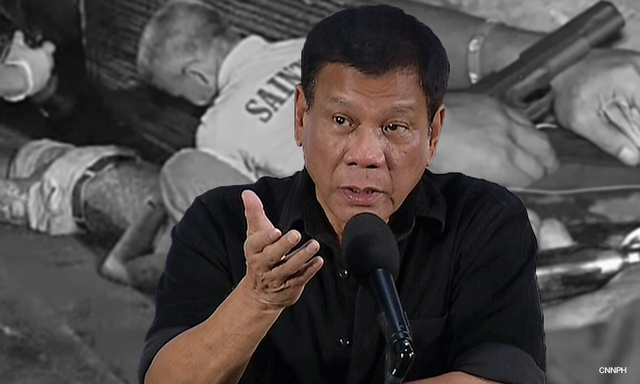
Filipino President Rodrigo Duterte’s war on drugs has captured the imaginations of those around the world who wish to eliminate the more deplorable facets of their societies through extremely hardliner methods, and though it might seem harmless to the casual spectator, the war has crossed all thresholds of human rights abuse.
In the Philippines, illegal drug usage and trade remain deeply entrenched in the population’s own perspective of its nation, despite evidence suggesting that drug usage in the Philippines doesn’t even come close to the nations considered the worst abusers.
But Duterte, when the time came for the Presidential election, fed on the concerns of his people, starting an entire political storm out of thin air.
Duterte built his entire presidential campaign around the single minded goal of eliminating crime, and more specifically, illicit drug trade from the Philippines, a goal not considered too big for him, taking into account his track-record.
In his hometown of Davao, Duterte reigned as Mayor for almost 22 years over multiple reigns, garnering a reputation for ruling with an iron fist and transforming what was considered the nation’s crime capital into its safest city. The results were achieved through, although Duterte denies their existence, government funded death squads that raided regions of the city suspected to be drug havens.
Duterte directed funding towards the police for forming forces to do their dirty work for them, albeit they had the task of finding members who would have to be those ready to take risks, or with nothing to lose. The local government found such people in their prisons and who, like their parent organization, were stuck in the past.
The Philippines, being a nation composed of multiple islands, has for long been plagued by armed movements waged for the sake of either separatist or ideological purposes, while dealing with them allowed Filipino drug trade to be birthed in the first place, for most forces were spent on keeping the insurgencies at bay, leaving lawless vacuums for drugs to freely proliferate. The most historical of these was one initiated by the Communist Party of Philippines, which, like other organizations subscribing to the ideology, wished to overthrow its government and replace it with a communist one.
The rebellion was incited in the underdeveloped regions of the nation, before spreading across the islands and earning thousands of followers, and by the 60’s, the movement had become one to reckon with, and the question of prolonging its existence became an essential one, the answer to which became extortion.
The rebellion’s participants were segregated into multiple groups termed the “sparrow units”, the members of which were not only adept in urban and guerrilla warfare, but in extortion and maintaining the garb of musclemen.
The sparrow units were assigned with the task of squandering their detractors, forcing local populations to become volunteers, and collect, what the NPA termed, “revolutionary taxes”.
Thus, former members of the NPA were adept at urban warfare, stealth and extortion, which made them ideal for recruitment, and as they would need to be released from prison in order to achieve Duterte’s goals, members were expected to accept orders without protesting too much, for it would be a matter of their freedom.
Thus, the Davao Death Squad (DDS) was conceptualized, with former police chiefs heading multiple units of the squad and noting the names of various suspected drug dealers reported to them by local area officials, who would traverse their localities and search for suspected drug dealers and addicts, issuing them warnings and advising them to leave, or die. The chiefs would then provide the members with a name and nothing else, leading to numerous cases of mistaken identity and with that, unintended murders bolstering the amount killed.
Killings would be routinely done in broad daylight and almost always by two men on motorcycles wearing black clothing, with guns and sometimes even knives being used. Such armed gunmen became responsible for the death of thousands throughout Duterte and even his daughter’s reigns as Mayor.
Police stations in the region would be informed and were commanded to respond slowly, and when on the scene, officials would “miss” key pieces of evidence such as bullet remains.
On a few occasions, the victims, mostly those who weren’t intended to be murdered or happened to be witnesses, would even have their corpses planted with drugs to create a more believable farce and take away the media’s ability to pose genuine questions.
Yet, family members of the victims would be the ones questioned by the police, and in the absence of credible evidence, relatives would be forced to recall the faces of the killers who they didn’t even see, compelling other victim’s families to not report incidents at all.
As a result, crime plummeted further, while paranoia became commonplace in the poorest of neighborhoods where even the slightest of illicit activities began to be collectively denounced by the community in order to save residents and keeping official scrutiny at bay, effectively ridding the city of crime, though at the cost of carnage and innocent lives.
The fact that the Philippines’ murder city was tamed by Duterte’s brutal tactics inspired admiration throughout the nation, leading to the methods utilized in Davao to proliferate across the nation, although it was a phenomenon resulting from the DDS’ antics that first spread them.
As the DDS’ ever growing threat became blatantly obvious to all criminals and drug dealers, warnings issued by police officials became more pronounced, leading to widespread surrenders in Davao. Some, though, were in no position to trust police officials and escaped to nearby cities in the Mindanao region.
Still, the DDS wanted to end what they had started, and with their numbers now more swelled than ever and a greater amount of funds streaming in from a confident and united political landscape, multiple units were assigned to neighbouring cities with the task of bringing back the more notorious of drug lords that were once present in their area.
The DDS influence spread everywhere and soon, most neighboring cities were assigned the task of banishing or making peace with them by their populations, whose reactions were inconsistent and diverse throughout the island of Mindanao.
More affluent cities didn’t wish for their streets, no matter how poor or criminal, to be soaked in blood like those of Davao as for many, the ends weren’t justifying the means, something that remains true to this day.
Yet, one way or the other, everyone was giving in to the wave of vigilantism that Duterte had single handedly birthed.
Those wishing to banish the DDS had to deal with the escaped Davao criminals themselves and return them to the DDS, giving birth to many groups inspired by Duterte’s antics in their own areas, while those cities already inspired by the DDS ratcheted off all legislations barring them from handing justice over to their public officials’ and vigilantes’ hands, the latter of whom were no longer perceived as threats to the societal structure as long as their aim was to curb its supposed destructive elements.
Duterte’s two decades in and out of Davao’s top office had made his star brighter than that of almost any other politician in the Philippines, and it showed on the most important stage.
Duterte got elected as President, that too with nearly 40% of the vote, meaning that he had the entire Philippine police at his disposal, while utilizing them would produce almost no backlash.
At the eve of his election in June, Duterte delivered a speech to Filipinos that not only ensured them that harming drug dealers and addicts would have no legal repercussions, but almost encouraged it, that too with great passion.
Not even 120 days have come to pass since that day and the Philippine police and vigilantes have already murdered over 3,000, many of whom happened to be mere suspects rather than hardened criminals. Such is the fear inspired by Duterte and his forces that over 700,000 of his nation’s drug dealers have chosen to surrender instead of facing his sword.
Hundreds of police operations have been undertaken nearly every night since June, although the problem lies in the fact that police kill most suspects in the more crowded districts of cities, attracting attention towards their actions and creating witnesses, who normally don’t survive either. Thus, a slew of innocent civilians have been murdered by the police, from pregnant mothers to street children, something that Duterte refers to as mere “collateral damage”.
Officers are always sure to adorn the corpses of all suspected drug dealers or criminals with a piece of cardboard indicating their status once they’ve enacted their justice, eliminating the chance of the murders being investigated, for they serve as warnings to suspecting officers or public officials from trying to report the matter.
And if that wasn’t enough, death squads resembling Davao’s still exist and our actively involved in the war, while lone vigilantes too are taking advantage of the license to kill provided.
The extrajudicial and illegal killings are being undertaken on such a magnitude that even if investigations were to be started, hardly any ground would be covered, making it futile to even try.
Further adding to the woes of human rights activists, the killings have had almost no effect on a majority of the Philippines’ population, for they’ve already been conditioned to such brutal measures since Duterte’s stint as Davao mayor and allows extrajudicial killings because of the Filipino court system being completely occupied from cases lodged years ago, while sluggish pace hampers even the rare new ones that do manage to find their way into courts. Further, the Philippines is a thoroughly corrupted nation and to such a degree that even the government is left incapacitated at times due to officials not carrying out tasks according to their duties.
In the presence of such circumstances, and Duterte’s encouragement bolstering their beliefs, the Filipino population has reached a point where it deems taking the law into its own hands the only plausible option to bring their nation some sort of peace, and to many, the drug war seems successful, though actual statistics paint a contrasting picture.
According to reports sanctioned by multiple international humanitarian organizations actively seeking to disparage Duterte on the global stage, the war on drugs has not managed to strike at the hearts of supply lines, for most begin overseas or in more rural and unconnected areas where even the dictator-like Duterte has a hard time administrating or enforcing his justice.
The violence inflicted upon drug dealers makes those addicted to them deprived of their supply within urban centers, thus requiring drugs to arrive from farther off areas, jacking up the prices and increasing profits for dealers and suppliers multiple times.
Hence, the war has only served to make drug dealing, although a much more dangerous task now than ever, an opportune and thriving business worth the risk, while the more optimistic ones in the narcotics business realize that, now or later, Duterte will lose the steady stream of funds that is upholding his luxurious war.
Numerous critics of the war also note that it has been confined to the poorer districts of Philippine cities, but there have been a few incidents that suggest otherwise and display the true extent of the war.
In September of this year, Aurora Moynihan, the sister of Filipina actress Maritoni Fernandez, was murdered in a police vehicle and dumped on a street, branded with a placard carrying the message – “pushers to celebrities, you’re next”.
But the incident is one of police action, and murders committed by vigilantes remain the prime source of the war’s death toll, with almost two-thirds of the nearly 3,000 killed having faced the wrath of their own fellow citizens.
Being a former lawyer, Duterte displays a remarkable lack of respect for the court of law, and has become a specialist at circumventing procedural justice and remaining at odds with established tenets, something that is evident in everything from his perception of China to how he deals with communists.
When it comes to China, Duterte wishes his fanatical support to sever the age old ties with the U.S that date back to the times of American colonialism in favor of forging a relationship with those whom they don’t trust, and are the source of what Duterte considers his nation’s worst evil – drugs.
According to a recent poll conducted with almost 400 Filipino respondents, 86% still trust the U.S and would prefer them to be their nation’s main allies, in contrast to Duterte, who has done his best to denounce the Americans by bringing up everything from their nation’s military escapades to the CIA’s hand in toppling multiple regimes, and how he too is at threat from their influence.
Duterte is disapproving of American influence in the Philippines, for he deems it one-sided exploitation rather than a friendship.
But contentious matters such as the South China Sea dispute, one which the Philippines has a big role to play and indeed a lot to lose in, hold the Filipino population back from being open to coming closer with the Chinese.
Hence, Duterte is left with a Chinese conundrum at his hands.
On one hand, he argues that Chinese influence in the islands would be much more advantageous than seeming American exploitation continuing to plague his nation. But, China also happens to be the land of the Triads, the international criminal organization Duterte blames for the majority of illegal drug trade present in the Philippines, and considering the tactics he employs to eliminate the facets of society he deems lowly, the population he rules could be at odds with forging ties with China, a nation who unlike theirs isn’t launching an all out assault against crime.
Yet, Duterte wants to follow his own path, and his desire to court China is made obvious by how he dons a more somber garb whenever interacting with the Chinese, refraining from spouting words characteristic of his brutish personality to even criticize the Chinese’s lackluster methods of dealing with crime, and, more specifically, the Triads.
But despite his population not being optimistic about a relationship with the Chinese, Duterte took the initiative to announce that his nation had “separated” from the United States in his ongoing state visit to China, leaving his diplomats in shambles and confirming an uncertain future for his nation’s foreign affairs.
Duterte has also allowed the Communist Party and the NPA to exist untouched under his regime, temporarily ending the war that each previous Filipino government had waged against them, just because they happen to support his drug war and can help in achieving his desired conclusion to it, while it remains obvious that the NPA continues to follow its methods of extortion and commit atrocities in the areas under its control.
But these glaring issues have continuously been swept under the rug, as Duterte has a cult of his own at this point, and his support is at such a degree that even his Wikipedia article is bloated with paragraphs that seem to entail his hagiography rather than the unbiased biography most wish to read.
Drug wars resembling the one being waged by the Philippines have occurred in various nations during the past, though each has failed miserably, and thus, the fate of Duterte’s war may have already been sealed, but considering his lack of fear in altering norms to suit his needs and the fanatical support that stands behind him, Rodrigo Roa Duterte might achieve the impossible, now or later.