
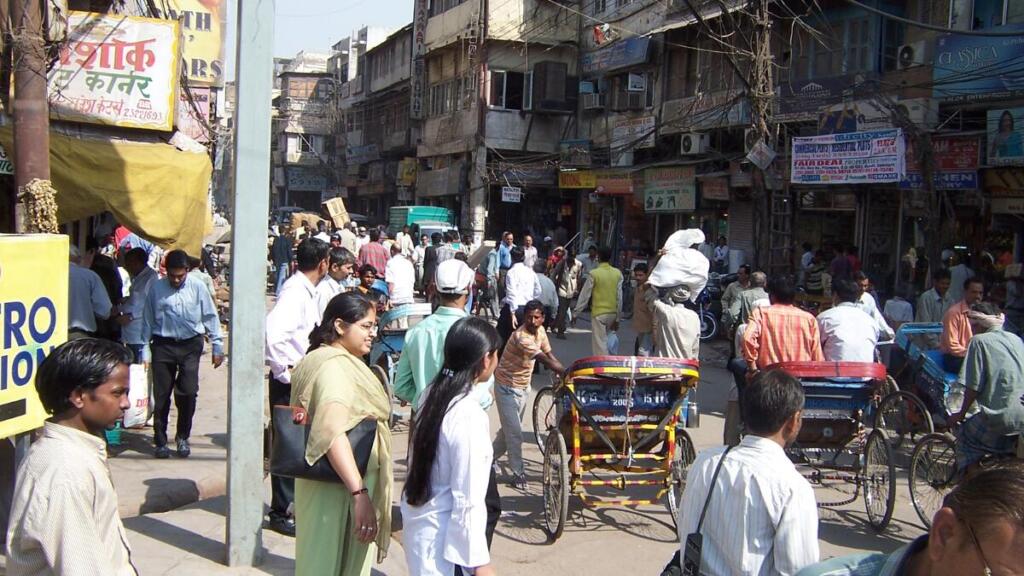
A loud crash echoed through Old Delhi’s crowded Chawri Bazar on the morning of Thursday, 5 November. A three-storey building under construction at Gali Sheesh Mahal, near Ajmeri Gate, collapsed at about 10:30 AM, killing two people and injuring five. By the next morning, officials said five more people were feared trapped in the basement, while four had been rescued.
The rescue showed how badly the neighbourhood is built for emergencies. The building sits at the end of a dead-end lane barely three feet wide, so no rescue trucks or earthmoving machinery could reach it. Responders and more than 30 municipal labourers had to walk in, and most of the debris was cleared by hand.
The suspected cause was a construction failure. An SDM at the site said a four-storey structure had been put up on a small plot, and the temporary supports appear to have been removed while the concrete was still wet. The same report said unauthorised construction on the upper floors gave way and brought down the whole structure. The Delhi government responded quickly, with two MCD engineers suspended and an FIR registered against the contractor. It was the familiar sequence of a collapse followed by suspensions and an FIR.
The next morning, a fire
On Friday, 6 November, a fire broke out at a shop in Karol Bagh’s Gaffar Market, and 22 fire service vehicles were sent. To be fair to the facts, this was the milder of the two events. Officials said the blaze was brought under control, and no casualties or injuries were reported, though the shop’s goods were damaged.
It still mattered, because Gaffar Market is another dense, congested commercial area, and the scale of the response reflects how quickly a fire in such places can threaten a whole lane.
Taken alone, the two incidents might look like bad luck. The record of recent months suggests otherwise.
In June, a fire swept through a New Delhi building, killing at least 21 people. In September, a building in Satya Niketan that served as student accommodation collapsed, killing seven people. Just a day before the Chawri Bazar collapse, Delhi Police filed a chargesheet against six individuals in that case. In October, a collapse in New Seemapuri in Shahdara saw the toll rise to four. Early this month, four workers died and two were injured in a fire at a shoe factory in Mangolpuri Industrial Area. Reports on the Chawri Bazar collapse itself noted that another collapse had already occurred in Satya Niketan in September.
What the pattern points to
The details of each case differ, but a few threads recur. Many involve construction that appears to have outrun its permissions, such as extra floors, cramped plots and shortcuts on structural safety. Many sit in tightly packed neighbourhoods where narrow lanes slow every response. Accountability tends to arrive after the tragedy, through suspensions, FIRs and chargesheets, rather than before it, through inspections that catch violations while they are still violations and not wreckage.
Delhi’s emergency crews are often praised for acting fast. But response is the last line of defence. The questions that keep returning are who approved or ignored the construction, who inspected it and how often, and why enforcement seems to wake up only after lives are lost.
The immediate question is the fate of those feared trapped in Chawri Bazar. The longer one is whether the engineers’ suspensions and the contractor’s FIR lead to convictions, and whether the city audits similar structures before the next failure. The Satya Niketan chargesheet will be an early test of how seriously such cases are pursued.