
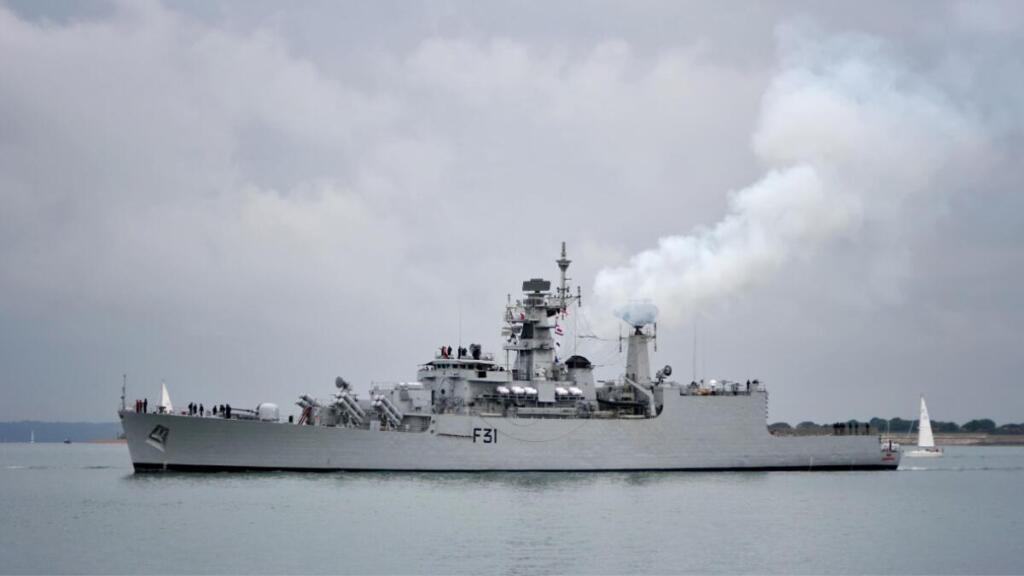
The Indian Navy has begun court-martial proceedings against two officers over the partial capsizing of the frigate INS Brahmaputra at the Naval Dockyard in Mumbai two years ago, the Hindustan Times reported, citing officials aware of the matter. The proceedings relate to alleged lapses that led to the accident while the warship was undergoing repairs.
The accused are the warship’s commanding officer, a captain, and its officer of the day, a lieutenant commander. The military court opened proceedings in Mumbai on October 12, an official told the newspaper. The captain, whose rank equals that of an Army colonel, faces charges that include hazarding an Indian Navy ship and negligence in the performance of his duties. The junior officer is charged with negligence, according to the Hindustan Times. Hazarding is the Navy’s term for putting a ship in danger.
A conviction could carry penalties ranging from a reprimand and loss of seniority to imprisonment of up to two years, the newspaper said. For a commanding officer, even the lighter outcomes would end the prospects of further advancement, since command of a warship is the stepping stone to flag rank.
The ship and the accident
INS Brahmaputra is a 3,850-tonne guided-missile frigate built in India and commissioned in April 2000. It carries a crew of 370, including 40 officers, Hindustan Times noted. The accident happened in July 2024, when the ship was in the dockyard for maintenance. A fire broke out on the vessel on July 21, 2024, while it was under repair at the Mumbai dockyard. Most of the crew escaped, but Leading Seaman Sitendra Singh drowned. The warship was later recovered and repaired. Hindustan Times had earlier reported that the ship was set to sail again after many had written it off.
A familiar path for naval accountability
Court-martial action against a commanding officer after a serious accident has precedent in the Navy. After the 2014 fire aboard the submarine INS Sindhuratna, which led to the resignation of then Navy chief Admiral DK Joshi, the vessel’s commanding officer was recommended for general court martial. Such cases usually follow a board of inquiry whose recommendations are accepted by Naval Headquarters, and they give the accused a full chance to defend themselves.
The trial is under way, and the evidence presented in it will determine whether the charges hold. The case will be watched closely inside the service, where the rules on watchkeeping, duty officers and ship safety in dockyards are likely to be scrutinised once the verdict is known.