
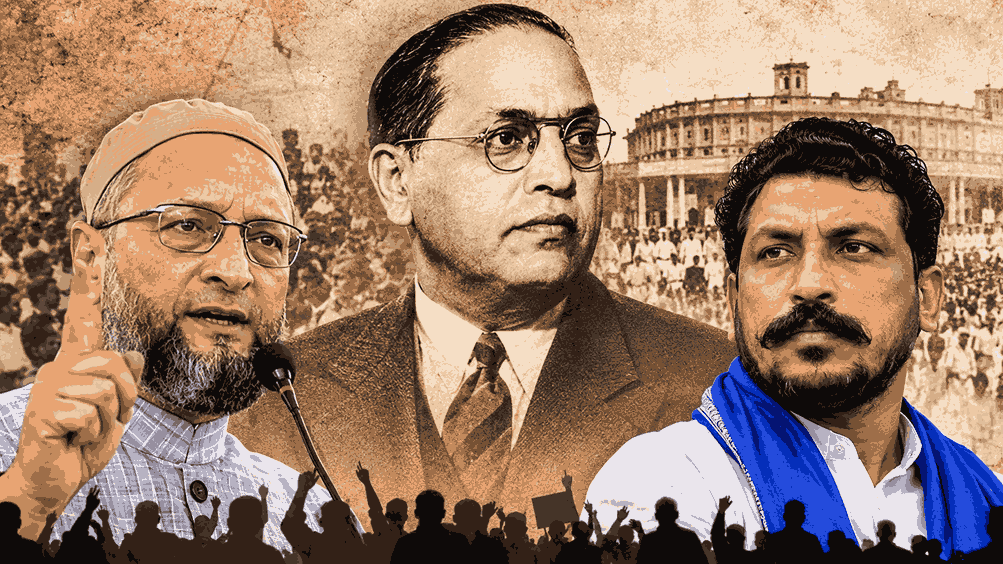
The proposed political partnership between Asaduddin Owaisi’s All India Majlis-e-Ittehadul Muslimeen (AIMIM) and Chandrashekhar Azad’s Azad Samaj Party (Kanshi Ram) has revived an uncomfortable chapter of Indian history. The proposed MIM-BHEEM alliance, which seeks to consolidate Muslim and Dalit voters ahead of the 2027 Uttar Pradesh Assembly elections, has brought the experience of Jogendra Nath Mandal back into the political spotlight. His story raises an important question: can two communities with different political, cultural and religious interests sustain an alliance merely because they share electoral objectives and a common opposition to perceived social inequalities?
The proposed alliance reportedly aims to contest a substantial number of seats in Uttar Pradesh, potentially around 150 of the state’s 403 Assembly constituencies. The political calculation is straightforward: combine the electoral strength of Muslim voters with Dalit support to create a formidable political constituency. Both Owaisi and Azad have attempted to establish themselves as representatives of communities that believe mainstream political parties have not adequately addressed their concerns. However, electoral arithmetic does not automatically translate into ideological compatibility or long-term political security.
The most significant historical parallel comes from the life of Jogendra Nath Mandal, a prominent Scheduled Caste leader from Bengal who once believed that political cooperation between Dalits and Muslims could transform the social and economic conditions of disadvantaged communities. Mandal was an associate of Dr B.R. Ambedkar and an influential figure in the Scheduled Castes Federation. He cooperated with the Muslim League, believing that the economic interests of Bengal’s Muslims and Scheduled Castes were sufficiently aligned to justify a political partnership.
Following Partition in 1947, Mandal became Pakistan’s first Law and Labour Minister. He was also entrusted with presiding over the inaugural session of Pakistan’s Constituent Assembly. His appointment symbolised the promise that the newly established country would protect minorities and provide equal political opportunities irrespective of religious identity. Mandal genuinely believed that his participation in the government would help safeguard the interests of Scheduled Castes and other vulnerable communities.
However, the political reality proved dramatically different from his expectations. Reports of violence against Hindus, including members of Scheduled Caste communities in East Bengal, increasingly reached him. Mandal raised concerns about killings, forced conversions, abductions, sexual violence and the destruction of property. He repeatedly appealed to the Pakistani leadership to protect vulnerable communities and take action against those responsible.
His disappointment eventually culminated in a historic decision. On October 8, 1950, Mandal submitted his resignation to Pakistan’s Prime Minister Liaquat Ali Khan. His lengthy resignation letter documented his grievances and described the failure of the government to protect minorities. He also explained how the political cooperation he had once considered essential for social emancipation had failed to deliver the promised security and equality.
The experience of Jogendra Nath Mandal therefore remains an important subject of discussion whenever contemporary politicians propose alliances based primarily on shared community identities. His political journey demonstrates that electoral cooperation cannot substitute for constitutional safeguards, institutional accountability and an independently articulated political agenda.
This does not mean that the proposed MIM-BHEEM alliance is destined to follow the same trajectory. India’s constitutional democracy, political institutions and contemporary circumstances are fundamentally different from those of newly established Pakistan in 1947. Dalit and Muslim voters are not homogeneous political blocs, and their interests cannot be reduced to religious or caste identities. Both communities have legitimate political aspirations, and democratic alliances between their representatives are entirely permissible.
Nevertheless, the experience of Jogendra Nath Mandal raises questions that Chandrashekhar Azad and his political associates should address. What concrete guarantees will protect Dalit interests within the proposed arrangement? Will the alliance prioritise education, employment, economic mobility, social security and political representation, or will it primarily focus on consolidating votes against rival parties? Most importantly, will Dalit political leadership retain its independence when disagreements emerge over policy and ideology?
For Chandrashekhar Azad, the challenge is to demonstrate that his party is entering the arrangement as an equal political partner rather than merely providing an additional electoral constituency. Similarly, AIMIM must establish how its political programme will accommodate the distinct concerns of Dalit communities.
The story of Jogendra Nath Mandal should not be used to dismiss every possibility of Dalit-Muslim cooperation. Instead, it should encourage political leaders to distinguish genuine social empowerment from temporary electoral convenience. An alliance becomes meaningful only when its partners respect each other’s independence and deliver tangible benefits to their constituents.
As Uttar Pradesh approaches another major electoral contest, the proposed MIM-BHEEM alliance will face scrutiny over its intentions, leadership structure and political commitments. History does not dictate the future, but it offers lessons that political leaders ignore at their own peril. Mandal’s experience is one such lesson: political promises must ultimately be judged by the protection, dignity and rights they actually deliver.