
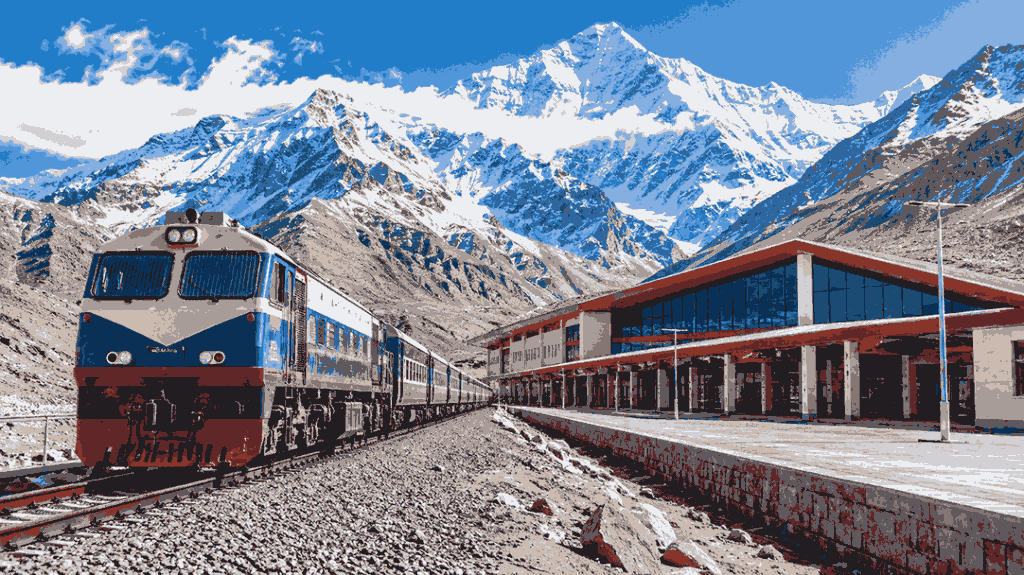
The proposed railway project represents a significant development in India’s efforts to strengthen connectivity across difficult mountainous and border regions. Stretching approximately 489 kilometres, the broad-gauge railway line will connect Bilaspur in Himachal Pradesh with Leh, passing through several strategically important locations. These include Sundernagar, Mandi, Manali, Sissu, Darcha, Keylong, Sarchu, Pang, Rumtse, Upshi and Kharu.
The proposed station near Tanglang La is expected to become the project’s most extraordinary feature. At approximately 5,256 metres, or 17,244 feet, above sea level, it would stand considerably higher than China’s Tanggula railway station, currently recognised as the world’s highest railway station at around 5,068 metres. If completed according to the proposed design, India’s achievement would exceed the existing record by approximately 188 metres.
For Ladakh, which has historically depended heavily on road and air transportation, the proposed railway connection could represent a transformative change. The Manali-Leh highway remains an important transportation route, but its accessibility is frequently affected by severe winter conditions, heavy snowfall and challenging mountain passes. A railway corridor could provide an additional transportation option, improving the movement of passengers and essential goods throughout the region.
The engineering requirements, however, are enormous. Approximately 270 kilometres of the proposed 489-kilometre railway corridor are expected to pass through tunnels. This means that more than half of the railway alignment could run beneath the Himalayan mountains. The project reportedly envisages 62 tunnels and 116 bridges, demonstrating the extraordinary scale of construction required to navigate the region’s difficult geographical conditions.
Another significant feature is the proposed underground railway station at Keylong, which would be a major engineering achievement in its own right. Constructing railway infrastructure beneath towering Himalayan mountains requires specialised technology, extensive geological investigations and careful planning. Engineers will have to address challenges involving unstable rock formations, extreme temperatures, high-altitude working conditions and the possibility of geological disturbances.
Beyond civilian transportation, the project carries considerable strategic importance for national security. The Ministry of Defence has identified the proposed railway corridor as a strategic infrastructure project because of its potential to strengthen logistical connectivity with India’s sensitive northern frontier. The railway could facilitate the transportation of military equipment, fuel, essential supplies and personnel, reducing dependence on existing road networks. The proposed alignment also incorporates dedicated military loop lines at railway stations to facilitate the movement of defence resources and improve emergency response capabilities.
The strategic significance of Ladakh has increased considerably because of its geographical position and proximity to sensitive international borders. Maintaining reliable transportation infrastructure is essential for both civilian administration and defence preparedness. Roads and air routes remain indispensable, but a high-capacity railway corridor could provide another important logistical channel, particularly for transporting heavy equipment and supplies over long distances.
The financial implications are equally substantial. With an estimated investment of ₹1.31 lakh crore, the Bilaspur-Manali-Leh railway corridor would rank among India’s most expensive railway infrastructure undertakings. The extensive tunnelling, construction of bridges and specialised engineering requirements are expected to contribute significantly to the overall expenditure. The project will also require careful environmental assessment to ensure that construction in the ecologically fragile Himalayan region does not create unnecessary damage.
According to available project information, the Railway Ministry has completed the survey and prepared the Detailed Project Report (DPR). However, the completion of these preparatory stages should not be confused with final construction approval. The project still requires the necessary administrative clearances, financial decisions and implementation arrangements. No confirmed completion deadline has been announced for the entire corridor.
The experience of other railway projects in Himachal Pradesh also highlights the difficulties associated with expanding connectivity through mountainous terrain. The Bhanupali-Bilaspur-Beri railway project, for instance, has encountered land acquisition-related complications. Such challenges underline the importance of resolving administrative, financial and engineering obstacles before undertaking an infrastructure project of this magnitude.
For residents and businesses in Ladakh, improved railway connectivity could eventually create opportunities in tourism, trade, transportation and local economic development. Easier access could encourage more visitors to explore the region’s distinctive landscapes, Buddhist monasteries, historical settlements and high-altitude deserts. Better transportation could also improve the movement of essential commodities, potentially reducing some of the logistical difficulties associated with supplying remote communities.
The proposed railway line also reflects India’s broader infrastructure ambitions under its railway modernisation programme. Over the past decade, the expansion of railway connectivity into previously inaccessible regions has become an important development priority. Projects such as the Udhampur-Srinagar-Baramulla railway line and the Bairabi-Sairang railway line demonstrate how difficult geographical barriers can be overcome through sustained investment and engineering innovation.
If realised, the Bilaspur-Manali-Leh corridor could become another landmark achievement in this transformation. For Ladakh, the arrival of railway connectivity would represent more than a transportation upgrade; it would establish a stronger physical connection with the rest of the country while creating fresh possibilities for economic development and national integration.
Ultimately, the proposed station near Tanglang La could give India a place in global railway history. Surpassing China’s Tanggula station would be a remarkable engineering accomplishment, but the larger achievement would lie in building reliable infrastructure across one of the world’s most challenging mountain environments. Ladakh could thus emerge as the setting for a new chapter in India’s railway history, provided the ambitious proposal successfully progresses from planning to construction.