
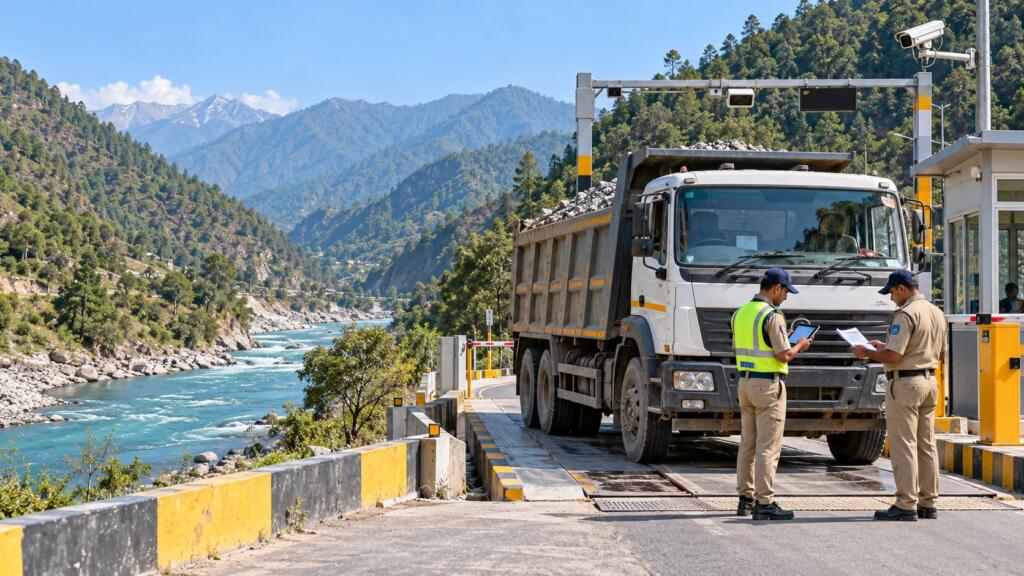
Illegal extraction of sand, stone and other minerals remains a serious governance and environmental concern in Uttarakhand. The state’s rivers, forests and mountain ecosystems are particularly sensitive to unregulated activity, making effective monitoring essential for both public safety and ecological protection.
Uttarakhand’s illegal mining debate often makes headlines through allegations, political claims and specific incidents. But to understand the bigger picture, it is very important to look at the rules, government action, available data and what still needs to be done.
Under the current government led by Chief Minister Pushkar Singh Dhami, the state has expanded its use of mining rules, district enforcement teams, digital checkpoints, surveillance systems and disciplinary action. These measures indicate a shift towards technology-led monitoring, although consistent implementation at the district level will determine their long-term impact.
Why Illegal Mining Is a Serious Issue for Uttarakhand
Mining provides construction material and generates revenue, but unregulated extraction can damage riverbeds, increase erosion, disturb natural drainage and create safety risks for nearby communities.
The problems don’t stop there. Overloaded or speeding trucks carrying mining material can damage roads and make travel dangerous for other road users. Unauthorised storage and movement also lead to revenue leakage because the material is transported outside the legal royalty and permit system.
The Uttarakhand mining environment debate, therefore, is not simply about whether mining should happen. It is about ensuring that extraction remains within approved areas, permitted quantities, environmental conditions and legally defined operating hours.
A Stronger Regulatory Framework
Uttarakhand has a dedicated regulatory structure covering mining concessions as well as the prevention of illegal extraction, transportation and storage.
The Directorate of Geology and Mining lists the Uttarakhand Mineral (Prevention of Illegal Mining, Illegal Transport and Illegal Storage) Rules, 2021, along with amendments introduced in 2023 and 2024. The state has also updated its Minor Mineral Concession Rules, including a fourth amendment notified in May 2026.
These rules provide the legal foundation for inspections, penalties, vehicle action and recovery proceedings. However, the effectiveness of any rule depends on enforcement. For this reason, the government’s focus is increasingly moving from manual checking towards digitally recorded and traceable monitoring.
District-Level Anti-Illegal-Mining Teams
District-level anti-illegal-mining forces have been constituted across Uttarakhand, including in Dehradun, Haridwar, Nainital, Udham Singh Nagar, Chamoli, Champawat, Pithoragarh, Uttarkashi and other districts.
These teams are designed to bring together district administration, mining officials, police and other relevant departments. Their role includes conducting inspections, checking transportation documents, identifying unauthorised storage and taking action against vehicles or operators violating mining rules.
A coordinated district structure is important because illegal mining rarely involves extraction alone. It can also include transportation, storage, local processing and the misuse of permits. Joint enforcement reduces the risk of an incident being passed from one department to another without action.
E-Check Gates and Digital Surveillance
One of the most significant developments has been the introduction of digital monitoring under the Mining Digital Transformation and Surveillance System.
According to the Directorate of Geology and Mining, 45 e-check gates had been installed by July 2026, of which 42 were operational. The department reported approximately ₹5 crore in e-challans against vehicles allegedly involved in illegal mining or transportation within two months. It also allocated 20 handheld e-challan devices across the state’s 13 districts.
These systems can help authorities verify vehicle movement, permits and transport records more consistently. Night-vision drones have also been cited as part of the monitoring mechanism, particularly for detecting activity outside permitted hours.
For people following the Uttarakhand khanan issue, this is a very important change: technology creates a digital trail that can support enforcement and reduce dependence on irregular roadside checks.
Enforcement Data Shows the Scale of Action
During a March 2026 Assembly discussion, the state government reported action in 2,252 cases involving illegal mining, transportation or storage during 2024–25, with recoveries of approximately ₹82.1 crore.
For 2025–26, up to January 2026, authorities reported action in 1,553 cases and recovery of around ₹39 crore. The government also stated that district-level teams headed by district magistrates were functioning and that legal mining was restricted by conditions such as operating hours and permissible depth.
These figures show active enforcement, but they should not be interpreted as proof that the problem has disappeared. A high number of cases may reflect stronger detection, continued violations, or both. Future reporting should therefore include repeat offences, district-wise action, case outcomes and environmental restoration.
Accountability Within the Enforcement System
Enforcement loses credibility if officials responsible for stopping illegal mining are suspected of supporting it.
In March 2026, CM Pushkar Singh Dhami ordered action following allegations of links between police personnel and illegal mining operators in Haridwar. Six personnel were suspended, and the SP Rural was tasked with investigating the matter. Dhami also called for a fair inquiry and legal action against anyone found guilty.
The case highlights why people search for terms like “Mining scam Uttarakhand.” Taking action matters, but it is only the beginning. To build public trust, authorities must also share the investigation’s findings and explain what happens next.
Citizen Reporting Must Be Safe and Trackable
The Directorate of Geology and Mining provides a grievance-redressal option on its official website. Citizen reporting can become a valuable enforcement tool if complaints receive tracking numbers, time-bound responses and confidentiality protection.
A stronger mechanism should allow residents to submit photographs, vehicle numbers, locations and time details without exposing complainants to local pressure. Complaints should also be connected with e-check-gate and permit data so authorities can verify violations quickly.
What Uttarakhand Should Focus on Next
The enforcement framework is becoming stronger, but the next phase should actually prioritise measurable outcomes:
- Publish district-wise monthly data on inspections, seizures, penalties and repeat offenders.
- Integrate e-check gates, mining permits, GPS records and e-challans into one monitoring dashboard.
- Use drones and geo-tagged inspections in environmentally sensitive river stretches.
- Protect complainant identities and establish clear response timelines.
- Publish the final status of departmental investigations and recovered penalties.
- Track river restoration and environmental compliance alongside revenue collection.
Conclusion
The response to Uttarakhand illegal mining is moving towards stronger rules, district-level coordination, digital surveillance and greater accountability. Measures introduced during the Dhami government’s tenure -including e-check gates, handheld enforcement devices and action against officials facing allegations—show a more structured approach.
The real measure of success will be whether these systems reduce repeat violations, protect rivers and communities, improve transparency and make enforcement consistent across every district. Continued public reporting will be essential to demonstrate that action is producing lasting results.