
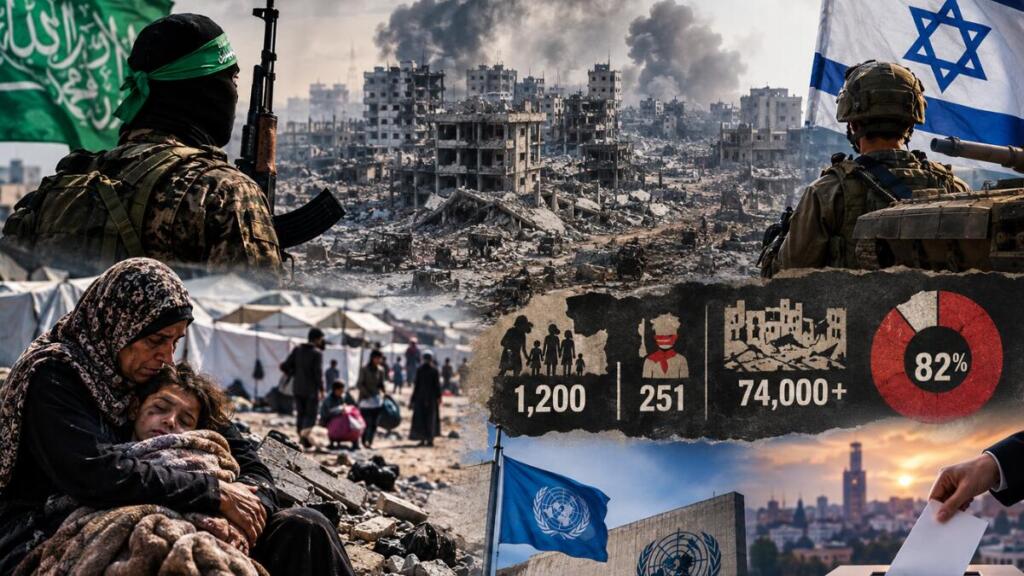
The large-scale fighting has stopped, but the war has not been resolved. Israel and Hamas are locked in a standoff over disarmament and withdrawal. Gaza is devastated, and Israel’s election on October 27 may decide what happens next.
Hamas’s attack on October 7, 2023 killed some 1,200 people, most of them Israeli civilians, and 251 were taken hostage. Israel’s two-year campaign that followed was condemned by a UN commission of inquiry, leading genocide scholars and major human rights organisations, who concluded it amounted to genocide. Israel rejects that characterisation, and the legal question remains contested. Gaza’s Health Ministry puts the Palestinian death toll above 74,000, and the vast majority of Gaza’s 2 million residents live in tent camps or among the debris. A Guardian report says around 82 per cent of Gaza’s structures have been seriously damaged or destroyed.
A ceasefire that isn’t quiet
A US-imposed ceasefire took hold a year ago, though mainly on paper. Major IDF assaults have ceased, but Israeli attacks in Gaza have continued. An Al Jazeera analysis found Israel attacked Gaza on 325 of the past 361 days. Israel says its strikes target Hamas and people involved in the October 7 attack. Israeli security officials say about 70 militants, including three brigade commanders, were killed in the past month.
One genuine milestone: the last living hostage came home in October 2025, and the remains of the last deceased hostage were returned in January 2026. This is the first anniversary with no hostages left in Gaza.
The core deadlock
The sequencing problem is the heart of the standoff. Netanyahu insists Israeli forces will not withdraw from their current lines until Hamas fully disarms, while Hamas conditions disarmament on Israeli withdrawal to the “yellow line” set in October 2025. Neither side has moved.
On the ground, the IDF controls about 64% of the Strip, with two divisions across roughly 30 outposts. Yet Israeli security officials themselves acknowledge that Hamas still rules Gaza’s population, and they say the absence of a long-term political framework is a central reason why.
Former Palestinian-affairs observers warn of the consequences. Ghaith al-Omari wrote that until Hamas is disarmed, no reconstruction or investment is plausible, and the group will remain functionally in control. He also argues that Hamas is reviving pre-war patterns of extortion, taxation and power consolidation.
The governance gap
The post-war architecture envisioned by President Trump’s plan is largely unbuilt. The International Stabilisation Force has yet to deploy, despite a US commander being appointed in January, and the technocratic Palestinian committee meant to run Gaza has not taken control on the ground. In August, Board of Peace head Nickolay Mladenov publicly criticised continued Israeli strikes, framing the choice as a disarmed, reconstructed territory versus a rearmed, radicalised one on the edge of renewed war.
Israel’s politics: a referendum on Netanyahu
Israel’s election is on October 27, the latest date legally allowed, and widely viewed as a referendum on Netanyahu’s leadership since the war began. The main challenger is former army chief Gadi Eisenkot, who resigned from Netanyahu’s war cabinet in June 2024, saying the government had completely failed to achieve its objectives in Gaza. Eisenkot, who lost a son and two nephews in the war, campaigns on mandatory military service and criticism of Netanyahu’s wartime leadership.
The numbers are tight. Likud began the race ahead in April but has declined steadily and was overtaken by Eisenkot’s Yashar in July. Still, in mainstream polls neither Netanyahu’s coalition nor the opposition has yet reached the 61 seats needed to govern. Possible disqualification of Arab parties could reshape the arithmetic further.
An important caveat: a change of government may not mean a change of Gaza policy. Analysts note that the election may remove Netanyahu without overturning the security consensus forged by three years of war, which includes holding territory inside Gaza rather than relying on the border fence.
Two national memories
The two societies are now living with very different wars. In Israel, communities near Gaza still struggle to see Palestinians next door as anything other than a threat, and the “Hamas is still in Gaza” message appears on roadside graffiti. Globally, the dominant reaction is shock at how the war was conducted and at the ruin and isolation of Gaza. Global attention has receded, which may reduce pressure on all sides.
Three years on, neither side has achieved what it declared as its aim. Israel has not destroyed Hamas’s grip on Gaza, and Hamas has not been able to protect the population it governs. The ceasefire has reduced the killing without resolving anything. Whether it becomes a path to a settlement or a pause before the next round depends on decisions that are still being made, beginning with Israeli voters on October 27.