
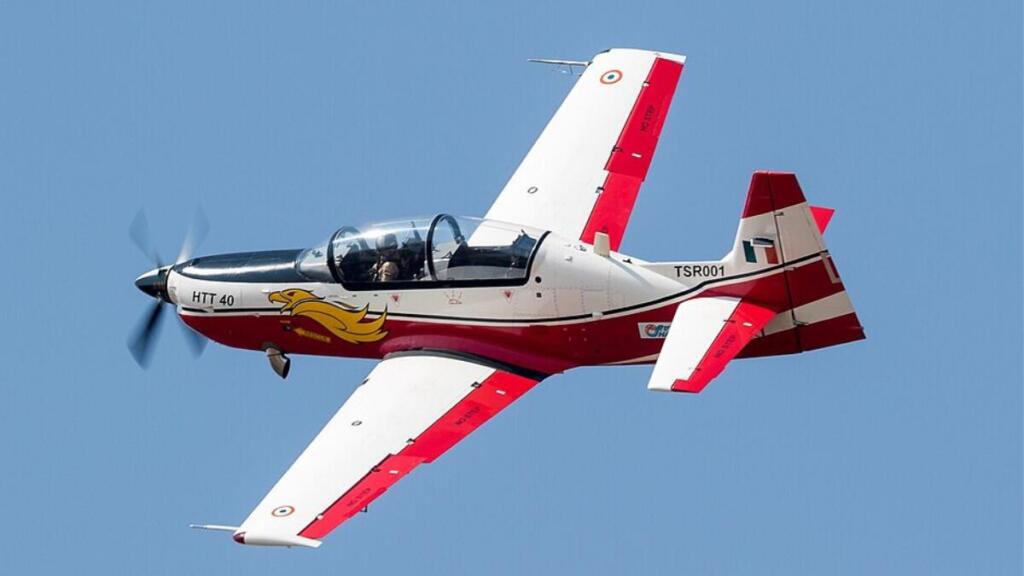
On 18 September, in Bengaluru, Defence Minister Rajnath Singh watched Hindustan Aeronautics Limited hand over the first three indigenously developed HTT-40 basic trainers to the Indian Air Force. It was a milestone that had been promised, postponed and promised again for more than a decade.
A Hindustan Times report on 21 October added the catch. Full-scale training of rookie pilots on the aircraft could take up to two years.
Why the jets are not training cadets yet
The three aircraft will not go to cadets. They are headed for the Flying Instructors’ School at Tambaram near Chennai, where instructors will first be trained on the type, so they can later teach rookie pilots to fly it.
Two things have to happen before the Air Force Academy near Hyderabad can use the aircraft. The IAF needs a fleet of about 25 to 30 HTT-40s and enough qualified instructors. It also has to develop operating procedures and a syllabus for the new aircraft. A trainer is more than an airframe. It needs a course built around it, and teachers who have flown it first.
The engine that stopped the line
The deeper trouble is on the production floor. The HTT-40 is Indian in design and assembly, but its engine is American. Honeywell supplies the TPE331-12B turboprop, and supply-chain problems at the US company held back deliveries.
The result was stark. The IAF had ordered 70 aircraft from HAL for ₹6,838 crore in 2023. HAL was due to deliver 12 during 2025-26 but could not deliver any because of the engine shortage. The target was later revised down to three.
A GlobalData analyst put the lesson plainly: a single component supplier can hold back an entire pilot intake, because every fighter pilot starts on a basic trainer. A delay at the first stage limits how quickly the IAF can crew the fighters it is buying. The service operates roughly 29 fighter squadrons against an authorised strength of 42.
There are signs of recovery. Honeywell delivered the first batch of engines a few months ago and assured HAL of timely supplies. Officials quoted in the report said HAL could build about 20 aircraft a year if engine supplies stabilise. A follow-on order for another 36 aircraft is planned once the type reaches full operational maturity.
A long history of doubt
The delays are not new. After the older HPT-32 trainer was grounded for safety reasons, HAL began work on a successor. In 2012, the Defence Ministry and the IAF rejected HAL’s offer, concluding the HTT-40 would cost more than 75 Swiss Pilatus PC-7 Mk II trainers. The IAF went with the Swiss aircraft, but HAL kept developing its own.
Technical clearance was slow too. A prototype demonstrated the critical six-turn spin test capability in September 2019, and spin certification flight testing was completed by August 2021. The order finally came in March 2023.
How many trainer types does the IAF fly?
The IAF’s pilot pipeline runs through four trainer types, with the HTT-40 as the newest.
Stage I, basic training: Until now, all ab initio training for rookie pilots has been done on the Swiss-origin Pilatus PC-7 Mk II. The HTT-40 is meant to take over part of this role. It will supplement rather than replace the 75 PC-7 Mk IIs.
Stage II, intermediate: Pilots chosen for fighters move on to the PC-7 Mk II and the Kiran Mk-1A jet trainer. The Kiran is the ageing Indian-built jet, and the plan for its replacement has not been delivered.
Stage III, advanced: Trainees then undertake instruction on the British-origin Hawk advanced jet trainer before reaching frontline fighters.
That makes four types in the pipeline: the PC-7 Mk II, Kiran Mk-1A, Hawk and now HTT-40. The total grows if two-seat conversion variants of operational fighters are counted. HAL has just handed over the final two Tejas Mk1 twin-seat trainers alongside the HTT-40s, and the IAF flies two-seat versions of other fighters as well.
The IAF also still lacks a home-grown intermediate jet. Commentators note that the HJT-36 intermediate jet trainer remains mired in developmental delays. That leaves the Stage-II link in the chain the weakest.
What it means for the Air Force
The HTT-40’s story is a lesson in how a single missing part can slow a service. The trainer’s design is sound enough to be bought in numbers. Its supply chain was not strong enough to keep to the schedule.
For now, three aircraft are in the hands of instructors, who will spend the next two years learning to teach on them. The Air Force’s next generation of pilots will keep starting out on the Swiss trainer until a fleet of Indian ones is ready. The real test is whether HAL can reach about 20 deliveries a year, and whether the engines keep arriving when it does.