
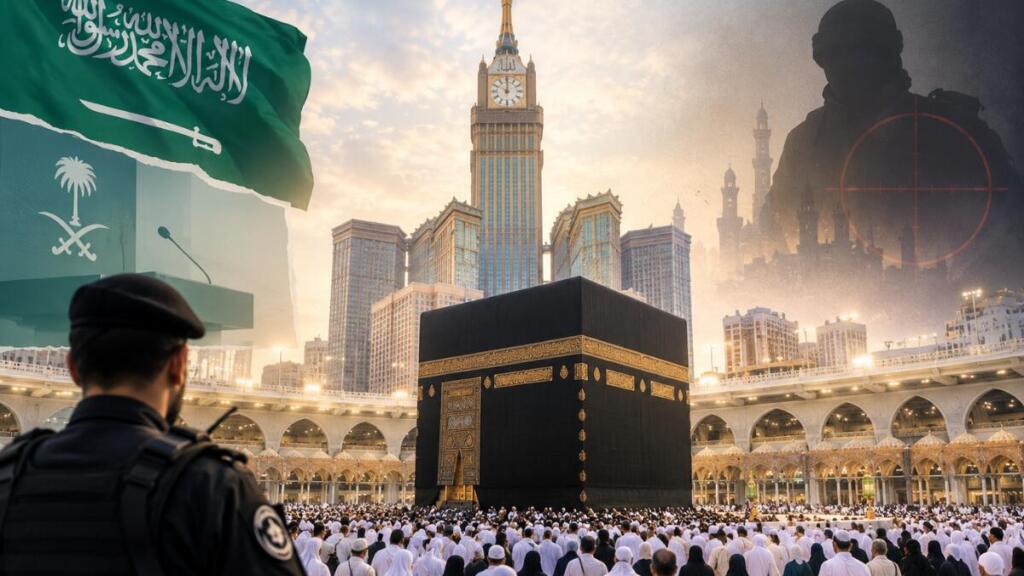
Reports spread on social media on Friday that a suicide bomber had tried to detonate an explosive vest near the Kaaba inside Mecca’s Grand Mosque. The device malfunctioned and no blast occurred. The same report noted that Saudi authorities denied the bombing claim.
The Saudi security authorities said there was no truth to the claims circulating online. They said a man had been arrested for harassing passersby and causing fear and panic, and was dealt with immediately. They gave no details about his identity and did not disclose any information indicating that explosives were found. The clarification followed videos on social media claiming to show a suspected bomber being detained. I could not independently verify either account. The bomber claim remains unconfirmed and officially denied.
The claim spread quickly because Mecca has a real history of such threats.
A short history of attacks and threats
1. The 1979 siege. On 20 November 1979, Juhayman al-Otaybi, a Saudi religious dissident and ex-soldier, and his followers seized the Grand Mosque and held it for two weeks. He called for an uprising against the House of Saud and proclaimed that the Mahdi, the messianic redeemer of Islamic belief, had arrived in the form of his brother-in-law. The group reportedly demanded the royal family abdicate. The official death toll was 229, though other accounts give higher figures. Saudi forces retook the mosque, and 63 militants were later executed, in what is described as the largest mass execution in modern Saudi history. Historian-journalist Yaroslav Trofimov’s book on the siege argues that it was the birth of Al Qaeda, a thesis that remains debated.
2. The 1987 Hajj clashes. This was a political confrontation rather than a bombing. A clash between Iranian pilgrims holding a demonstration and Saudi security forces left more than 400 dead. The Saudi government put the toll at 402, including 275 Iranian pilgrims and 85 police. The two sides blamed each other. Saudi officials said pilgrims were armed with knives, sticks and stones. Iran said security forces provoked the procession. Brookings notes that Saudi Arabia had banned political demonstrations during the Hajj.
3. The 1989 bombings. On 9 July 1989, two bombs exploded in Mecca, killing one pilgrim and wounding 16. Saudi authorities blamed Iranian-inspired terrorists and later beheaded 16 Kuwaiti Shia Muslims over the bombings. Iran denied involvement.
4. 2016 and 2017: the Islamic State era. In May 2016, Saudi forces shot dead two alleged IS fighters outside Mecca, and two others blew themselves up. In June 2017, forces foiled a plot against the Grand Mosque near the end of Ramadan. A bomber blew himself up in a house near the mosque, collapsing the building and injuring six foreigners and five security personnel. The ministry did not name the group behind it. Since late 2014 the kingdom had faced periodic bombings and shootings claimed by the Islamic State, according to AFP. Four security officers had been killed the previous Ramadan near the Prophet’s Mosque in Medina.
Why Mecca? The question behind the headlines
The better question is not why Islam’s holiest site is attacked, but why different extremist movements have wanted to challenge who controls it. The record suggests several answers.
It is a symbol of legitimacy. AP says the Grand Mosque has been targeted because it represents the ruling family’s clout in the Islamic world. Whoever challenges the custodian challenges the claim to lead Muslims. That was Juhayman’s explicit aim in 1979.
The audience is enormous. Hundreds of thousands of worshippers gathered for Friday prayers during the 2017 plot. A threat there gets global attention, which is part of the logic for groups seeking it.
Mecca is a stage for rivalries. The 1987 and 1989 episodes reflect the Saudi-Iranian rivalry and sectarian mistrust, not a single ideology.
1979 changed Saudi Arabia. One analysis says it strengthened conservative influences in Saudi society. That is an interpretation, but it shows why the siege is treated as a turning point rather than a footnote.
What the record does not show is a single source of danger. The attackers and alleged attackers over the decades have included a Saudi millenarian preacher, state-linked demonstrators, accused Shia cells and IS-linked plotters. Those most often put at risk are Muslim pilgrims and Saudi security personnel. The Saudi interior ministry’s own language in 2017 was that the plot would have violated “all sanctities.”