
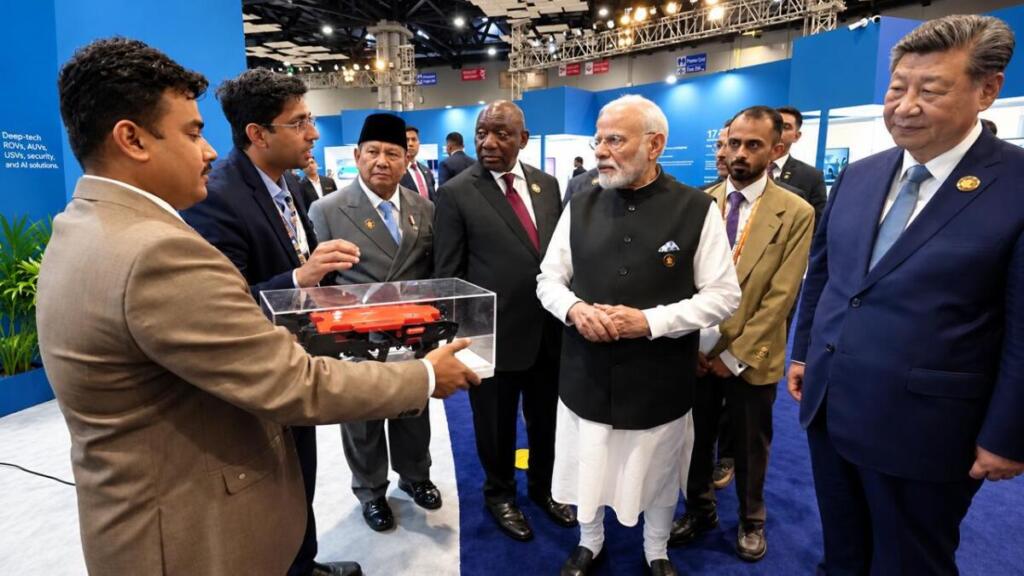
Six leaders visited the EyeROV pavilion at the BRICS Bharat Innovates Exposition in New Delhi, the company said on 17 September. They were Prime Minister Narendra Modi and five presidents: Vladimir Putin of Russia, Xi Jinping of China, Masoud Pezeshkian of Iran, Prabowo Subianto of Indonesia and Cyril Ramaphosa of South Africa.
The exposition ran on 11 and 12 September at Bharat Mandapam, alongside the 18th BRICS Summit. According to the summit programme, the leaders toured it on 12 September after the closed plenary. Modi posted pictures of the visit on X with the words “Innovation from India. Solutions for the world!”
The 37 exhibitors spanned space technology, semiconductors, quantum computing, renewable energy, battery materials, critical minerals, robotics, biotechnology and healthcare, Business Standard reported. They had been selected from the 120 startups and ventures that took part in the first Bharat Innovates exposition in Nice in June, according to the Press Information Bureau.
The Navy’s endorsement
What EyeROV put in front of the leaders was the Trout, a military-grade remotely operated vehicle built in Kochi by IROV Technologies Pvt Ltd for deep-water exploration, autonomous navigation and advanced payload integration. It is rated to 300 metres and was developed with the Indian Navy through the Defence India Startup Challenge, where it was an iDEX DISC 7 SPRINT winner. The Navy then ordered Trout units in a ₹47-crore contract, announced by the company on 30 September 2025. For a young deep-tech firm, that order is a strong sign that the platform meets naval standards, and it supports India’s push to modernise its defence and maritime surveillance capabilities with homegrown technology.
A dual-use argument built on hardware
EyeROV’s product sheet describes a dual-use platform. It says the Trout can monitor strategically important subsea infrastructure, including undersea communication cables, ports and offshore energy installations, and lists defence, search and rescue, offshore research and maritime industry inspection as intended uses. It can also carry out non-destructive testing of ship hulls and underwater structures.
The payload list backs this up. The main camera is a 4K unit with 10x optical zoom, and a second Full HD camera with a 120-degree wide-angle lens can tilt through 90 degrees. A three-degree-of-freedom arm carries a grabber, rope cutter and recovery jaws. A dual-frequency multibeam imaging sonar produces clear pictures in poor visibility, and a DVL/USBL system handles underwater positioning. An ultrasonic thickness gauge supports structural inspections. The company says the vehicle moves in six degrees of freedom on seven thrusters, four vectored horizontally and three vertically, and that its four 1,500-lumen lights give 6,000 lumens in total.
Software and control
The Trout is operated through EyeROV’s i-Control Hub software, which shows multiple camera feeds, imaging sonar and position data together, overlaid on S63 Electronic Navigation Charts. It supports auto-depth, auto-heading, station keeping and GPS waypoint navigation. For mission safety it offers geofencing, return-to-home and retrace functions, and built-in self-tests of the vehicle’s subsystems. Operators work from a 21.5-inch sunlight-readable, IP65-rated Full HD display and a programmable joystick with five axes and 15 buttons.
EyeROV’s release says dams, bridges, ports and offshore installations are hard to reach and inspect underwater, and that its robots help operators examine them and collect data. The company names Tata Power, NHPC, Adani, ONGC, BPCL and Maersk among its industrial clients. Its vehicles have been used in Antarctic waters and in deep-water volcanic studies at depths beyond 400 metres, according to coverage of the Navy order.
From exposure to partnerships
Whether exposure at this level turns into partnerships is a separate question. The Ministry of Education’s programme offers exhibitors access to BRICS-based investors and structured business-to-business matchmaking, DD News reported. At the Business Forum on 11 September, Modi called for 100 BRICS startups a year to be helped into other member markets and for 1,000 new business partnerships annually.
EyeROV has said it is expanding its presence across international markets. Its 17 September release names no partner and no order arising from the six visits, and says the company’s focus remains on practical challenges in defence, energy, infrastructure, maritime security and marine research. With a Navy order behind it and a BRICS-level introduction now added, the company enters that push with more credibility than most.