
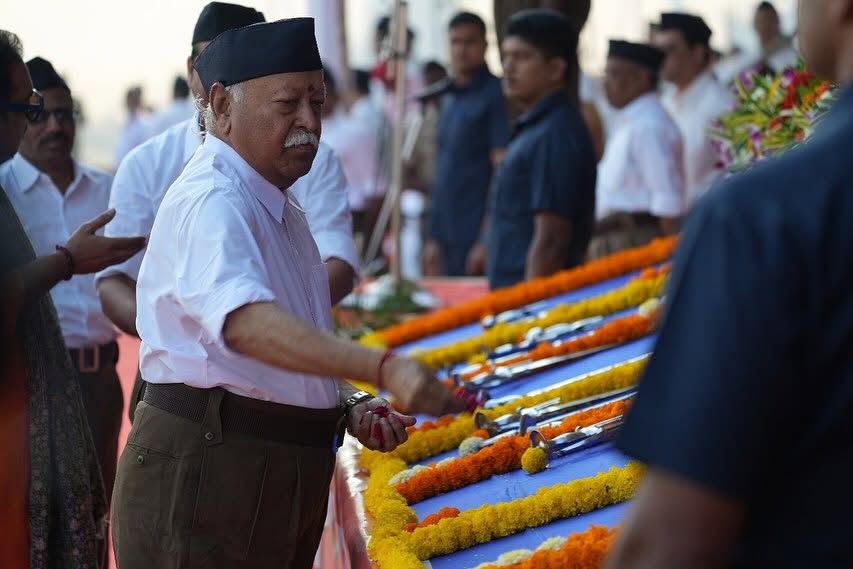
Founded by Keshav Baliram Hedgewar in 1925, the RSS developed an organisational model centred on Hindutva and daily shakhas, physical training, ideological instruction and community organisation. Rather than functioning as a conventional political party, it concentrated on building a disciplined network of volunteers. Over time, this structure helped it establish a presence across different regions and social groups, while affiliated organisations entered fields ranging from education and labour to student politics.
The distinction between the RSS as an organisation and its political affiliates is important to understanding its history. The Bharatiya Jana Sangh, founded in 1951 under Syama Prasad Mookerjee, provided a political platform for Hindu nationalist ideas. Its successor, the Bharatiya Janata Party (BJP), initially experimented with a broader political vocabulary, including Gandhian socialism, before increasingly embracing a more explicit Hindu nationalist identity during the late 1980s.
The RSS’s engagement with socialist politics became particularly consequential during the political turmoil of the 1970s. Opposition to Prime Minister Indira Gandhi’s government and the Emergency of 1975–77 brought RSS workers into contact with a wider coalition of democratic activists. Jayaprakash Narayan, popularly known as JP, emerged as a central figure in the movement, drawing support from socialists, students and political organisations that otherwise differed sharply in their ideological outlook.
For the RSS, participation in this movement offered an opportunity to oppose authoritarian rule and expand its acceptance among sections of the political opposition. For socialist leaders, cooperation was driven largely by the immediate objective of restoring democratic freedoms. This convergence did not mean that the participants had suddenly resolved their disagreements over nationalism, religion, economics or the structure of Indian society.
The alliance also illustrates how political movements can cooperate without merging their ideological foundations. Socialist activists could oppose the Emergency alongside RSS volunteers while continuing to disagree with the organisation’s understanding of Indian national identity. Similarly, the RSS could participate in a broader democratic movement without adopting the economic and social programmes of its socialist partners.
The aftermath of the Emergency produced another significant experiment. The Janata Party brought together former members of the Jana Sangh, socialists and other opposition groups to challenge Congress dominance. The coalition’s electoral victory in 1977 demonstrated the power of political unity against a common opponent. Yet disagreements over the participation of former Jana Sangh members in the RSS eventually contributed to the Janata Party’s internal crisis and fragmentation.
That episode exposed the limits of ideological accommodation. Political partners may share a common adversary or immediate objective, but competing ideas about organisational loyalty and national policy can eventually overwhelm their common ground. The experience remains relevant to understanding the RSS’s subsequent political development.
The relationship between pragmatism and Hindutva has continued to attract scholarly attention. Researchers have examined how the organisation has adapted its public language and social programmes while maintaining a distinct Hindu nationalist outlook. Under Balasaheb Deoras, who led the RSS from 1973 to 1994, the organisation placed greater emphasis on social harmony and outreach, including public statements opposing untouchability. Scholars have interpreted these initiatives as an effort to broaden Hindu social consolidation, although assessments differ over how far such efforts challenged entrenched caste hierarchies.
The BJP’s own evolution offers another illustration of political adaptation. Its early emphasis on Gandhian socialism gave way to a stronger focus on cultural nationalism, particularly as the Ram Janmabhoomi movement reshaped political debate during the late 1980s and early 1990s. This shift demonstrated how electoral strategy, public sentiment and organisational priorities could change without necessarily displacing the wider ideological tradition associated with the Sangh Parivar.
Nevertheless, claims that the RSS has remained entirely unchanged require qualification. Its methods, public messaging, organisational reach and engagement with government have evolved considerably since 1925. Critics argue that these changes have reinforced majoritarian politics, while supporters describe them as an effort to restore India’s civilisational identity. Understanding the organisation requires examining both its stated objectives and the consequences of its political influence.
Ultimately, the history of the RSS and socialist cooperation illustrates the difference between tactical flexibility and ideological surrender. Temporary alliances can advance common objectives without erasing deep disagreements. The continued debate over Hindutva reflects this tension between political pragmatism, organisational continuity and competing visions of India’s future.