
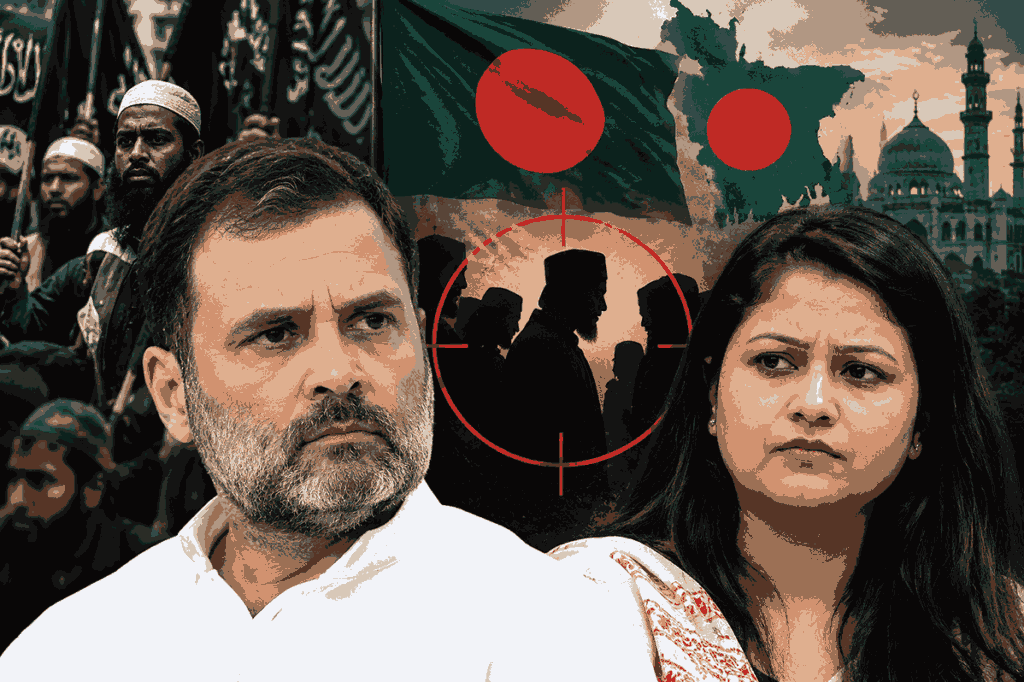
India’s political debate intensified after student activist Neha Bora praised Bangladesh’s youth-led movement as an inspiration for protesters in India. Her remarks have prompted the Bharatiya Janata Party (BJP) to question the intentions of Congress leader Rahul Gandhi and the opposition groups joining the demonstrations. The controversy has raised concerns about whether movements inspired by developments in neighbouring countries could deepen political instability in India. Critics have also invoked the threat of a Bangladeshi Islamist model, linking fears of political upheaval with reports of violence against Hindu minorities in Bangladesh. However, the distinction between political inspiration, regime change through protests and religious persecution remains essential to understanding the dispute.
Bora, the national president of the All India Students’ Association, was heard in a video congratulating Bangladeshi youth for showing Indian protesters the way. She linked the two movements to demands for democratic and voting rights and expressed solidarity with young people across South Asia. The BJP seized on her remarks, arguing that the opposition was seeking to reproduce the political upheaval that led to the removal of Bangladesh’s former prime minister, Sheikh Hasina, in August 2024. The party has portrayed the comments as evidence of a broader strategy, although the claim that the opposition intends to reproduce a Bangladeshi Islamist system in India has not been independently established.
The political controversy comes amid demonstrations against the Election Commission’s Special Intensive Revision of electoral rolls. Opposition parties have alleged that the exercise threatens eligible voters’ rights and demanded accountability from Chief Election Commissioner Gyanesh Kumar. The Election Commission has defended the revision process, while the opposition continues to challenge its handling. Rahul Gandhi has joined the demonstrations and presented them as a defence of constitutional rights. Against this background, the BJP argues that references to Bangladesh warrant scrutiny, particularly when activists invoke a foreign protest movement as a model for political mobilisation in India. Critics fear that a Bangladeshi Islamist narrative could become a rallying point in an increasingly polarised national debate.
Bangladesh’s recent history provides a complicated backdrop to these arguments. The student-led demonstrations that culminated in Hasina’s departure began amid disputes over public-sector job quotas and expanded into a wider movement against her government. The subsequent political transition was accompanied by serious violence and attacks on minority communities, including Hindus. Reports of assaults, vandalism and damage to religious sites have intensified concerns about minority security. These incidents deserve impartial investigation and accountability. Nevertheless, the presence of a Bangladeshi Islamist influence in any particular Indian political campaign must be demonstrated through credible evidence rather than inferred solely from comparisons between protest movements.
For Hindu communities, the reported persecution of minorities in Bangladesh is not an abstract concern. Religious freedom and physical security are fundamental rights, and governments have a responsibility to protect vulnerable communities regardless of their faith. Indian political leaders should therefore address concerns about attacks on Hindus across the border without turning the suffering of victims into an instrument for unsubstantiated domestic accusations. A Bangladeshi Islamist political framework associated with religious intolerance would be incompatible with equal citizenship and constitutional protections.
The BJP’s criticism of Rahul Gandhi and Bora reflects a wider struggle over the political meaning of youth activism. Supporters of the protests argue that young citizens are demanding accountability, fair elections and the right to dissent. Government supporters counter that foreign examples should not be romanticised without considering their consequences. The danger of a Bangladeshi Islamist trajectory is a legitimate subject for public discussion when grounded in evidence about religious extremism, minority rights and political violence.
Rahul Gandhi and the Congress leadership face a political challenge: they must explain the objectives of their alliance with student activists and demonstrate that their campaign remains committed to peaceful, constitutional politics. Bora’s remarks can reasonably be examined in their full context, including her stated emphasis on democratic rights and resistance to religious fundamentalism. A Bangladeshi Islamist outcome cannot be presumed simply because activists draw inspiration from another country’s youth movement. Equally, opposition leaders should recognise that references to Bangladesh carry particular sensitivity because of the region’s history of political upheaval and attacks on minorities.
Ultimately, India’s democratic resilience depends on more than partisan accusations. Electoral complaints should be investigated through transparent procedures, peaceful demonstrations should be protected within the law, and religious minorities must receive equal protection. The possibility of a Bangladeshi Islamist influence should be evaluated through verifiable statements, organisational links and actions, not speculation. Rahul Gandhi, Neha Bora and others should all be judged by evidence and constitutional standards. India can defend its democratic institutions and stand firmly against Hindu persecution without treating unproven allegations as established facts.