
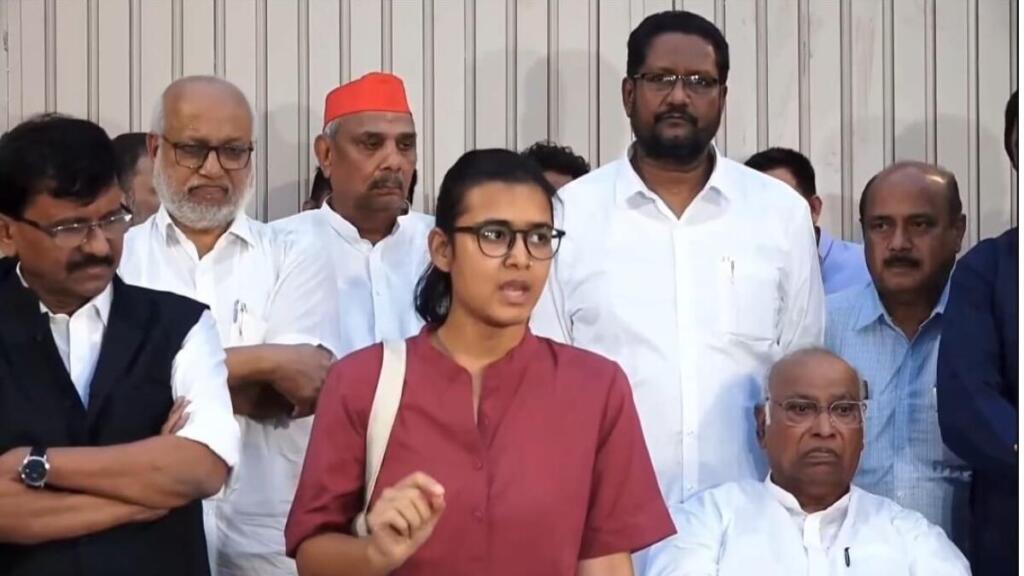
The sight of AISA national president Neha Bora walking beside Rahul Gandhi and Priyanka Gandhi Vadra has opened a fault line inside the Congress, with its student wing, the NSUI, among those questioning the prominence given to a leader from a Left organisation that has long competed with it on campus.
The unease dates to the Opposition march to the Supreme Court on October 12, where Bora was seen alongside the two Gandhis. The leadership sees the move as a way to broaden anti-BJP opposition unity, but sections of the party and the NSUI have questioned the growing influence of Left-affiliated activists at the expense of grassroots Congress workers.
Why Bora matters
At 29, Bora is a JNU PhD scholar and one of the most recognisable faces of the youth-led agitation of recent months. She drew national attention through a 23-day hunger strike at Jantar Mantar, alongside fellow AISA leaders and activist Sonam Wangchuk, demanding Education Minister Dharmendra Pradhan’s resignation over the NEET-UG paper leak allegations. The wider campaign was popularised by the satirical Cockroach Janata Party, which used memes and reels to reach Gen Z, alongside efforts by Left student groups led by AISA.
Detained by police during a weekend protest, she urged supporters to regroup at Dilli Haat after demonstrators were blocked from reaching Jantar Mantar. That sort of improvisation has helped build her profile well beyond the AISA cadre.
A pattern of appearances
The Supreme Court march was not the first time Rahul Gandhi put Bora in the frame. She appeared with him at a July 25 press conference where he highlighted alleged police excesses against protesters during the July 20 march to Parliament, and he made a point of drawing attention to her presence during the October march.
Political observers read this as a calculated step. By featuring a familiar face from the CJP’s protest network beside Congress leaders, Gandhi can project a broad coalition without bringing the CJP leadership itself into the picture, at a time when that movement has competed with him for space in the Opposition.
For the party, the logic is straightforward. A youth movement with real street energy sits outside the Congress, and a visible association with one of its best-known faces offers a bridge to voters the party has struggled to reach.
The NSUI’s grievance
Inside the organisation, the calculation looks different. Several NSUI members are unhappy with the importance given to Bora during the march, and the images drew attention at a time when senior Congress leaders were also jostling to be seen near the top leadership. Party workers have also pointed out that groups like AISA have previously criticised the Congress and the NSUI in sharp terms.
The rivalry has a long history on campuses, where AISA and the NSUI contest the same student constituencies, including in JNU and Delhi University. For NSUI office-bearers who have spent years on the ground, seeing an AISA leader take centre stage beside the party’s first family at a marquee march reads as a loss of standing.
Even as it criticised the leadership’s choice, the NSUI kept up its own agitation. On October 3, while AISA marched towards Jantar Mantar, the NSUI staged a separate protest at India Gate demanding the resignation and arrest of Chief Election Commissioner Gyanesh Kumar. The parallel protests showed two organisations working the same issue on separate tracks.
Rahul Gandhi’s message
The leadership moved to contain the discontent. At a meeting with Indian Youth Congress, NSUI and Seva Dal members at the party headquarters, Gandhi reportedly told them that anyone who joined the party to seek credit was in the wrong organisation, and reminded them that the youth and student wings exist to teach leadership, discipline, sacrifice and resilience. Priyanka Gandhi Vadra is also said to have reminded youth leaders of their responsibility.
The message, as reported, asks the younger ranks to prize organisational work over visibility. It does not address the underlying question of why an outside leader received the visibility in the first place. Accounts of the closed-door meeting rely on party sources, and the Congress has not issued an official statement on it.
What is at stake
Some of the reports on the controversy come from outlets openly hostile to the Congress, and their language about Bora is partisan. The reporting on the dissent itself, however, matches across several sources, and the underlying tension is plain: a leadership that wants to be seen leading a broad youth coalition, and an organisation that wants the credit for building its own youth base.
Bora herself has been careful about the politics. She has welcomed support from parties including the Congress and from student bodies such as the NSUI and Youth Congress, and said opposition parties have a responsibility to take up people’s issues. The framing leaves room for cooperation without suggesting AISA is joining the Congress fold.
The risk for the Congress is the long-term cost to its own pipeline. Youth and student wings are where the party recruits and tests future leaders, and workers who feel sidelined at the moments of greatest visibility may question where their effort leads. For the leadership, the gain is access to a movement it does not control, and whether that outweighs the friction with its own younger cadre is a question the next round of street protests will begin to answer.