
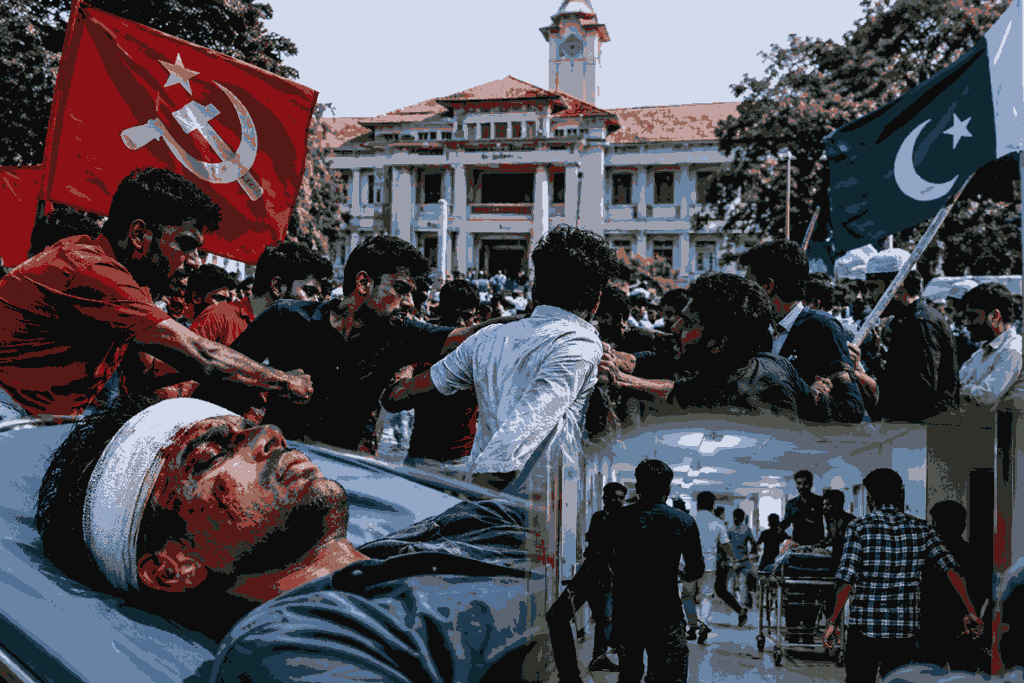
The confrontation unfolded after the SFI secured all nine general seats in the university’s campus students’ union election. The result marked a significant victory for the Left-affiliated student organisation, but celebrations were overshadowed by clashes involving members of the United Democratic Students’ Front (UDSF), an alliance comprising the Kerala Students’ Union (KSU) and MSF.
According to reports, tensions began when Leftists and SFI activists objected to the presence of two MSF members outside the SFI election committee office on campus. The disagreement reportedly escalated into a violent confrontation, with both sides accusing each other of provocation. Around 30 students were reported injured, while the SFI election committee office was vandalised and motorcycles were damaged during the unrest.
The police intervened to bring the situation under control. However, the violence did not end with the clashes on campus. In a development that intensified the controversy, MSF members allegedly entered DMS Hospital at Mele Chelari in Thenhipalam around 12:30 a.m. on October 29 and assaulted SFI activists who were visiting injured colleagues.
Among those reportedly attacked were SFI state joint secretary N. Adil and Malappuram district president M. Sujin. Adil sustained a head injury, while Sujin reportedly suffered serious injuries to his head and nose. Both were initially taken to Kozhikode Medical College Hospital before being shifted to EMS Hospital in Perinthalmanna for further treatment.
Police registered a case against 15 MSF members following a complaint filed by the SFI Malappuram district secretary. A separate case was reportedly registered after the hospital complained of damage to its property. The allegations remain subject to investigation, and the legal responsibility of individual participants must be established through due process.
Videos circulating on social media appeared to show a group of men entering the hospital carrying sticks, rods and other objects. The footage intensified public outrage because the alleged assault occurred inside a medical facility, where injured people were receiving treatment. Hospitals are expected to remain safe spaces for patients and medical staff, regardless of the political affiliations of those involved.
The episode has exposed the volatile nature of student politics in Kerala, where campus elections frequently reflect wider rivalries between political parties. The SFI is affiliated with the Communist Party of India (Marxist), while MSF is the student wing of the Indian Union Muslim League. KSU, the Congress party’s student organisation, also participates in the UDSF alliance.
For Leftists, the incident has raised questions about the security of student activists and the ability of university authorities to prevent political disputes from turning violent. At the same time, the allegations underline the need for impartial investigations rather than treating the actions of individual activists as representative of an entire political or religious community.
Kerala Chief Minister Pinarayi Vijayan condemned the violence and demanded action against those responsible. He also criticised the police response, alleging that the authorities had failed to adequately protect the victims. On October 30, CPI(M) state secretary M. V. Govindan also denounced the alleged attacks and accused MSF and IUML leaders of failing to restrain their workers. These accusations have added to the political confrontation surrounding the incident.
The university administration responded by suspending classes for undergraduate, postgraduate and integrated postgraduate students in its teaching departments and study centres on October 29 and 30. Students were directed to vacate the campus and hostels, with regular classes scheduled to resume on November 2. University offices were permitted to continue functioning.
The election itself had been closely watched because of the changing balance of power among student organisations across colleges affiliated with Calicut University. SFI has reported significant gains in several institutions, including campuses previously controlled by its rivals. The latest victory demonstrated its continuing influence, even as the violence exposed the tensions accompanying electoral competition.
The attack allegations also raise a broader question about democratic culture within educational institutions. Student elections should provide a forum for political debate, competing ideas and peaceful organisation. When disputes over electoral outcomes spill into classrooms, campus offices and hospitals, the fundamental purpose of student representation is undermined.
For Leftists and their political opponents alike, the immediate priority should be accountability, protection of students and a credible investigation into the reported assaults. Political differences cannot justify intimidation or violence. The authorities must establish the sequence of events, identify those responsible and ensure that students can participate in campus politics without fear of retaliation. The outcome of the investigation will be crucial in determining responsibility and restoring confidence in the university’s ability to maintain a safe academic environment.