
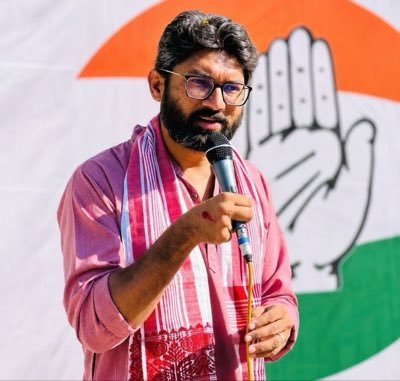
Jignesh Mevani, the Congress MLA representing Vadgam in Gujarat, has come under renewed public scrutiny after a video from a village meeting in Banaskantha district circulated widely on social media, with a participant making allegations concerning bogus voting and a ₹4 lakh payment. The claims were made publicly during a meeting in Tokariya village, where Mevani was present. The allegations have not been independently established, and they remain subject to verification and any appropriate legal or official investigation.
The video reportedly comes from a meeting held on September 28, when Mevani visited Tokariya, a village within his constituency. During the gathering, a man identified in reports as former sarpanch Yakub Sherasiya confronted the MLA and raised questions about money and election-related matters. The exchange was recorded and later circulated online, turning a local meeting into a much wider political controversy.
One of the most serious claims concerned an alleged payment of ₹4 lakh. According to reports on the video, Sherasiya alleged that the money had been handed over to Mevani at the Palanpur Circuit House in connection with obtaining a Congress ticket. He reportedly said he was prepared to swear on the Quran regarding his allegation. These are allegations made by the individual in the video, rather than findings established by an investigating authority.
Jignesh Mevani reportedly responded that if money had been taken, it was from someone associated with the Congress organisation and was a matter between the individuals concerned. He argued that villagers had no connection to the issue. The response has since become another part of the discussion surrounding the viral footage, although the available reports do not establish that the alleged payment occurred.
The meeting also produced another striking allegation. A participant claimed that approximately 250 bogus votes had been arranged in support of Jignesh Mevani during the election. In the video, the speaker reportedly described a conversation in which he was asked how many votes could be secured and then claimed that additional votes were subsequently arranged. Such a statement, however, is an allegation by an individual speaking at the meeting and should not be treated as proof that fraudulent voting actually took place.
The voting allegation has attracted particular attention because questions about electoral integrity have become a prominent part of political debate in India. Congress leaders have repeatedly raised concerns about alleged irregularities and what they describe as “vote chori.” The emergence of a viral video containing an allegation of bogus voting involving a Congress legislator has therefore created an additional political talking point.
Beyond the allegations involving money and voting, residents at the meeting reportedly questioned Jignesh Mevani about development work in the constituency. Some participants complained about roads, basic facilities and the utilisation of development grants. Mevani reportedly responded that his responsibility was to raise issues, while decisions concerning approval and implementation of works rested with the government and administrative authorities.
The episode has also generated a political response outside the meeting. Congress leaders have defended Mevani, with reports saying some party figures argued that grievances should have been discussed privately rather than raised during a public gathering. One such response suggested that the public confrontation appeared intended to damage the MLA’s reputation. These statements represent the political defence of Mevani and do not independently resolve the allegations made in the video.
For Jignesh Mevani, the controversy comes at a time when his political profile extends well beyond Vadgam. The activist-turned-politician has frequently been involved in contentious political debates, and his statements and activities have attracted attention across Gujarat. That background means that footage from a local public meeting can quickly acquire national visibility once it reaches social media.
The immediate question is whether the allegations will lead to any formal inquiry capable of establishing what actually happened. Viral footage can provide a starting point for questions, but it cannot by itself determine whether an offence occurred, whether votes were unlawfully cast or whether money changed hands for a political ticket. Those matters require evidence, corroboration and, where appropriate, investigation by competent authorities.
Until such verification takes place, the claims made during the Tokariya meeting should remain clearly distinguished from established facts. The controversy nevertheless demonstrates how quickly a local political confrontation can become a national story in the social-media era. For voters, political parties and authorities alike, the episode places renewed attention on the importance of transparent electoral processes, accountable public representatives and evidence-based scrutiny of serious allegations.