
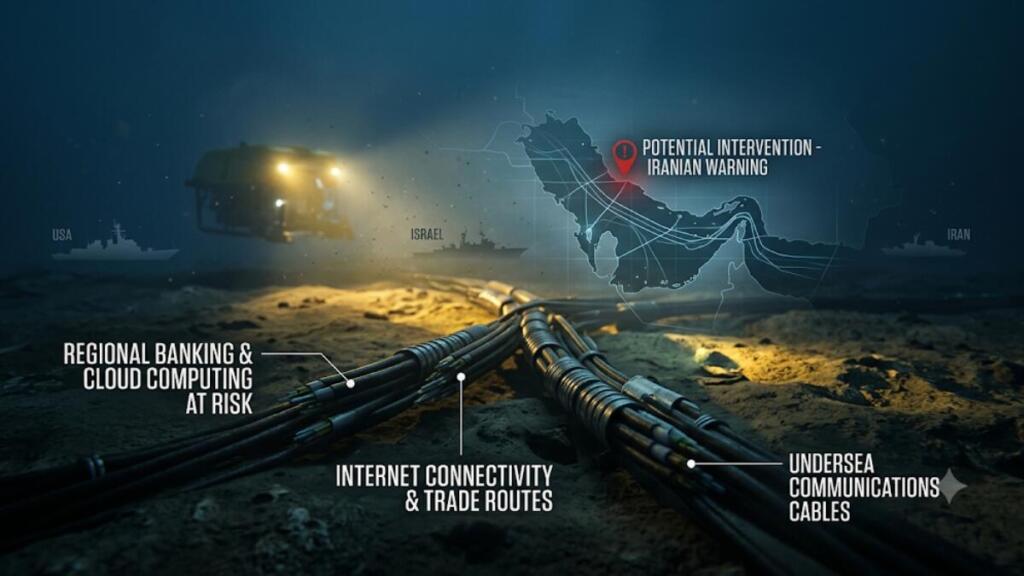
Iran has reportedly prepared plans to target undersea communications cables in the Gulf if the United States and Israel resume military strikes, extending potential targets beyond energy and military infrastructure. The warning raises concerns for regional banking, cloud computing and internet connectivity, although no cable attack has been confirmed.
Two senior Iranian security officials described the plans to Reuters on condition of anonymity without providing operational details. One said Tehran could obstruct repairs to prolong outages, warning that there would be “no more red lines” if Iran were attacked.
Yadollah Javani, deputy head of political affairs for the Islamic Revolutionary Guard Corps (IRGC), said on Wednesday that seven major cables beneath the Strait of Hormuz could be targeted if Iranian infrastructure came under attack. The US president, Donald Trump, separately said on Friday that another military operation against Iran was possible.
Why undersea cables matter
Undersea fibre-optic cables carry data as pulses of light, linking telecommunications providers, banks, cloud platforms and businesses across borders. The International Telecommunication Union (ITU) says these networks transport more than 99 per cent of international data traffic worldwide.
That does not mean 99 per cent of internet traffic passes through Hormuz. Less than one per cent of international bandwidth uses the strait, according to Alan Mauldin, research director at TeleGeography, although disruption there could affect Gulf networks reliant on those routes.
Multiple cable cuts could slow internet connections, delay online payments and disrupt e-commerce and cloud services. Operators could reroute traffic, but the impact would depend on spare capacity and the number of damaged connections.
Repairs during fighting could be difficult because specialized ships need safe access, insurance and permission to enter territorial waters. Any deliberate obstruction could prolong disruption.
Gulf technology investments and India’s exposure
Iranian security official Mohsen Rezaei has warned that US-linked data centres and artificial intelligence (AI) facilities could also be targeted. Iranian strikes in March directly hit two Amazon Web Services facilities in the United Arab Emirates and damaged infrastructure near another in Bahrain, according to Reuters.
During the fighting in March, the IRGC also named American technology companies, including Microsoft, Google, Apple and Nvidia, as potential targets. The warnings highlighted the vulnerability of US-linked digital investments across the Gulf.
Gulf states are investing in technology to diversify beyond oil. Microsoft plans to spend more than $400 million on submarine and land-based connectivity in the region by 2030.
Alex Vatanka of the Middle East Institute said Tehran’s threats appeared designed to encourage Gulf governments and American technology companies to pressure Washington against renewed military action.
The Red Sea is another route linking Europe, East Africa and Asia. TeleGeography estimates it handles three per cent of global international demand and 10 per cent of interregional traffic, but no Iranian plan to attack cables there has been confirmed.
India’s connectivity interests include Asia-Africa-Europe 1 (AAE-1), linking India with Gulf countries and Europe, and Falcon, which connects India with several Gulf states. Prolonged regional disruptions could affect Indian businesses and digital services, although alternative submarine and terrestrial networks could limit the impact.