
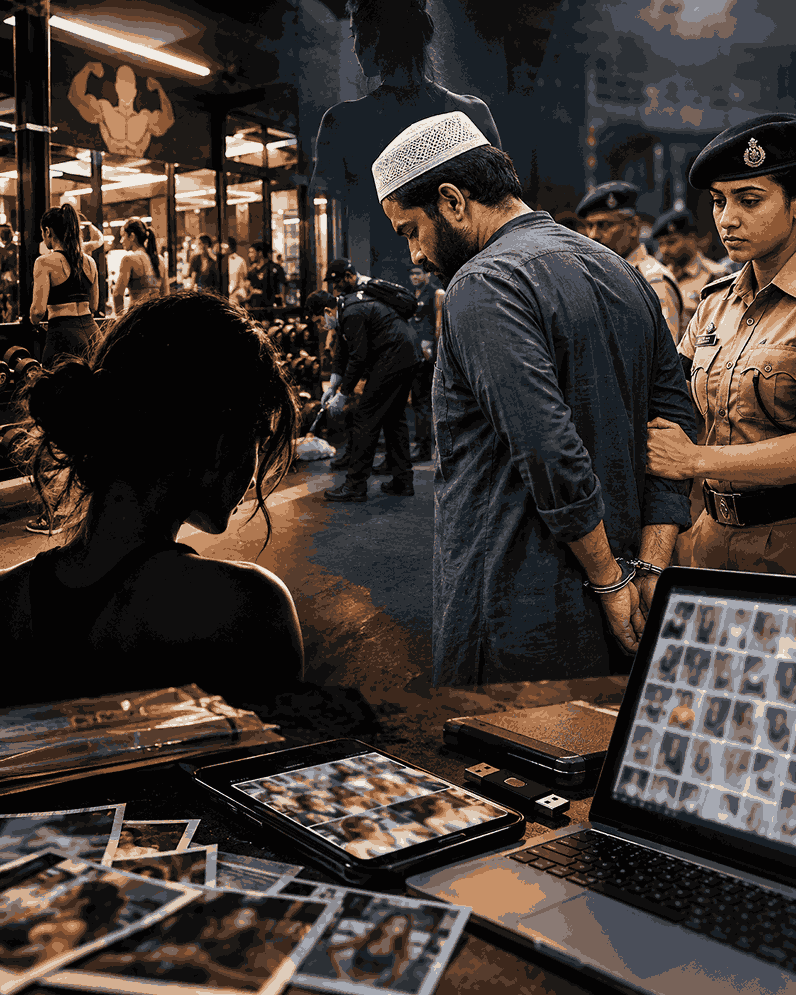
The Gym Jihad controversy has erupted in Gujarat after police arrested a gym owner in Surendranagar following a raid that reportedly uncovered more than 1,300 photographs and videos involving women. The seizure has raised disturbing questions about privacy, surveillance and the alleged misuse of personal images, while investigators work to determine how the material was collected, why it was stored and whether any women were subjected to intimidation, coercion or blackmail.
The case came to light after a woman reportedly approached the Surendranagar police with allegations concerning activities at Club 71, a gym operating in the city. Her complaint prompted senior police officials to take immediate action, with authorities reportedly treating the allegations as sufficiently serious to warrant an undercover operation.
According to reports, a police team led by Surendranagar ASP Vedika Bihani entered the gym in civilian clothing, posing as prospective customers. The operation reportedly took place within hours of the complaint reaching senior officers. What investigators allegedly discovered during the subsequent search turned an individual complaint into a much wider investigation.
Police reportedly seized digital storage devices, including a pen drive, along with documents such as blank cheques and an account diary. The digital material allegedly contained a large collection of photographs and videos involving women. Reports have cited more than 1,300 files, although the precise nature, origin and context of the material remain subjects of investigation.
The Gym Jihad label has subsequently spread across social media and sections of the media, adding a communal dimension to a case that police are still investigating. That distinction matters. The arrest and seizure of electronic material are facts reported in connection with the investigation; allegations concerning motive, coercion, blackmail or an organised pattern of targeting must still be established through evidence and due process.
The most disturbing question is therefore not simply how many files were recovered, but what they represent. Were the women photographed or recorded without their knowledge? Were any images obtained from publicly available sources or personal devices? Did anyone threaten the women? Were photographs or videos circulated to others? And, critically, was the material allegedly being used to exert control over anyone?
Reports surrounding the case have also raised questions about hidden cameras. While allegations initially suggested that women could have been secretly recorded in private areas of the gym, police reportedly did not find a hidden camera during the raid. The seized electronic devices have reportedly been sent for forensic examination, potentially providing investigators with crucial evidence about when and how the files were created.
That forensic investigation could become the turning point in the Gym Jihad case. Digital evidence can reveal metadata, file histories, storage patterns and other information that may help investigators reconstruct what happened. It could establish whether the material was deliberately collected, transferred or circulated—or whether some of the online claims surrounding the case have been exaggerated.
The arrest of the gym operator, identified in reports as Amin Yasin Multani, has nevertheless intensified public scrutiny. If investigators establish that private images were obtained without consent and subsequently used to threaten, manipulate or exploit women, the matter would extend far beyond a conventional dispute involving a fitness centre. It would represent a serious alleged breach of personal privacy and potentially involve multiple criminal offences.
The Gym Jihad debate has also exposed a broader concern that reaches beyond this particular gym: the vulnerability of personal data in an increasingly digital society. People enter gyms expecting a degree of privacy. They change clothes, exercise, interact socially and often share personal information with staff. The possibility that photographs or videos could be secretly collected or improperly stored can fundamentally undermine that trust.
At the same time, the communal framing surrounding the Gym Jihad controversy demands caution. An allegation against an individual cannot automatically be transformed into an accusation against an entire religious community. If criminal conduct is established, accountability should rest with those responsible. The investigation should follow the evidence wherever it leads, regardless of identity or background.
For investigators, the central task now is to separate fact from speculation. The Gym Jihad narrative may generate headlines, but the evidence seized during the raid will ultimately matter more than the label attached to the case. Police must establish the provenance of the photographs and videos, identify whether any victims were recorded without consent, determine whether the material was shared, and establish whether anyone was threatened or financially exploited.
The Gym Jihad controversy has therefore become a test not only of policing but also of responsible public discourse. A large cache of images is undeniably serious, but the public deserves answers grounded in forensic evidence rather than rumours circulating online. If wrongdoing is proved, those responsible should face the strongest punishment permitted under law. If allegations cannot be substantiated, that too must be acknowledged.
For now, the Surendranagar investigation leaves a series of uncomfortable questions hanging over the case. Who took the images? Why were so many allegedly stored together? Were the women aware of their existence? Did anyone attempt to distribute or weaponise them? And was there a deliberate pattern behind the alleged collection?
Those questions—not viral slogans or social-media speculation—will determine the truth behind the Surendranagar case. The police investigation, forensic examination and judicial process must now provide the answers.