
India’s young population is increasingly discussed through the familiar label “Gen Z”, but a recent opinion argues that the phrase may be too narrow to describe the country’s complex social, cultural and civilisational reality. The argument comes at a time when young Indians are highly visible in politics, technology, education, entrepreneurship and social media, making the question of how they are described increasingly significant.
The term Gen Z is widely used as a demographic shorthand for people born broadly between the late 1990s and early 2010s. Such classifications can be useful for studying consumer behaviour, employment preferences and social trends. Yet the OpIndia article questions whether an imported demographic framework can adequately explain the aspirations of young Indians who grow up within very different family structures, traditions and cultural experiences.
The central point is not that young Indians are identical, or that generational categories have no value. Rather, the argument is that Gen Z should not become a substitute for understanding the individual, family and society behind the label. India’s youth are not a single political constituency, cultural bloc or social-media community. Their experiences vary dramatically between cities and villages, economic groups, professions and regions.
This distinction has become particularly relevant as political movements and commentators increasingly present particular protests or online campaigns as expressions of an entire generation. A gathering of young people can certainly demonstrate genuine public anger, but its participants cannot automatically be treated as representatives of millions of others. The same principle applies to social-media trends: visibility online does not necessarily translate into a consensus among the country’s young population.
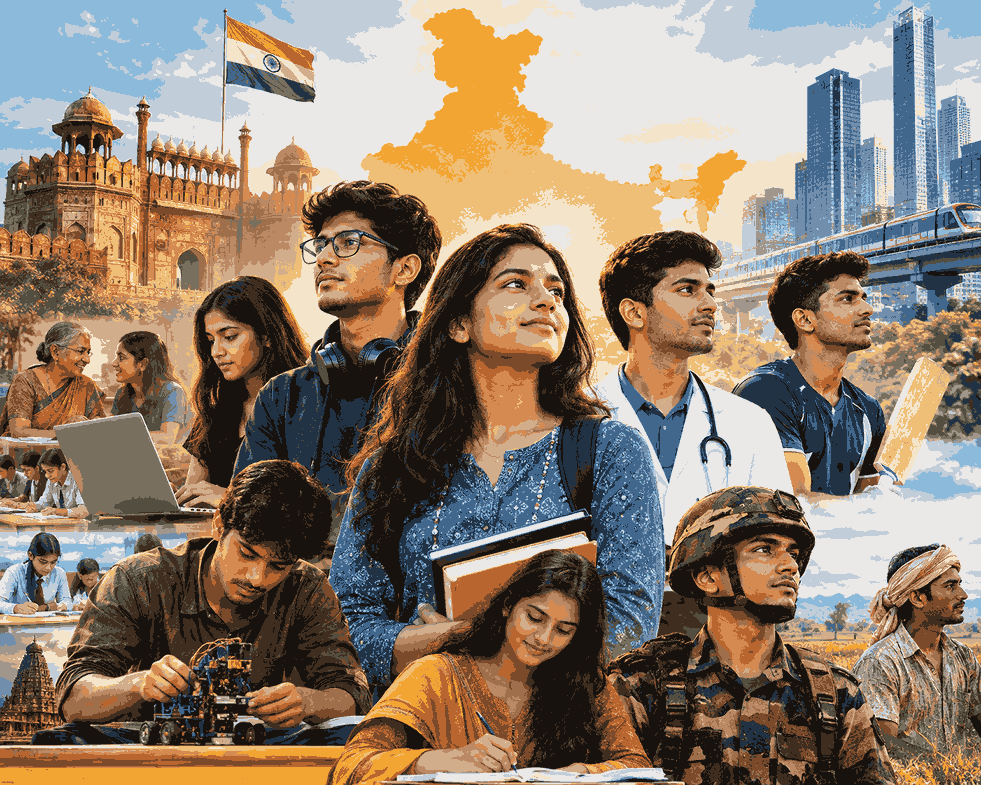
The broader Gen Z debate also overlooks the many young Indians whose lives rarely become national headlines. They include students preparing for competitive examinations, athletes training for international events, entrepreneurs building companies, engineers working on new technologies and researchers pursuing scientific breakthroughs. There are also young people serving in the armed forces, working in hospitals, teaching in schools and supporting their families while quietly building careers.
India’s youth culture also contains a strong intergenerational element. Technology may have changed how young people communicate, work and consume information, but family relationships remain important for millions. Grandparents, parents and children can exchange knowledge in both directions: younger people may introduce older relatives to digital technology, while older generations pass down stories, values, skills and memories. This creates a form of continuity that cannot be fully captured by an age-based label.
The article therefore presents Gen Z as a useful description only when it remains a demographic category rather than becoming a complete cultural identity. It argues that India should examine its younger population through the realities of family, responsibility, ambition, spirituality, education, work and civic life. These dimensions can coexist with modernity rather than being treated as its opposite.
The discussion comes amid wider national attention on young Indians. Recent reporting has shown that the country’s younger population has substantial political and economic significance, while demographic changes are also altering the size and composition of younger age groups. At the same time, political parties and public movements are seeking to connect with younger voters through digital campaigns and youth-focused messaging.
This makes the question of Gen Z more than a semantic dispute. Labels influence how institutions, political organisations, businesses and the media interpret public behaviour. If every youth protest is presented as a generational rebellion, millions of young people who disagree, remain politically inactive or pursue constructive work may disappear from the narrative.
India’s challenge is therefore to understand its youth without reducing them to either stereotypes or romanticised images. Young Indians can be technologically ambitious while remaining connected to family traditions. They can challenge authority while respecting institutions, seek individual freedom while accepting responsibility, and participate in global culture without abandoning local identity.
The most useful description may ultimately be the simplest one: India’s young people are a diverse generation living through rapid change. They should be understood through what they do, what they value and what they hope to build—not merely through the demographic label Gen Z. In a civilisation as diverse and historically layered as India, that distinction matters.