
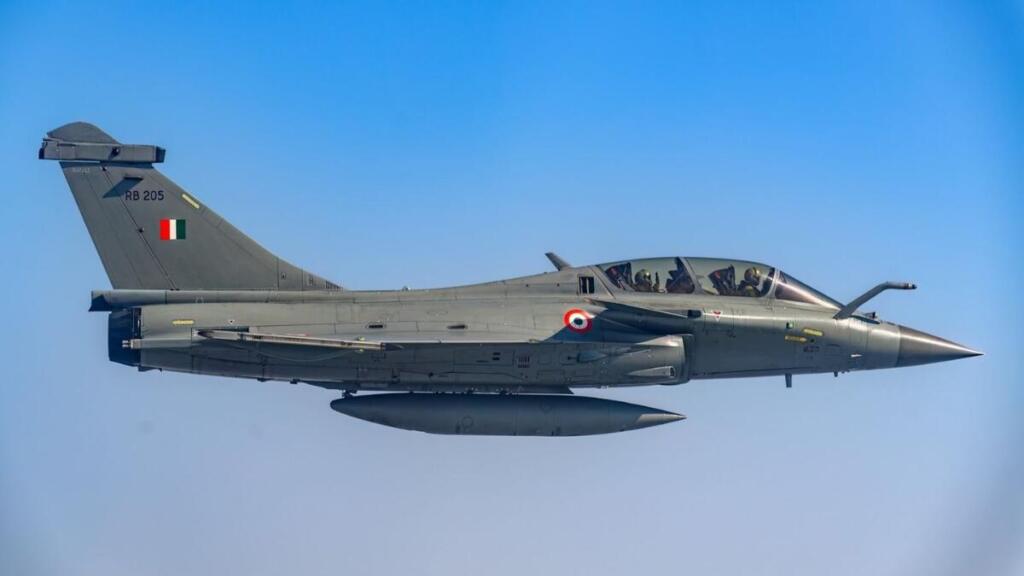
At the edge of the airfield at INS Hansa in Goa, a runway ends in a ramp that points at the sky. It copies the ski-jump on India’s carriers and was built so naval aircraft can learn to fly off a ship while still on land. This week, the Rafale Marine is the jet being put through it.
Defence officials said on Wednesday that the Navy is conducting Rafale Marine trials in Goa to validate the modifications needed to operate the French-origin fighter from INS Vikrant. The trials are also helping the Navy judge whether its carriers need small changes to operate the French-made jet smoothly.
A jet built for a different kind of ship
The core of the problem lies in how the Rafale M was designed. The French jet was built for the Charles de Gaulle, where catapults launch aircraft. India’s carriers work differently, using a ski-jump ramp for take-off and arresting wires for landing.
The system is known as STOBAR, short take-off but arrested recovery. The Goa trials test whether the Rafale M can launch off the ski-jump ramp and land safely using the steel arrestor wires on the deck. A catapult hurls a jet to flying speed. A ramp only points it upward and asks the engines and wings to do the rest. How much fuel and how many weapons the jet can carry off a ramp are questions only flying can answer.
The squeeze on deck
Launch and landing are only part of the story. A carrier is a crowded place, and the Rafale M has a wingspan of about 10.9 metres. The Navy is studying how to park, move and store the jet on its ships. A source said the Navy had this point in mind while negotiating the aircraft deal.
Space has been an issue before. When the jet was first assessed in 2022, one report said the solution for fitting it into the carrier’s elevator was to remove a part of the aircraft’s wings. The modifications now being studied are described as minor. Officials have not said what they are.
The Rafale M has flown here before. In 2022 it went through the same facility in a contest against Boeing’s F/A-18 Super Hornet to become the Navy’s carrier fighter. The Rafale won. This time the jet is already chosen, and the work is about fitting it to the ships rather than competing for them.
The deal behind the trials
India signed the agreement with France on 28 April 2025. It is worth roughly ₹63,000 crore and covers 22 single-seat and 4 twin-seat jets, along with training, simulators, weapons and maintenance support. The four trainers are reportedly land-based versions rather than a new carrier-capable two-seater, meaning they will train pilots ashore and not operate from the ships.
The package also reaches into Indian industry. It provides for a fuselage production facility in India and maintenance, repair and overhaul facilities for engines, sensors and weapons. The jet’s carrier-capable version is common in design with the 36 Rafales the Air Force already flies, which should ease training and logistics.
The original agreement put deliveries between 2028 and 2030. Coverage of this week’s trials puts the first arrivals at the end of 2028 or early 2029.
From the ramp to the ship
Goa is the first of several steps. Defence media report that a French Navy pilot will land a Rafale M on INS Vikrant before the end of 2026 in a First Flight Campaign, followed by a second campaign early next year. Those campaigns are meant to check compatibility with the deck’s arresting gear, ski-jump launches and approach profiles. The Navy has not issued an official schedule.
Indian pilots will not fly the jet until those tests are done. Indian Navy pilots and technical teams are to be trained in France before the aircraft arrive.
The results of the Goa trials have not been made public, and certification for Vikrant depends on them. The jet is a bridge to the future. India’s own twin-engine deck fighter is still years away, with induction projected around 2034. Until then, the Rafale M is meant to fill Vikrant’s hangar, and the ramp at Hansa is where that plan is first put to the test.