
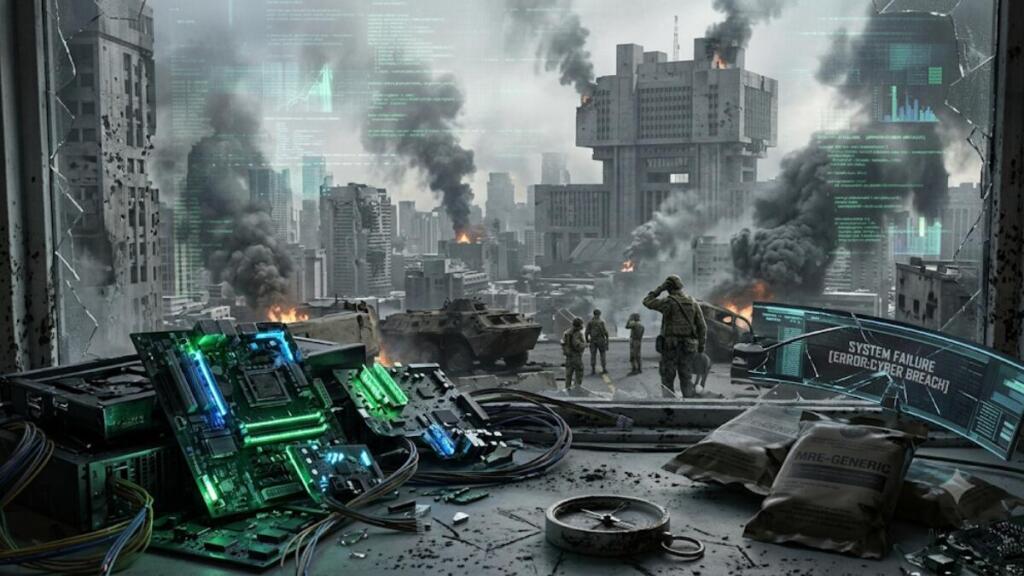
When a government tells families to stock three days of water, when an army rehearses burying 2,400 of its own dead in a day, and when bases are ordered to survive 90 days without the grid, is that housekeeping or a warning?
Britain launched its “Be Ready” campaign on 23 October, and Normandy renewed its own warning on 27 October. Sweden advises a week of supplies, and Norway set the same standard in 2024. Japan’s disaster minister says he will ask every household to keep at least three days of food, water and toilet supplies. The advice lists bottled water, non-perishable food, cash and power banks, the contents of a kit built for a country where cards, ATMs and electricity may stop working.
The British government has said the campaign is not a response to any specific intelligence warning. Its defence secretary, Wes Streeting, put the larger concern this way: adversaries could have the force and war economy to attack by 2030, leaving roughly 1,000 days. If no specific warning exists, why does the language of “ready to fight and win a war” now sit beside advice on tinned food?
Why bury the dead before the war?
On 20 and 21 October at Fort Bragg, soldiers dug and filled trenches for mock remains. The Army said it has not needed to do this on a large scale since the Korean War, and that up to 2,400 soldiers could be temporarily buried in 24 hours. The graves are meant to be temporary, with locations recorded so remains can be identified and returned later.
The Army’s explanation points to a change in assumptions. For more than twenty years in Iraq and Afghanistan, air superiority let remains be flown home quickly, and future conflicts may not offer the same capability. A force that rehearses for losses on this scale is planning for an enemy that can contest the air, and for casualties in the thousands. Which enemy does it have in mind?
What does a base need to survive 90 days alone?
Under the Pentagon’s FORTRESS initiative, major US bases would secure their own electricity, water, fuel and communications. The plan envisions battery banks, microgrids and portable nuclear reactors. The Pentagon’s spokesman said that without electricity you lose communications, water, logistics, assembly lines and basic command structures. The initiative was designed for a major war that could cripple power grids and threaten critical infrastructure on American soil. Who is expected to attack the American grid, and with what?
Isn’t a war already burning?
The US-Iran war began on 28 February 2026. The June memorandum meant to end it collapsed on 8 July after Iran attacked commercial vessels in the Strait of Hormuz. Traffic through the strait now sits at about 3% of pre-war transits. On 30 October, the Revolutionary Guard reported tankers on fire, and limpet mines appeared to be used successfully for the first time since the war began. Houthi missiles are falling on Saudi Arabia.
Diplomacy is racing a date. Qatari mediators are pushing for a deal to restart talks and prevent the resumption of war after the US midterms on 3 November. Senators have reportedly been briefed on a plan to restart the war. President Trump says the war is going to end soon, without saying how. If talks fail, what happens on 4 November?
And what comes after Iran?
German officials say intelligence assessments show Russia is creating the option of a war against NATO by 2029 at the latest. Britain’s 2025 security strategy named Russia its most acute threat and flagged Iranian hostile activity and a persistent challenge from China. Are these dates forecasts, or the working assumptions on which budgets, stockpiles and exercises are now being built? And do those assumptions become self-fulfilling when every capital plans for the same scenario?
Who is attacking the networks?
Cyberattacks run through every one of these questions. In October, hackers triggered defrost cycles in refrigeration units across French supermarkets, and temperatures reportedly reached 50°C. Suspected Iran-linked hackers breached more than 30 water utilities in Minnesota over two days in July. On 29 October, an attacker drained about $6.3 billion from Binance in the largest crypto theft on record, and no one has been publicly blamed. If a future war begins with power, water, payments and food chains failing, are these the rehearsals? Or are they crime, theft and opportunism that happen to resemble a prelude?
What would a real warning look like?
Preparedness advice is public and gradual. Imminence usually looks different: evacuation orders, reservist call-ups, airspace closures, emergency financial measures, and officials naming a specific threat and date. None of these has been reported. Classified intelligence is invisible by definition. How much weight should an ordinary Indian give to what cannot be seen?
The question that remains
Governments are preparing for the possibility that deterrence fails. Whether that possibility is rising, and how fast, is the unresolved matter. A war is already under way in the Gulf, a deadline falls on 3 November, and a longer horizon points to 2029 and 2030. For India, the practical question is closer to home: if Hormuz stays shut and a wider conflict follows, what happens to fuel, food prices and the supply lines the country depends on?
The kit, the trench and the 90-day base all rest on the same unanswered question. Is the world rehearsing for a war it expects to avoid, or one it expects to fight?