
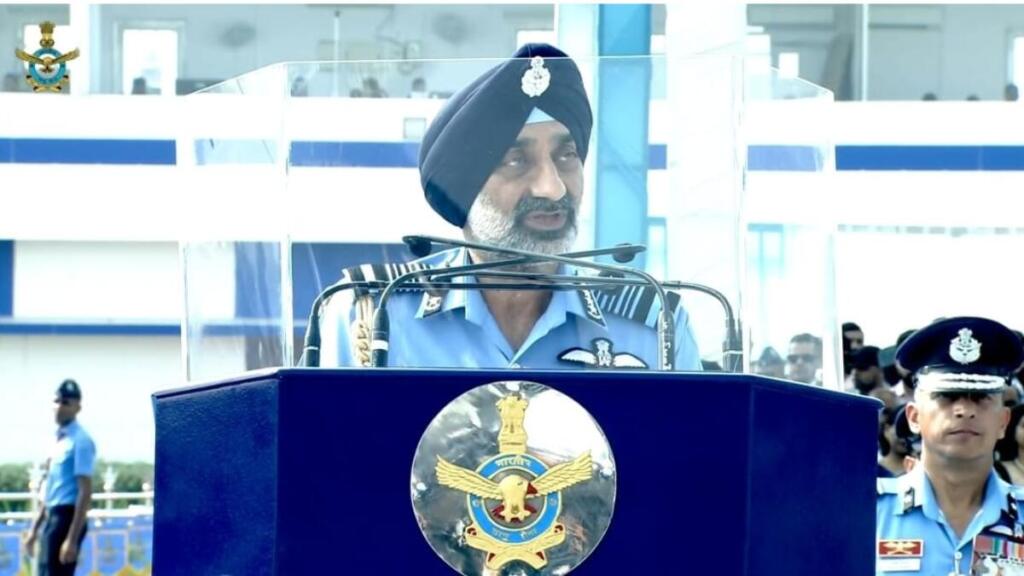
The Indian Air Force turned 94 on Thursday with a ceremonial parade at Hindon Air Base, marking how far the force has come since its founding on October 8, 1932.
The IAF held its parade at Hindon Air Base to mark over nine decades since its inception in 1932. The parade returned to Hindon after a gap of three years, following a full-dress rehearsal on October 6.
The theme this year was “Indian Air Force – Infallible, Impervious and Precise,” reflecting an emphasis on operational readiness, technology, precision and resilience. In his address, Air Chief Marshal A P Singh said the IAF has evolved since 1932 into a network-centric, multi-domain force that is alert and ready for any challenge.
The tarmac display included Rafale and Tejas fighters, and a flypast by three Mi-17 helicopters. The BrahMos missile system and the LCH Prachand combat helicopter were also on show. The Akash air-defence missile and the BrahMos were reported to be in the static line for the first time at such a gathering, and Mi-17s were to carry the National Flag, the IAF flag and the Operation Sindoor flag.
One of the day’s most applauded moments came from the past. A British-era Tiger Moth, a vintage trainer preserved by the IAF and now based at Hindan, drew the loudest cheers.
The full ceremonial aerial display will come later. The flypast marking the 94th anniversary will be held in Varanasi on October 25.
This was Air Chief Marshal Singh’s last Air Force Day as chief, as he retires on October 31. Air Marshal Ashutosh Dixit, who served as Chief of Integrated Defence Staff during Operation Sindoor, is set to take over.
The Journey So Far
1932–1933: Humble beginnings. The Indian Air Force was formally established on October 8, 1932, as an auxiliary arm of the Royal Air Force. Its first flight was raised in April 1933 with a handful of Indian pilots, a few Westland Wapiti biplanes and a small band of airmen.
World War II: Baptism by fire. Indian squadrons flew in the Burma campaign, and the force won the “Royal” prefix in 1945 for its service. It became the Indian Air Force again when India became a republic in 1950.
1947–48: Kashmir. Within months of Independence, the IAF airlifted troops and supplies to Kashmir, in what was among its first major tests as the air arm of a free nation.
1962: A hard lesson. The war with China exposed gaps in the force’s preparedness and became a turning point for modernisation.
1965 and 1971: Wars that shaped its legend. In 1965 the IAF fought alongside the Army on multiple fronts. In 1971 it played a decisive role in the liberation of Bangladesh. The defence of Longewala, where airpower broke up an armoured thrust in the Thar desert, became part of military folklore.
1999: Kargil. In Operation Safed Sagar, IAF pilots struck targets at extreme altitude in the high mountains, with strict limits on crossing the Line of Control.
2019: Balakot. The IAF’s precision strike on a militant camp in Pakistan’s Khyber Pakhtunkhwa, followed by an aerial engagement the next day, marked a new level of strategic signalling.
2025: Operation Sindoor. Air Chief Marshal Singh hailed the force’s combat speed during the operation, and its flag was carried in this year’s aerial display.
From Biplanes to Multi-Domain Power
The force that began with a few biplanes now operates Rafale and Su-30MKI fighters, indigenous Tejas jets, C-17 transports, Apache and Prachand helicopters, and layered air-defence systems. One report puts it among the top three air forces in the world. Beyond combat, it has long been the first responder in floods, earthquakes and cyclones, evacuating civilians and delivering relief.
Its motto, Nabhah Sprisham Deeptam, taken from the Bhagavad Gita, is usually rendered as “touch the sky with glory.”
The challenges are as visible as the achievements. The force is working to rebuild its fighter squadron strength, induct indigenous platforms and keep pace with drones, missiles and networked warfare. On its 94th birthday, with a new chief about to take charge, the IAF carries its history with pride and an eye on the next decade.