
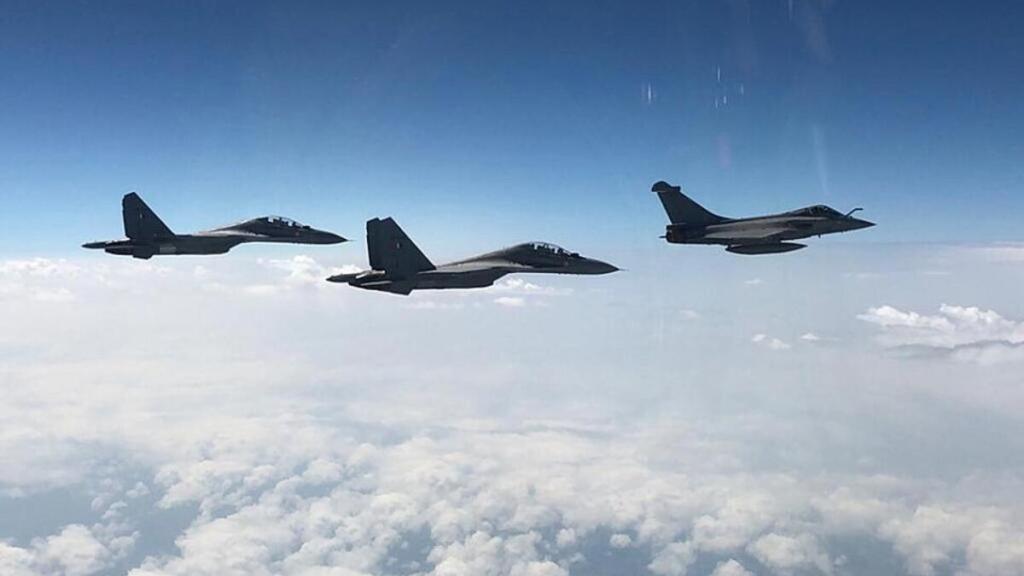
The deal for 114 more Rafale fighters is likely to conclude by the end of the financial year, Defence Secretary Rajesh Kumar Singh has said, according to ANI. Reporting varies on the wording. One account says he should conclude that procurement cycle before the end of this year. It is worth watching whether “concluded” means a signed contract or a government decision.
The announcement raises two questions. The first is what India would actually get and how it changes the Air Force’s squadron numbers. The second is whether the indigenous Tejas programmes still have a future once the Rafales arrive.
What India could get
Singh described the Rafale deal as a buy-and-make programme, with the bulk of the aircraft assembled in India and significant indigenisation and integration of Indian systems and weapons. Dassault Aviation has submitted its commercial bid for building most of the aircraft in India. Only a limited number would arrive fly-away from France. Singh said the programme would create a second fighter production line in the country alongside the Tejas.
On weapons, Singh said the manufacturer had already agreed to integrate Indian weapons on the Rafale Marines India has bought, and that this deal goes one step further. He did not name the specific weapons. Indian sources cited in the same report said access to interface control documents could allow integration without handing over the Rafale’s full mission-system source code.
The programme is widely reported to be worth about Rs 3.25 lakh crore. That figure is an estimate while bids are still being assessed. Earlier reporting mentioned a possible split of 18 aircraft from France and 96 built in India, but the final arrangement is still being negotiated.
What it does to squadron strength
The IAF already operates 36 Rafales under a 2016 government-to-government agreement, and India ordered 26 Rafale Marines for the Navy in April 2025. The Air Force’s combat squadron strength is currently assessed at 29, below the sanctioned level, after retirements including the MiG-21. Other reports put the authorised figure at 42.5 squadrons.
My rough arithmetic, not an official figure: at about 18 aircraft per squadron, 114 jets would equal roughly six squadrons. That would narrow the gap but not close it. Deliveries would take years after a contract is signed, and older types will keep retiring in the meantime.
Does the Tejas still have a future?
The programmes serve different timelines and needs. Singh has said the Rafale line will not displace indigenous programmes. The government is pursuing Rafale procurement, Tejas Mk1A production and Mk2 development at the same time.
The Mk1A is the numbers play. India ordered 83 in 2021 and in September 2025 signed for 97 more, worth Rs 62,370 crore, for about 180 in total. A defence ministry document says deliveries of the 97 will run from September 2027 to September 2033.
HAL has 27 airframes ready and expects to induct at least one squadron by the end of this year. Weapon integration is nearly complete, though radar performance issues are still being addressed. One analysis noted that at 10 to 12 jets a year, delivering 180 Tejas would take 15 years. That is part of why a faster stopgap like the Rafale has appeal.
The Mk2 is the conditional bet. Singh said it is still on, with first flight scheduled for the middle of next year. He added that the prototypes must be delivered and evaluated before any decision follows, so the backing is not unconditional. A separate report on HAL’s chairman describes a more cautious timeline of ground run in March 2027 and first flight in late 2027. Earlier reporting said the Mk2 would eventually replace the Mirage-2000 and MiG-29, which would put it in a different part of the fleet from the Rafale.
The AMCA is the fifth-generation bet. On a foreign fifth-generation stopgap, Singh said no decision has been taken. He said the Advanced Medium Combat Aircraft is where India is putting “all our eggs” for now, and that requests for proposals have gone out to shortlisted vendors.
How the layers might fit through the 2030s
This is my reading of the official statements, not a published plan. The Rafale would be the medium multi-role workhorse, flying with Indian weapons, with the contract targeted this financial year and deliveries coming later. The Tejas Mk1A would be the volume replacement for retired MiG-21s, with its first squadron expected by the end of 2026 and the 97-jet order running to 2033. The Mk2 would be the heavier indigenous multirole fighter replacing older medium types, with first flight targeted for 2027 and evaluation to follow. The AMCA would sit at the top as the indigenous fifth-generation fighter, still at the request-for-proposals stage.
Several things could change this picture. The Rafale bids are still under evaluation, weapons integration is the sticking point, and the price and delivery schedule are not yet public. The Mk2’s future depends on its prototypes performing and on HAL’s delivery record, which has slipped repeatedly. If the Rafale deal closes and the Mk2 slips further, pressure could grow to reconsider it. The question is as much about execution as strategy.