
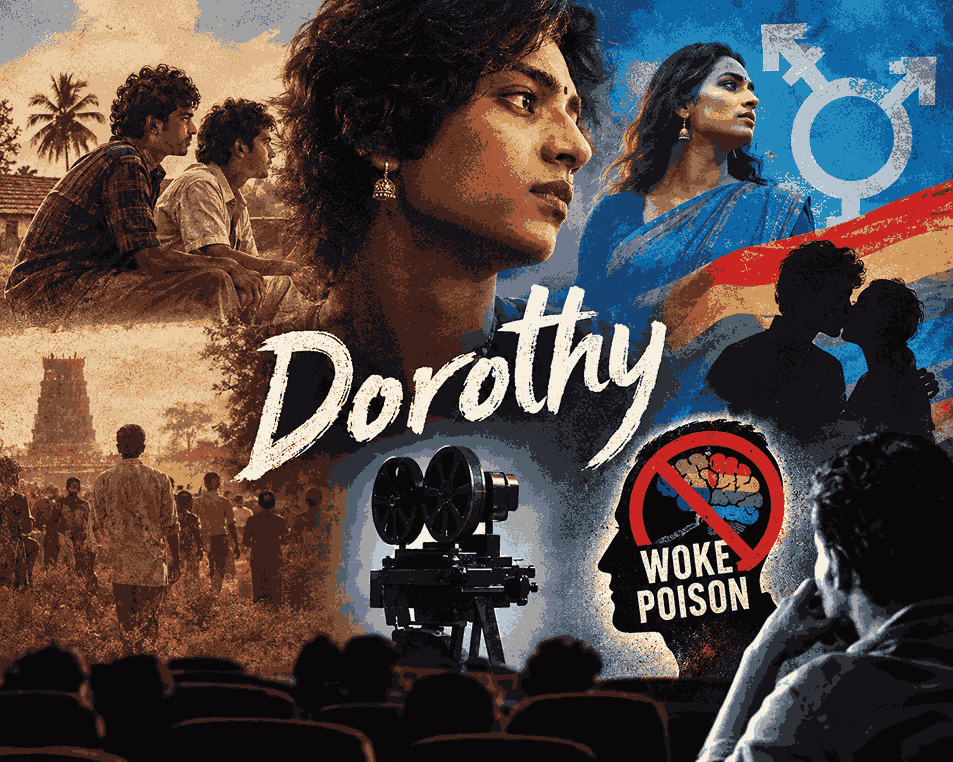
Karthik Subbaraj’s latest Tamil film Dorothy has triggered a sharp debate over the role of gender identity, sexuality and social messaging in contemporary cinema, with critics describing the film as an example of Woke Poison being introduced into mainstream entertainment. The criticism, published by The Commune, argues that the film moves beyond its social themes and adopts what the publication considers an overt ideological position.
Set in rural Tamil Nadu during the 1990s, Dorothy follows childhood friends Karthi and Subbu as they grow up in an environment shaped by caste divisions, violence and rigid ideas of masculinity. According to the review, the narrative initially appears to focus on familiar social tensions before moving into questions surrounding gender identity, same-sex attraction and acceptance.
One of the film’s prominent themes is the treatment of transgender people in a socially conservative setting. A transgender character delivers dialogue questioning why society does not recognise transgender people as human beings and predicts that attitudes towards them could change significantly over time. The film consequently places questions of social acceptance alongside its exploration of masculinity and caste.
The Commune’s review argues that these themes dominate the latter portion of the film and describes the approach as Woke Poison. Its central criticism is that the characters increasingly appear to serve the film’s social message rather than developing independently as elements of a conventional dramatic narrative. The reviewer contends that this weakens the storytelling and makes the film feel more like an argument than a character-driven work.
The article also points to the film’s treatment of same-sex attraction. It notes a romantic moment involving characters Rishikanth and Sananth near the conclusion and interprets the sequence as part of the film’s broader argument for social acceptance. Rather than treating the moment as simply another component of the story, the review regards it as evidence that the filmmakers are attempting to communicate a particular cultural position.
The controversy surrounding Woke Poison therefore reflects a wider disagreement about what audiences expect from socially conscious cinema. Supporters of films addressing gender identity and marginalised communities may view such storytelling as an attempt to bring difficult subjects into mainstream discussion. Critics, meanwhile, can argue that a social message should not overwhelm character development, narrative coherence or artistic ambiguity.
The Commune’s article is particularly critical of director Karthik Subbaraj, whose earlier films, including Pizza and Jigarthanda, established a reputation for distinctive storytelling. The publication argues that Dorothy represents a significant departure because its social and ideological themes are more prominent than the narrative experimentation associated with some of his earlier work.
The review also connects the film’s themes with Subbaraj’s previously reported political and social positions. It references his support for A.G. Perarivalan, his association with activists and his positions concerning protests over projects including Kudankulam and Neduvasal. These references are presented by the publication as part of its explanation for what it sees as the ideological direction of Dorothy. They are the reviewer’s interpretation rather than an independent demonstration that the film was created for political purposes.
At the centre of the criticism is the concept of Woke Poison, which the publication uses to describe what it regards as an excessive emphasis on contemporary identity politics in entertainment. The article argues that cinema can address controversial social questions without turning characters into representatives of predetermined ideological positions.
At the same time, the themes explored by Dorothy are not unusual subjects for contemporary cinema. Questions involving discrimination, gender identity, sexuality, caste and social acceptance have increasingly appeared in films across different Indian-language industries. Whether audiences interpret such material as meaningful social commentary or as excessive messaging ultimately depends on their reading of the screenplay and its execution.
The debate over Woke Poison also raises a broader question about the balance between artistic expression and social commentary. Filmmakers have considerable freedom to explore subjects that may challenge prevailing attitudes, while audiences remain free to question whether those subjects have been incorporated effectively. A film can therefore generate discussion even among viewers who disagree sharply about its message.
For critics of Dorothy, the issue is not simply that the film discusses gender identity or same-sex attraction. Their argument is that these themes allegedly become so central that they overshadow the storytelling itself. The Commune describes this as a case where a message takes precedence over narrative subtlety.
Ultimately, the discussion surrounding Woke Poison illustrates the increasingly contested space occupied by socially themed cinema. Dorothy has become a point of debate not merely because of its plot, but because of the questions it raises about representation, ideology and the responsibilities of filmmakers. Whether the film succeeds artistically or politically will remain a matter of individual interpretation, but its themes have clearly ensured that the conversation surrounding it extends beyond the screen.