
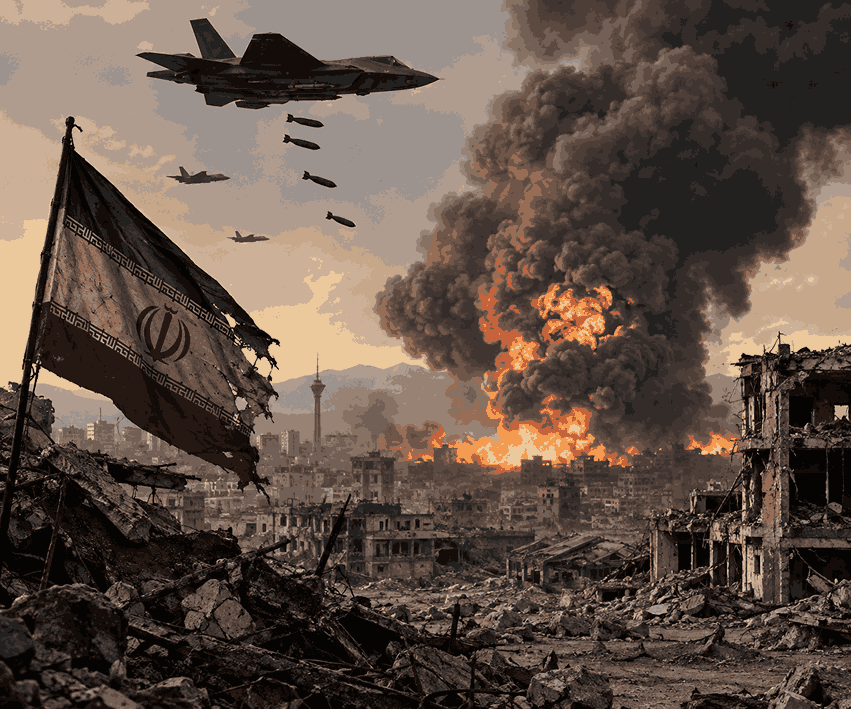
The latest US War Crime controversy has intensified after a United Nations-backed fact-finding mission said there were reasonable grounds to believe that American forces committed war crimes in two strikes in Iran, including an attack on a primary school in Minab that killed more than 150 people, many of them children. The findings were published on September 17 and are due to be presented to the UN Human Rights Council in Geneva.
The investigation examined two February 28 attacks. The first involved the Shajareh Tayyebeh Primary School in Minab, southern Iran. According to the mission, more than 150 people were killed, including approximately 120 schoolchildren. Iranian state media have reported a higher figure of 168 deaths. The investigators said they found no evidence that the school was being used for military purposes when it was struck.
The findings are significant because the investigators did not describe the incident simply as an accidental civilian casualty. They said the school was a clearly identifiable civilian building and concluded that US forces had failed to properly update targeting information and verify whether the building remained a military objective before launching the attack. The mission said the circumstances went beyond ordinary negligence and amounted to an indiscriminate attack under international humanitarian law.
The US War Crime finding concerns the legal characterization reached by the independent investigators, rather than a final judgment by a court. UN fact-finding missions investigate alleged violations and document evidence, but they do not themselves impose criminal penalties. Their conclusions can nevertheless become relevant to subsequent investigations or accountability proceedings before national or international judicial bodies.
The second case involved a strike on a sports complex and surrounding residential areas in Lamerd, also on February 28. The UN mission said precision missiles containing tungsten pellets struck a clearly identifiable sports facility and residential area. According to the investigators, 22 civilian men and women were killed or injured, while nearby houses and a school were also damaged. The mission similarly concluded that the attack was indiscriminate.
The US War Crime allegations come amid disagreement over responsibility for the individual attacks. US Central Command has previously denied that American forces carried out the Lamerd strike. In the Minab case, President Donald Trump said in June that nobody had intentionally attacked the school. Earlier reporting on an internal US military assessment indicated that American forces were likely responsible, but the Pentagon has not publicly released its investigation findings.
The White House has rejected the UN-backed conclusions. Spokesperson Anna Kelly criticized the Human Rights Council and argued that Iran was responsible for war crimes in the conflict. The US State Department also questioned the credibility of the findings, pointing to the administration’s withdrawal from the Human Rights Council. US officials have separately maintained that American military operations are conducted in accordance with the law of armed conflict.
The US War Crime findings were not the only major conclusions in the UN report. The investigators also accused Iranian authorities of widespread and systematic abuses against civilians during anti-government protests that began in late 2025. Their report cited unlawful killings, torture, arbitrary detention, enforced disappearances and restrictions on freedom of expression. The mission said some of these actions amounted to crimes against humanity.
The report therefore presents a broader picture of civilians caught between military conflict and domestic repression. Iranian authorities have rejected allegations of systematic abuses and have blamed violence on what they describe as foreign-backed terrorists and rioters. The UN mission said its investigation faced obstacles, including limited cooperation from governments and difficulties independently verifying casualty figures.
The US War Crime controversy is consequently likely to remain part of the international debate over accountability in the Iran conflict. The mission has called for alleged violations by all sides to be independently investigated and for those responsible to be held accountable. It has also urged governments to provide reparations to victims and take measures to prevent similar incidents.
For families who lost children at the Minab school, however, the legal terminology is only one part of the story. The destruction of a school and the deaths of civilians have left questions about targeting decisions, intelligence failures and responsibility. The UN investigation has attempted to reconstruct those events using interviews, satellite imagery, photographs, videos and other material.
The US War Crime allegations will now move into a wider diplomatic and legal discussion when the report is presented to the 47-member Human Rights Council. The investigators’ conclusion is not itself a criminal conviction, but it adds an important body of documented evidence to continuing international scrutiny of the conflict.
As governments debate the findings, the central issue remains civilian protection. Whether responsibility is ultimately established through further investigations or judicial proceedings, the UN report has placed renewed attention on the obligations of military forces to distinguish civilian objects from legitimate military targets and to take effective precautions to protect civilians during armed conflict.
For the international community, the US War Crime findings underline the continuing challenge of enforcing humanitarian law during war, particularly when competing governments dispute responsibility and investigations remain incomplete.