
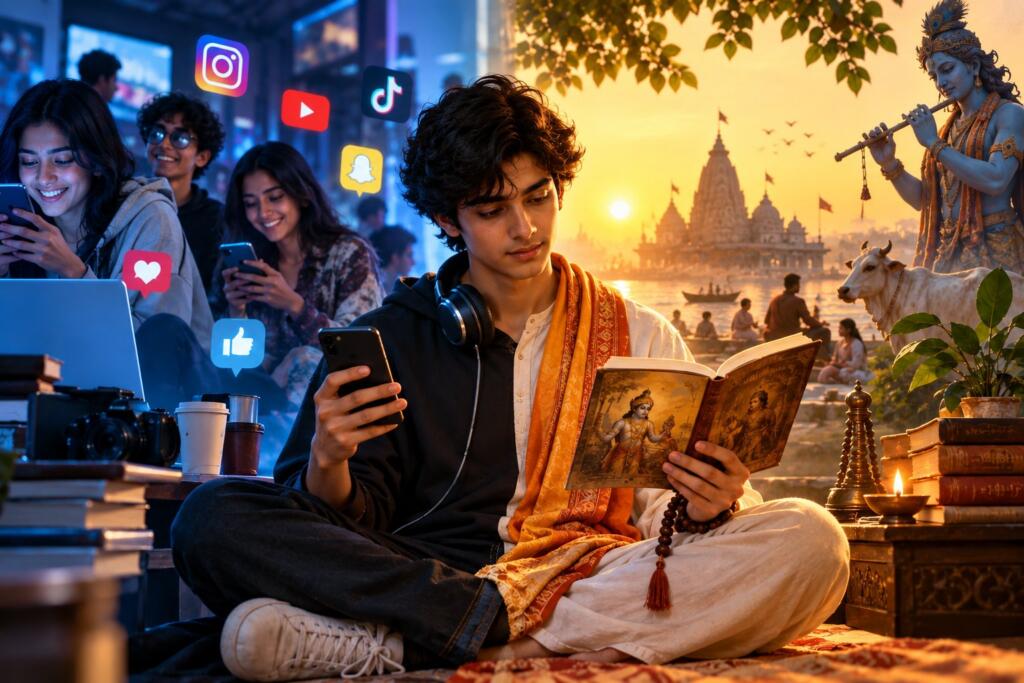
Generation Z, born between 1997 and 2012, is the first generation to grow up completely in the digital age. Generation X saw the birth of the internet and social media. Millennials witnessed its rapid growth. But for Gen Z, smartphones, social media, artificial intelligence and the internet have always existed. They have never known a world without them.
They are digital natives. They learn from YouTube, AI tools and online courses. They have a digital–avtar of their own. They connect with friends across the world through social media. They are creative, entrepreneurial and comfortable with technology. They care about climate change, mental health, equality and social justice. At the same time, they also face serious challenges. Information overload, social media addiction, loneliness, anxiety and constant online comparison have become part of modern life. Many young people are searching for peace, purpose and emotional balance.
This search is creating an interesting trend in India. A growing number of young people are reconnecting with Sanatan Dharma. But they are doing it differently from their parents and grandparents. They are not simply following traditions because they are told to. They want to understand them. They ask questions. They seek meaning. Their methods are new, but their destination is the same.
Earlier generations experienced spirituality mainly through temples, family rituals, festivals and community gatherings. Gen Z is discovering spirituality through podcasts, YouTube videos, Instagram reels, meditation apps, online Gita classes and digital communities. A one-minute explanation of a Bhagavad Gita verse on Instagram may inspire them to read the entire chapter. A devotional short on youtube song is viewed and liked by millions.
Many members of Gen Z say they are more spiritual than religious. They are less interested in rituals performed without understanding. They are more interested in practices that improve their lives. Yoga, meditation, chanting, mindfulness, reading the Bhagavad Gita and visiting sacred places help them find peace and clarity. For them, spirituality is not just about going to a temple. It is about becoming calmer, kinder and more aware.
This is where Sanatan Dharma naturally connects with Gen Z. Sanatan Dharma has never insisted that everyone must follow the same path. It offers many ways to reach the same goal. The methods are different, but the aim is the same – to discover inner peace and live a meaningful life.
What attracts many young people is not only the rituals but also the values. Sanatan Dharma teaches responsibility, truthfulness, compassion, selfless service, self-discipline, gratitude and respect for nature. These values match many of the concerns of today’s youth. A generation that worries about climate change easily connects with the idea that nature is sacred. A generation concerned about mental health appreciates the value of meditation. A generation searching for meaningful work understands the idea of Karma Yoga.
Ancient Wisdom, Digital Generation
Technology has become a bridge rather than a barrier. Smartphones are now carrying ancient wisdom. Spiritual teachers explain the Upanishads and the Bhagavad Gita in simple language on YouTube. Instagram is filled with short videos explaining Sanskrit shlokas. AI helps students understand difficult concepts. Ancient knowledge is reaching millions of young people through modern technology.
Music is also becoming a powerful gateway to spirituality. Young people are attending Bhajan Sandhyas, devotional concerts and even modern Bhajan Night Clubs, where bhajans are presented with contemporary music while preserving their devotional spirit. Spiritual singers such as Kailash Kher have made devotional music popular among young audiences by blending traditional themes with modern musical styles. Instagram, Spotify and YouTube are full of devotional songs, kirtans and bhajans that are now part of many young people’s daily playlists. For Gen Z, devotion can begin with a song shared on social media.
The growing interest in spirituality is supported by surveys. A YouGov–Mint survey found that 53% of India’s Generation Z considers religion important and 62% pray regularly. An MTV Youth Study reported that 62% believe spirituality helps them gain clarity, while nearly 70% feel more confident after prayer. Another survey found that around 80% of Indians between 18 and 30 engage with spiritual or religious content online. These figures suggest that many young Indians are exploring spirituality in ways that fit their modern lifestyle.
Mental health is another reason for this shift. Academic pressure, career uncertainty and constant digital engagement have increased stress among young people. Yoga, meditation, breathing exercises, chanting and mindfulness are becoming practical tools for managing anxiety. Many young people describe spirituality as a source of healing, grounding and emotional strength rather than merely a religious practice.
Community life is also changing. Across cities, Bhajan Clubs are becoming popular among young people. These are not just places for singing devotional songs. They are spaces where people meet, make friends, discuss values, meditate and participate in community service. Young people join because they enjoy the atmosphere of positivity, music and belonging. Devotion is becoming a shared experience rather than a formal obligation.
Pilgrimages are also attracting a new generation. Young Indians are travelling to Kedarnath, Kashi, Mahakaleshwar, Ayodhya, Rameswaram and the Kumbh Mela, often documenting their journeys on social media. Many attend yoga camps, meditation retreats and spiritual festivals. Others are choosing traditional wedding ceremonies with Vedic rituals because they want to reconnect with their cultural roots. These choices show that tradition is not disappearing. It is being rediscovered in a modern context.
Sanatan Dharma has survived for thousands of years because it has always adapted to changing times while preserving its core values. Every generation has understood it in its own way. Generation Z is doing the same. They are not rejecting modern technology. They are using technology to deepen their understanding of ancient wisdom. They are combining smartphones with scriptures, artificial intelligence with philosophy and social media with spirituality.
The emerging Sanatani Gen Z is therefore not defined simply by religious identity. It is defined by values. It is a generation that wants success with peace, technology with wisdom, freedom with responsibility and progress with purpose. They believe that life is not only about earning more but also about becoming better human beings.
Generations change. Technology changes. Methods change. But the human search for truth, happiness, peace and self-realization never changes. That is why Sanatan Dharma continues to remain relevant—even in the age of artificial intelligence. This fusion has given rise to a generation known as Sanatani-Gen Z.
Rajiv Tuli is the Chairman of Suruchi Prakashan, known for publishing works on Indian culture, history, and national thought. He is actively involved in public discourse and the promotion of Indian civilisational and cultural ideas. Follow him on X: @RajivTuli