
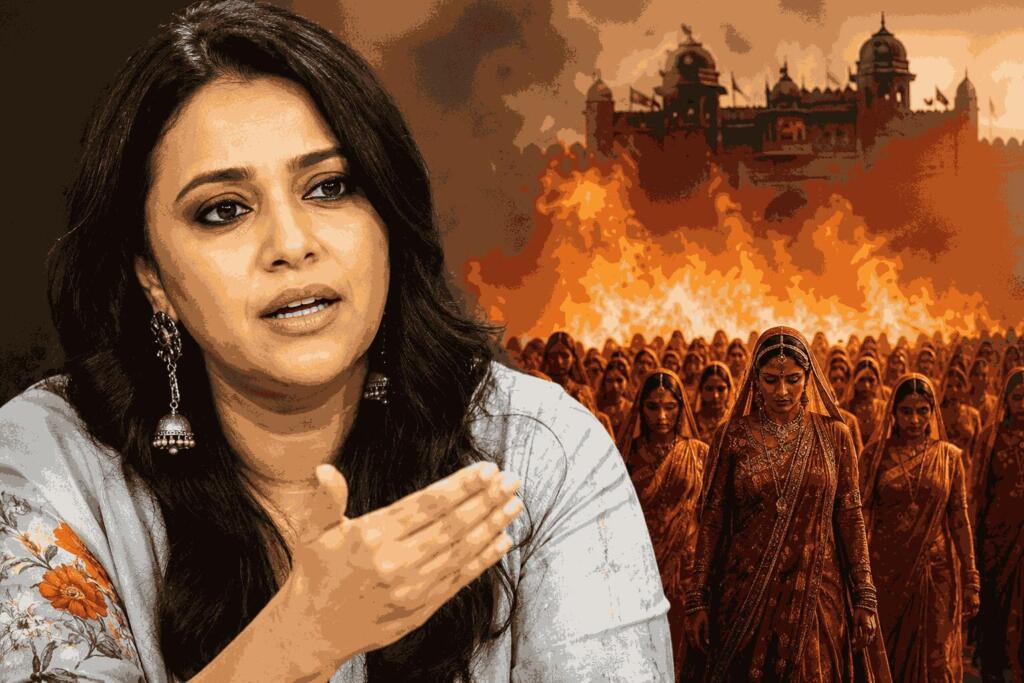
Actor Swara Bhaskar has reignited the controversy surrounding Sanjay Leela Bhansali’s Padmavat, questioning the film’s depiction of Jauhar and arguing that portraying death as preferable to sexual assault can send a deeply troubling message about women and survivors of rape. Speaking at an event at Delhi’s India International Centre on August 31, Bhaskar revisited the concerns she had raised in an open letter to Bhansali following the film’s release in 2018.
At the centre of her criticism is Padmavat’s climactic Jauhar sequence, in which Rani Padmavati and a large number of Rajput women enter a massive fire following the defeat of Chittor. The scene was presented as a dramatic culmination of the film’s narrative and has long been defended by some viewers as a depiction of resistance in the face of captivity and sexual violence.
Bhaskar, however, sees the sequence differently. Swara Bhaskar has argued that the imagery raises a fundamental question about what society tells women after sexual violence: are they expected to regard death as preferable to survival? For her, the problem lies not merely in depicting a historical practice, but in how such imagery can be received by contemporary audiences, including women who have themselves experienced sexual assault.
Her criticism becomes particularly pointed when she discusses the presence of a pregnant woman in the Jauhar sequence. Swara Bhaskar recalled being disturbed by the implication that women, including those carrying unborn children, were entering the flames rather than risking capture. She questioned the moral framework in which the possibility of rape could become sufficient justification for ending a woman’s life and that of her unborn child.
The controversy surrounding her remarks is inseparable from the larger debate over Jauhar. Historically, Jauhar has been described in accounts of medieval warfare as a collective act undertaken by women during sieges, particularly when defeat raised the prospect of captivity, enslavement or sexual violence. At the same time, critics argue that interpreting Jauhar solely through the language of honour can obscure the brutal social pressures placed on women and the absence of meaningful choices available to them.
Swara Bhaskar’s intervention challenges the tendency to romanticise such episodes without examining the human cost behind them. The question is particularly relevant in an era when conversations around rape increasingly focus on survivor dignity, psychological trauma and the right to rebuild one’s life after sexual violence. From that perspective, Bhaskar’s objection is less about denying the historical existence of Jauhar and more about challenging the values that modern audiences might infer from its cinematic glorification.
Yet Padmavat itself occupies complicated territory. The film is not a conventional historical record. It draws substantially from Malik Muhammad Jayasi’s sixteenth-century epic poem Padmavat, blending literary imagination, folklore and historical personalities. Consequently, the cinematic portrayal cannot automatically be treated as a definitive account of what happened during the siege of Chittor.
That distinction has not prevented the film from becoming one of the most contentious cultural productions in recent Indian cinema. Even before its release, Padmavat faced intense political and social opposition over concerns about its portrayal of Rajput history and the character of Rani Padmavati. The controversy ultimately transformed the film into a national debate over artistic freedom, historical memory and cultural representation.
Swara Bhaskar’s latest remarks reopen a different front in that debate. Instead of asking only whether the film accurately portrays medieval history, she is asking what happens when an act associated with extreme historical circumstances is presented through the visual language of heroic sacrifice. Does the portrayal preserve the memory of women confronting a terrifying fate, or does it reinforce the idea that a woman’s honour is inseparable from her sexual purity?
That question is uncomfortable precisely because it challenges two competing interpretations. To some, Jauhar represents extraordinary courage under catastrophic circumstances. To others, it represents a society in which women were made responsible for protecting collective honour with their own lives. The cinematic representation of such an episode inevitably forces modern viewers to confront both interpretations.
Swara Bhaskar’s comments are unlikely to settle the argument. They may, however, ensure that the conversation moves beyond whether Jauhar looked spectacular on screen and towards the harder question of what that spectacle actually means. Historical cinema does not exist in a vacuum. The stories filmmakers choose to glorify, condemn or dramatise can influence how later generations understand violence, honour and agency.
Ultimately, the renewed debate over Padmavat is not simply about one controversial film or one actor’s criticism. It is about whether historical suffering should be remembered primarily as heroic legend or examined through the experiences of those who bore its consequences. Swara Bhaskar has chosen the latter lens—and nearly a decade after the film’s controversy erupted, that argument remains as divisive as ever.