
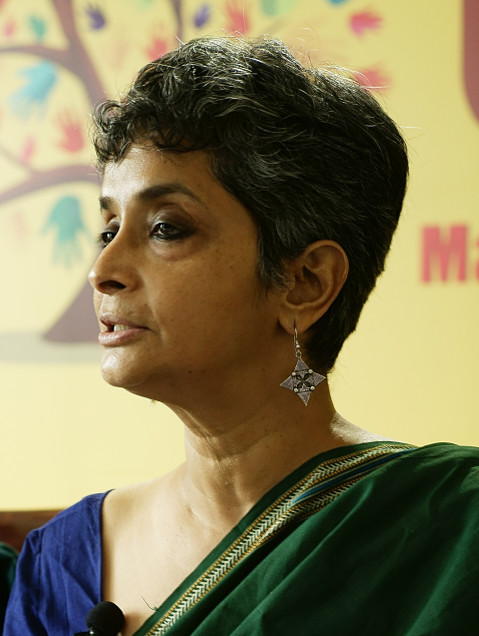
Former Jawaharlal Nehru University professor Nivedita Menon has become the centre of a fresh controversy in Rajasthan after a group of civil society organisations in Udaipur demanded cancellation of her proposed Rama Mehta Memorial Lecture, citing her past comments on Kashmir, nationalism, religion and Indian institutions. The groups held a press conference on September 19 and questioned the decision to invite her to speak at the Vidya Bhavan Auditorium.
Menon, who retired from JNU in November 2025, has spent decades teaching political science and international studies. Before joining JNU, she taught at Lady Shri Ram College and Delhi University. Her academic work has focused on feminism, gender, politics and nationalism, but several of her public interventions have generated intense political debate.
The Udaipur controversy centres partly on remarks attributed to Menon during the political debates surrounding Kashmir in 2016. During a lecture at JNU, she was reported as saying that India was “illegally occupying Kashmir” and that Kashmir and Manipur had been illegally occupied by the Indian state. An ABVP student leader subsequently filed a police complaint. Menon disputed aspects of the wording attributed to her and maintained that the lecture was an academic discussion concerning nationalism and Kashmir. No conviction resulted from the complaint.
Another episode cited by the protesters dates to 2017, when Menon was invited to speak at Jai Narain Vyas University in Jodhpur. The university subsequently filed a police complaint over allegations concerning her remarks on Kashmir, Indian soldiers, the national flag and the national anthem. University authorities and Menon offered sharply different accounts of what happened. Menon rejected the allegations as baseless and argued that the controversy had been manufactured against her. The incident was accompanied by protests and disruption on the campus.
The current dispute has also been fuelled by comments from a recently surfaced interview in which Nivedita Menon discussed the political situation in India, the Muslim community, protest movements and the broader political climate of the past decade. During the conversation, she used the Hindi phrase “is manhoos desh”, translated in reports as “this cursed country” or “this accursed country”, while discussing the experience of Muslims in India. The remark subsequently circulated widely online and attracted criticism.
The protesters have also referred to Nivedita Menon’s views on the Uniform Civil Code. In a 2016 article published by The Hindu, she argued that the UCC debate was connected to a Hindu-nationalist project and described the proposed legislation as “a stick to beat Muslims with”. Her argument was part of a wider debate over personal law, gender justice and the constitutional question of a common civil code. Supporters and critics of her position have interpreted that intervention very differently.
The Udaipur groups say their objection is based on what they consider a pattern of controversial public statements rather than opposition to academic discussion itself. According to reports, Dr Parmveer Singh Dulawat, representing the group, questioned why the Rama Mehta Trust had selected Menon as the speaker and asked the organisers to reconsider the invitation. The group also pointed to overlapping associations among some trustees of the Rama Mehta Trust, Vidya Bhavan Society and Seva Mandir.
At the same time, the controversy has raised questions about the boundaries between public protest and academic freedom. Nivedita Menon has previously faced disruption at public lectures. In March 2024, a lecture at Gangadhar Meher University in Odisha was interrupted by protesters who reportedly shouted slogans demanding that she leave. The event was subsequently called off, while the JNU Teachers’ Association criticised the disruption and expressed concern about intimidation of scholars because of their views.
The Udaipur episode therefore brings together several long-running debates in Indian public life: Kashmir, freedom of expression, academic independence, nationalism and the right to protest against controversial speakers. The organisers of the proposed lecture have not been reported as having announced a cancellation in the available accounts, while the protesting groups have indicated that opposition could intensify if the programme proceeds.
For Nivedita Menon, the controversy represents another confrontation between her strongly expressed political views and critics who believe those views cross lines concerning national identity and sovereignty. Her supporters, meanwhile, have historically defended her right to express dissenting opinions and participate in academic debate.
The dispute ultimately places the organisers in a difficult public position. Inviting a speaker with a record of controversial interventions can generate debate and scrutiny, while cancelling an event because of opposition can itself raise questions about whether public pressure is determining who gets a platform. As the Udaipur controversy develops, the central questions will remain whether the lecture proceeds, whether the organisers respond formally to the cancellation demand, and how the competing claims over free expression and public accountability are addressed.