
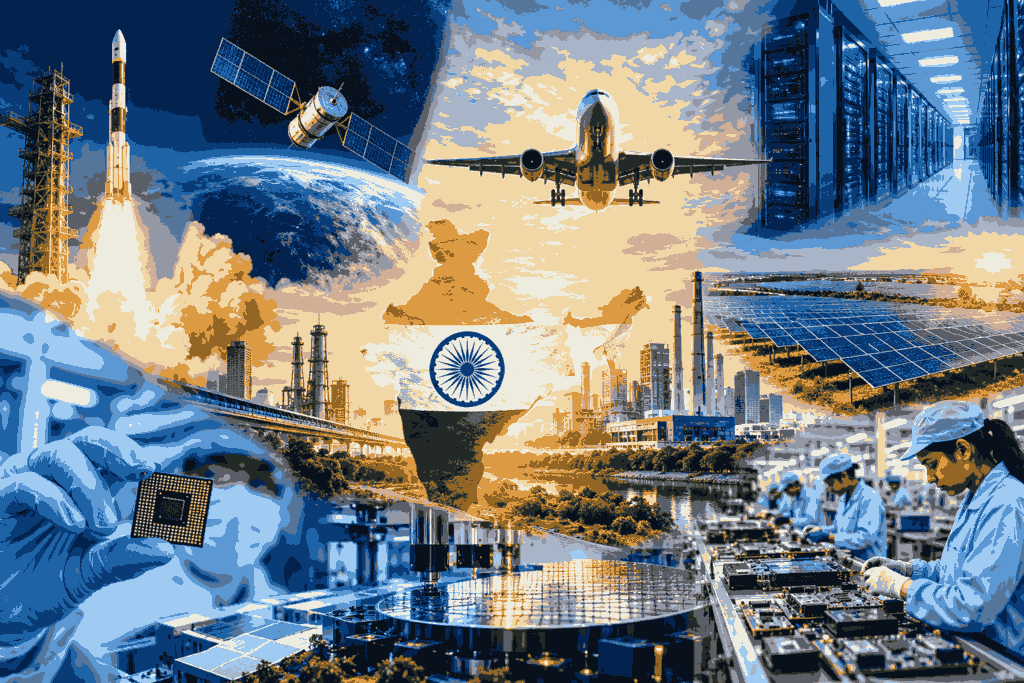
India is standing at the threshold of a potentially transformative economic era, with global investment bank Jefferies identifying six high-growth sectors that could define the country’s next phase of industrial expansion. Described as India’s New Industrial Revolution, the emerging growth story is expected to be driven by space, aerospace, data centres, solar energy, semiconductors and electronics manufacturing.
For decades, India’s economic rise has largely been associated with information technology, services and a rapidly expanding consumer market. But the next chapter could look dramatically different. The focus is increasingly shifting towards advanced manufacturing, strategic technologies, energy security and industrial self-reliance.
Jefferies believes that India possesses several important advantages that could help these sectors grow at an unprecedented pace. A massive domestic market, rising private-sector participation, government support and growing global interest in diversifying supply chains have created conditions that could accelerate the New Industrial Revolution.
The space sector is among the most exciting areas of this transformation. India has already demonstrated its technological capabilities through successful satellite launches and ambitious space missions. The opening up of the sector to greater private participation could create fresh opportunities for startups, manufacturers and technology companies. From satellite production to launch services and space-based communications, the commercial potential of India’s space economy is expanding rapidly.
Aerospace is another sector expected to gain momentum as India seeks to strengthen domestic manufacturing capabilities while reducing dependence on imports. The country’s growing defence requirements, expanding aviation market and increasing emphasis on indigenous technology are creating a strong foundation for long-term investment. The New Industrial Revolution could see aerospace emerge not merely as a strategic sector but also as a major source of manufacturing jobs and technological innovation.
Data centres represent another major pillar of India’s industrial future. As digital services, cloud computing, artificial intelligence and online platforms continue to expand, the demand for massive computing infrastructure is growing rapidly. India’s enormous population and fast-growing digital economy make it an attractive destination for global and domestic investment in data infrastructure. New data centres also create opportunities across construction, power generation, cooling technologies and telecommunications.
Solar energy has been identified as another critical driver of the New Industrial Revolution. India faces the dual challenge of meeting rising energy demand while reducing its dependence on conventional fuels and imported energy resources. Solar power offers an opportunity to address both concerns. With strong government backing and falling technology costs, India is expanding its renewable energy capacity at a remarkable pace.
However, the larger opportunity lies beyond simply installing solar panels. Domestic manufacturing of solar modules, cells and related equipment could help India build a more complete renewable energy ecosystem. This could create industrial capacity while strengthening the country’s position in the global clean-energy supply chain.
Perhaps no sector better represents India’s technological ambitions than semiconductors. Chips are now essential to everything from smartphones and automobiles to defence systems and artificial intelligence. The global semiconductor shortage in recent years exposed the risks associated with dependence on a limited number of manufacturing hubs. India is now attempting to establish itself as an important player in this strategically crucial industry.
Building a semiconductor ecosystem will require enormous investment, advanced technology and highly skilled manpower. Yet the potential rewards are equally significant. Success in this field could make semiconductors one of the defining achievements of the New Industrial Revolution, while reducing India’s vulnerability to global supply disruptions.
Electronics manufacturing completes Jefferies’ list of six sectors expected to drive India’s industrial growth. India has already made significant progress in mobile phone manufacturing, but the next challenge will be moving deeper into the value chain. Assembly alone cannot deliver the full economic benefits of manufacturing. The real transformation will come from producing components, circuit boards and other high-value technologies within the country.
This transition could fundamentally reshape India’s manufacturing landscape. Greater backward integration would strengthen domestic supply chains and encourage companies to invest in research, design and advanced production facilities. The New Industrial Revolution is therefore not simply about producing more goods; it is about producing more sophisticated goods and capturing a larger share of global value chains.
The convergence of these six sectors could also have a wider impact on employment and investment. Space technology requires engineers and scientists, semiconductor plants need specialised technicians, solar manufacturing demands industrial workers, while data centres require advanced infrastructure and energy networks. Together, these industries could create an interconnected ecosystem of skills and opportunities.
India’s journey, however, will not be without challenges. Advanced manufacturing requires reliable infrastructure, skilled workers, access to capital and consistent policy support. Global competition remains intense, particularly in sectors dominated by established industrial powers. Execution will ultimately determine whether the promise of the New Industrial Revolution translates into lasting economic success.
Yet the opportunity before India is undeniable. As global supply chains are reshaped and technology becomes increasingly central to economic power, India has a rare chance to build industries that could influence its growth for decades. If the momentum continues, the six sectors identified by Jefferies may not only drive investment and innovation but could also mark the beginning of a profound transformation in India’s economic identity.
The New Industrial Revolution could ultimately determine whether India moves from being one of the world’s largest markets to becoming one of its most powerful industrial and technological centres.