
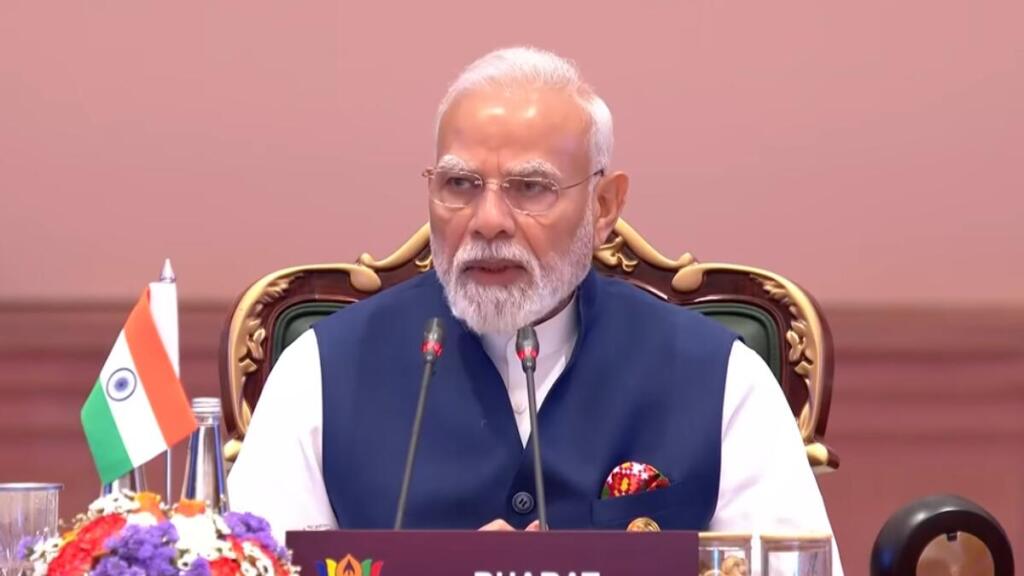
Prime Minister Narendra Modi closed out the 18th BRICS Summit on Sunday with a pointed message to the grouping he had spent the weekend hosting: two decades in, BRICS can no longer afford to be a talking shop. As the summit wound down at Bharat Mandapam, Modi combined a wide-ranging closing address with the formal handover of the BRICS chairship to China, alongside the adoption of a sweeping joint declaration that leaders had spent the previous night negotiating.
“Coming of age”: Modi’s reform pitch
Framing BRICS’ 20th anniversary as a “coming of age” moment, Modi told fellow leaders that unity and consensus within the grouping now had to translate into tangible outcomes on the world stage. He laid out a 10-point roadmap for global governance reform, to be finalised by next year’s summit, built around three principles: representation, responsiveness and rule-making.
Modi argued that reform of the UN Security Council could no longer be postponed, calling for negotiations with a definite timeframe and clear outcomes rather than indefinite discussion. He extended the same logic to international financial institutions, saying voting power and leadership positions there should reflect today’s economic realities rather than a decades-old status quo.
“Today, the Global South stands in the front row of global crises but in the back row of decision-making,” Modi said, calling for the world’s existing “pyramid of privilege” to become a “platform of partnership.”
A mechanism to make BRICS keep its promises
Modi paired his global reform push with a proposal aimed squarely at BRICS’ own functioning. Because the chairship rotates annually, he argued, institutional momentum often stalls between summits. His fix: a “BRICS continuity and implementation mechanism,” run through a Troika of the outgoing, current and incoming chairs, backed by a secure digital repository tracking who is responsible for each decision, on what timeline, and how far implementation has progressed.
Modi also used his remarks to tout India’s chairship year, noting that it had organised more than 350 meetings across nearly 30 cities under a people-first approach to the grouping’s work.
Technology, minerals and supply chains
Building on his opening remarks, Modi’s closing message returned to the economic concerns that have defined much of BRICS’ recent agenda: he flagged the risks of critical minerals and emerging technologies being turned into tools of coercion, and pressed the bloc to build more resilient, diversified supply chains that do not leave developing economies exposed to any single country’s restrictions.
The New Delhi Declaration: what leaders signed onto
The summit’s substantive centrepiece was the New Delhi Declaration, unanimously adopted after negotiations that reportedly ran until 4 am. Among its key elements:
- UN reform: China and Russia, both permanent Security Council members, reiterated their support for India and Brazil to take on a greater UN role, including possible Security Council seats, as part of a broader push for a more representative and effective Council.
- Terrorism: The bloc condemned the April 2025 Jammu and Kashmir terror attack “in the strongest terms” and called for zero tolerance and an end to double standards in counterterrorism, along with finalising a long-pending UN Comprehensive Convention on International Terrorism.
- West Asia: Leaders urged maximum restraint amid escalating regional tensions, called for protection of civilians and civilian infrastructure, and voiced concern over attacks on nuclear facilities under international safeguards.
- Gaza: The declaration pressed all sides to uphold the ceasefire reached in October 2025, ensure unhindered humanitarian access, and opposed any forced displacement of Palestinians.
- Trade: BRICS reaffirmed support for an open, rules-based multilateral trading system and called for restoring a fully functioning WTO dispute settlement mechanism, while condemning unilateral tariffs and sanctions as disruptive to global supply chains.
- Security and disarmament: The declaration flagged concern that rising global military spending was crowding out development financing for poorer nations, and renewed calls for stronger arms control and non-proliferation efforts.
Passing the gavel to China
With the New Delhi summit concluded, Modi formally passed the BRICS chairship to China for 2027, extending what he described as best wishes and expressing confidence that the incoming presidency would build on this year’s momentum. In brief closing remarks, Modi said the world now expects concrete results from BRICS, capping a summit that combined lofty institutional ambition with the granular, overnight diplomacy needed to hold an increasingly diverse bloc together.
Alongside the closing session, Modi also held bilateral talks with Abu Dhabi Crown Prince Sheikh Khaled bin Mohamed, covering defence, AI, space, critical minerals, energy and connectivity, and touching on a proposed $11.5-billion aluminium investment in Odisha — a reminder that even as the summit’s formal business wrapped up, the sidelines kept generating their own headlines.