
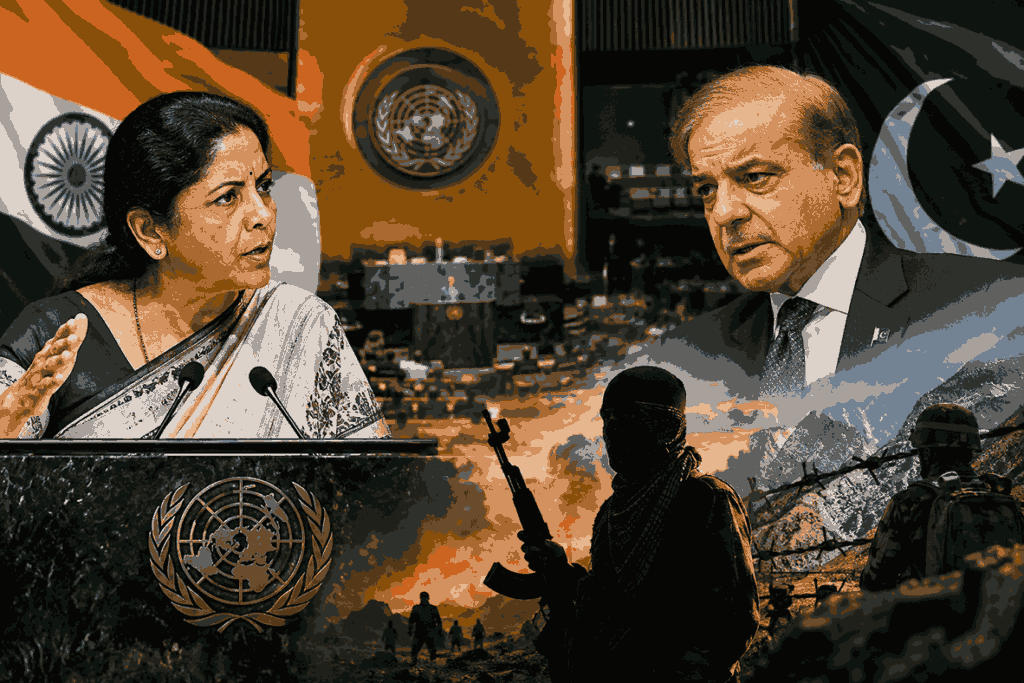
India delivered a sharp response to Pakistan Prime Minister Shehbaz Sharif’s address at the United Nations General Assembly, accusing Islamabad of repeatedly using the international forum to promote allegations against New Delhi while continuing a policy of cross-border Terrorism. India’s First Secretary at the UN, Petal Gahlot, said Pakistan’s actions would have consequences and asserted that India would continue exercising its right to defend itself.
Gahlot was responding to Sharif’s remarks concerning Jammu and Kashmir, the Indus Waters Treaty and India-Pakistan relations. Sharif warned that any attempt by India to stop, impede or divert Pakistan’s share of Indus waters would be treated as an “act of war”. India rejected the broader narrative presented by the Pakistani leader and turned the discussion towards Islamabad’s record on security and cross-border Terrorism.
At the heart of India’s response was its contention that Pakistan has pursued a long-standing policy of supporting cross-border Terrorism. Gahlot referred to India’s actions following the Pahalgam attack in April 2025 and said New Delhi had demonstrated that terrorists would have nowhere to hide. She stressed that India’s right to defend itself against attacks would continue to be exercised.
The Indian representative also challenged Pakistan’s attempt to portray itself as a victim while raising questions about its own record. Gahlot pointed to Osama bin Laden’s presence in Abbottabad and questioned Pakistan’s credibility when discussing security and extremism. She argued that repeatedly making accusations against India at the UN could not erase the record of Terrorism that New Delhi attributes to Pakistan.
The Kashmir issue featured prominently in Sharif’s address. He reiterated Pakistan’s position on Jammu and Kashmir and called for international intervention. India firmly rejected that position, describing Jammu and Kashmir as an integral part of the country. Gahlot also turned attention towards Pakistan-occupied Jammu and Kashmir, referring to allegations of violence, unrest and restrictions on basic rights there. The exchange demonstrated once again how sharply the two countries differ over the region and the wider question of Terrorism.
India’s response extended beyond security concerns. Gahlot criticised Pakistan’s references to democracy, human rights and religious tolerance, arguing that Islamabad’s own record deserved scrutiny. She also referred to the treatment of minorities and Pakistan’s blasphemy laws while questioning the credibility of its criticism of India. These remarks added a wider political dimension to an already tense diplomatic exchange.
The Indus Waters Treaty was another major point of contention. Sharif warned that interference with Pakistan’s water supply would amount to an act of war. India has kept the treaty in abeyance since the Pahalgam attack, while Pakistan has continued to challenge that position. The dispute has therefore become intertwined with the larger deterioration in bilateral relations, alongside continuing disagreements over Kashmir and Terrorism.
Gahlot’s final message was direct: repeating allegations year after year would not make them true. She said India expected the international community to judge Pakistan by its policies and actions rather than by the claims made from the UN podium. Her remarks also underlined New Delhi’s position that continued Terrorism originating from Pakistan would carry consequences.
The confrontation at the UN reflects the broader state of India-Pakistan relations, where diplomatic exchanges increasingly centre on security, Kashmir, water-sharing and accusations of supporting militant groups. For India, the message delivered at the General Assembly was that security concerns would remain central to its foreign-policy response and that it would not separate bilateral diplomacy from the issue of Terrorism.