
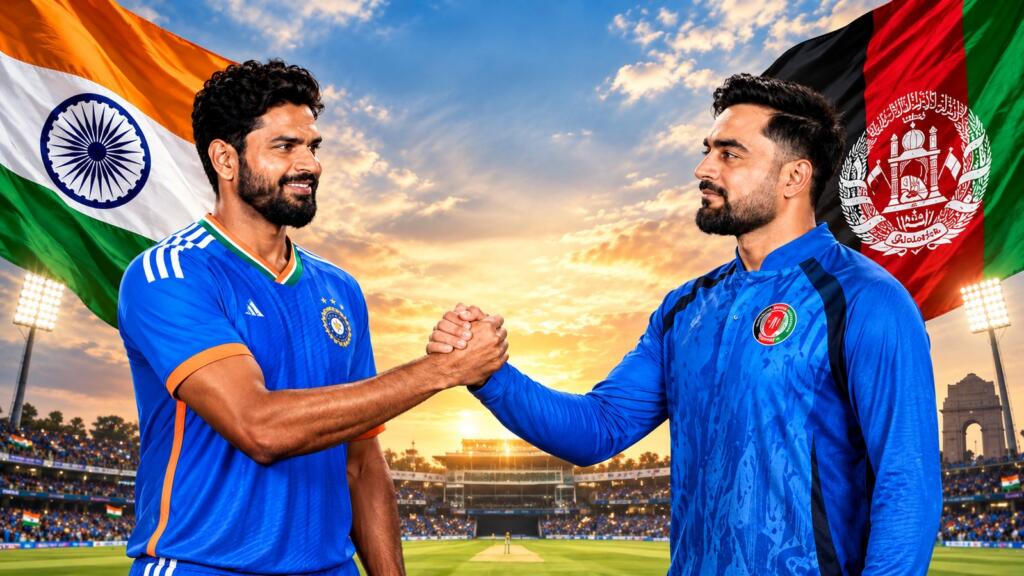
The three-match T20I series between India and Afghanistan begins today, with all three games scheduled to be played at Delhi’s Arun Jaitley Stadium. The ground is Indian, the crowd will be Indian, the pitch will be Indian and the matches will be played in India. Yet, there is one fascinating twist to this series: Afghanistan are the home team, while India are officially the visiting side.
In the 94-year history of Indian cricket, this is the first time India will play an international series on its own soil while officially being the visiting team.
So, why is this happening?
The Afghanistan Cricket Board is the official host of the series. Due to security conditions, Afghanistan has long struggled to host international cricket on its own soil. As a result, its home fixtures have often been played at overseas venues, including in India and the UAE.
In a way, India has already become something of a second home for Afghan cricket. Afghan players have trained in India, played international cricket here and built a strong connection with Indian cricketing infrastructure. But this series takes that relationship a step further.
For the first time, India itself will become the visiting team on Indian soil
On the surface, this may simply look like an unusual cricketing arrangement. But there is a bigger story behind it a glimpse of the role India has increasingly played for its neighbours.
For a cricketing nation, hosting a home series is about much more than simply having a stadium. It is about identity, ownership, confidence and the feeling of playing in familiar surroundings. Afghanistan cannot currently enjoy that privilege at home. India, with its world-class cricketing infrastructure and enormous sporting ecosystem, has effectively provided Afghanistan with that platform.
The ground belongs to India. The fans will be Indian. The infrastructure is Indian. But officially, the host is Afghanistan.
And that is why a few things will look rather unusual at the Arun Jaitley Stadium.
Who gets to influence the pitch?
The pitch at the Arun Jaitley Stadium will, of course, be prepared by the local Indian curators. But as the official home team, Afghanistan can provide its inputs and make requests regarding the kind of conditions it would prefer.
The home team traditionally has a say in preparing conditions that suit its strengths.
This is not entirely new for Afghanistan either. The Afghan team has previously played home internationals at different venues in India. On several occasions, Afghanistan have preferred surfaces that offer assistance to their strong spin attack, although they have also opted for batting-friendly pitches when circumstances demanded.
So, even though the pitch is being prepared in Delhi, Afghanistan will technically have the privileges of the home side.
Who will toss the coin?
Under the standard cricket procedure, the captain of the home team tosses the coin, while the visiting captain calls heads or tails.
So, even though the match is being played in Delhi, it will be Afghanistan captain Ibrahim Zadran who will toss the coin And India’s captain Shreyas Iyer will have to make the call: Heads or tails?
Think about that for a moment.
Thousands of Indian fans will be sitting inside the Arun Jaitley Stadium, cheering for India. The Indian team will walk onto an Indian ground. Yet, officially, India will have to behave like the visiting side.
What responsibilities will Afghanistan have as the host?
Being the official home team also comes with certain responsibilities.
The Afghanistan Cricket Board will take care of several logistical arrangements associated with the series, including accommodation, transportation between the hotel and stadium and related team arrangements. However, that does not mean Afghanistan will decide what the Indian players eat.
Team India typically shares its players’ dietary requirements with the hotel, and selected chefs prepare meals according to those requirements. The Afghan team can follow a similar system based on the needs of its own players.
Who gets the revenue from the series?
Since Afghanistan is the official host, the commercial benefits associated with hosting the series will largely accrue to the Afghanistan Cricket Board.
This includes revenues linked to broadcast rights, stadium advertising and ticket sales, subject to the commercial agreements governing the series. In other words, Indian soil, Indian infrastructure and an overwhelmingly Indian audience are helping Afghanistan create an important economic opportunity for its cricket board as well.
For India, cricket has never been merely a sport. It has also become an important instrument of engagement with its neighbours, what is often described as soft diplomacy.
Afghanistan may not currently be able to host international cricket at home. But that does not mean Afghan cricket has to stop growing.
India can provide the stadiums. India can provide the infrastructure. India can provide the platform.
India has done this before, not just in cricket, but whenever its neighbours have needed support. Whether it is a natural disaster, a humanitarian crisis, an economic challenge or another emergency, India has repeatedly stepped forward to help countries in its neighbourhood according to its capabilities.
Because the strength of a country is not measured only by how powerful it becomes itself. Real strength is also about having the confidence to use that strength to help someone else stand on their feet And that is exactly what we will see in Delhi today.
India will play on its own soil. Millions of Indians will cheer for their team. The stadium will be Indian.The pitch will be Indian.
Yet, officially, India will be the visitor and Afghanistan will be the host. It may sound unusual But perhaps that is precisely what India does.
India does not just build its own strength. It uses that strength to give its neighbours a platform to rise. And perhaps that is why, in times of crisis, India is not merely seen as a neighbour.
It is seen as a country people can trust. This is India. This is the Indian way.
India vs Afghanistan T20, India vs Afghanistan T20 series, India Afghanistan T20 series 2026, India visiting team, Afghanistan home team, India visiting team in India, India home series visiting team, India Afghanistan cricket, India vs Afghanistan, Afghanistan vs India T20, India Afghanistan T20, Afghanistan home series, Afghanistan cricket, India cricket, Team India, Indian cricket team, Ibrahim Zadran, Shreyas Iyer, Arun Jaitley Stadium, Delhi T20, Afghanistan cricket in India, Afghanistan home matches in India, India cricket 94 years, Indian cricket history, cricket diplomacy, India Afghanistan relations, cricket soft diplomacy, Afghanistan cricket home ground, India helps Afghanistan cricket