
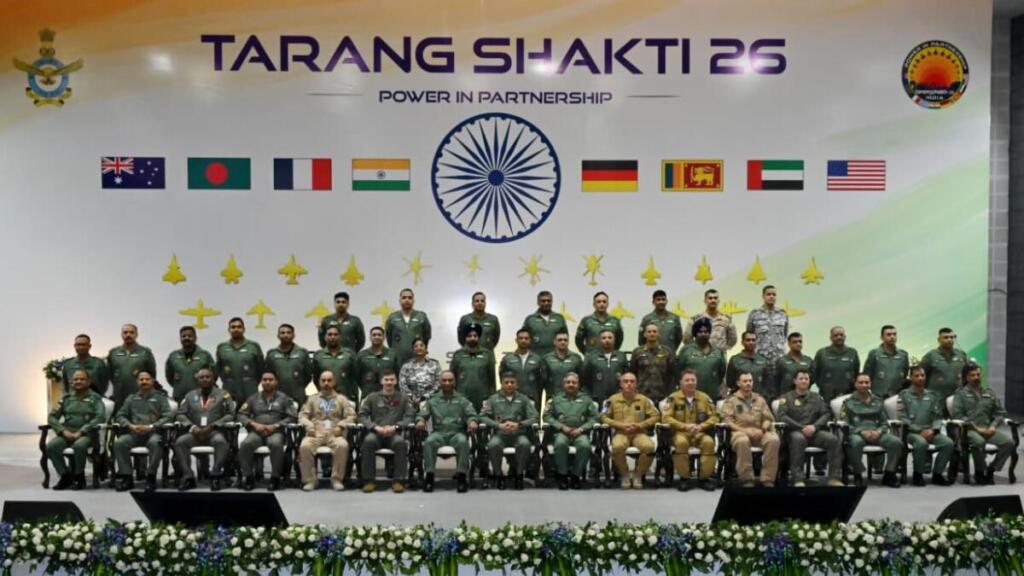
The Indian Air Force (IAF) is set to begin the operational phase of Exercise Tarang Shakti 2026 at Air Force Station Jodhpur, a day after the inaugural ceremony. The multilateral exercise runs from September 26 to October 12 under the theme “Power in Partnership.” Here is what it involves and why one aircraft on the participants’ list stands out.
It is a multilateral air exercise hosted by the IAF, and this is its second edition, following the inaugural one in 2024. It gives participating air forces a chance for advanced joint training, an exchange of operational expertise and a consolidation of professional experience. Aircrew, mission planners and operational support personnel from the different contingents will work together, with the focus on interoperability, mutual learning, aerospace safety and a better understanding of each other’s operating procedures.
Seven friendly foreign countries are participating: Australia, the United States, the United Arab Emirates, France, Germany, Sri Lanka and Bangladesh. Several other countries will attend as observers. The foreign aircraft include the F-35 Lightning II, Rafale, F-16, A400M, MRTT, C-130, C-130J and KC-30A. Together they bring combat, airlift and air-to-air refuelling capabilities, and the contingents will fly alongside the IAF’s frontline combat platforms and support elements across a range of missions. The IAF’s statement does not say which country’s F-35s are taking part.
Most of the aircraft on the list are fourth-generation or transport and tanker types, which Indian crews already know from their own fleet or from earlier exercises. The F-35 Lightning II is a fifth-generation fighter, a category defined by low observability (stealth), advanced sensors and the ability to fuse data from those sensors into a single picture for the pilot and to share it with other assets. India’s own combat fleet does not include a fifth-generation fighter at present, so the exercise offers IAF pilots and planners a rare chance to operate with, and against, one.
That has practical value on several fronts. Fighting a stealth aircraft is difficult because it is hard to detect and track, and crews can learn how their radars, sensors and tactics cope with such a target. Working alongside one shows how a network-centric platform shares information and how it fits into a mixed package of aircraft. It also tests interoperability at a higher level, since older and newer platforms have to be coordinated within the same mission. For mission planners, it offers a look at how fifth-generation operating concepts differ from the ones they use today. The IAF says the exercise will help participants understand each other’s capabilities and operating philosophies, and the presence of a fifth-generation type widens what there is to learn.
This edition goes beyond flying. The programme includes a dedicated seminar, an industrial tour for the foreign contingents, the Sekhon Marathon, heritage tours and yoga sessions. The IAF says these will allow professional exchange, exposure to India’s aerospace and industrial ecosystem, and greater camaraderie among the participants.
The IAF describes the exercise as a chance to demonstrate its operational capabilities, professional standards and institutional ethos, and to highlight India’s growing indigenous aerospace and defence capabilities. It says the exercise reaffirms India’s commitment to constructive defence engagement and military cooperation in support of regional peace, security and stability.