
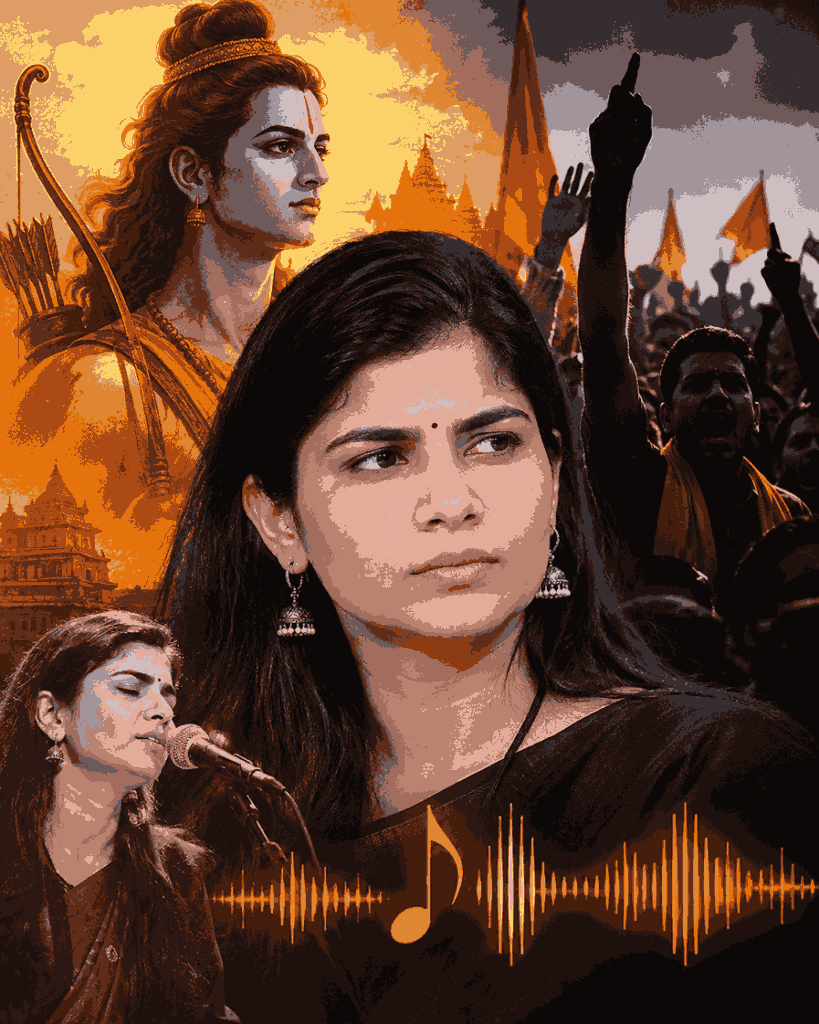
Singer and dubbing artist Chinmayi Sripada has found herself at the centre of a fresh Ramayana controversy after lending her voice to the Tamil version of “Jai Jai Ram,” the first song released from Nitesh Tiwari’s much-anticipated cinematic adaptation of the epic. The devotional track, composed by A.R. Rahman, has generated considerable interest, but her involvement has also prompted sections of social media to revisit her earlier comments concerning Lord Rama and Sita.
The song was released on September 25 and features Chinmayi alongside Haricharan. Karthik Netha has penned the Tamil lyrics, while the composition by Rahman has been described by the makers as an attempt to combine the spiritual character of an aarti with the emotional sweep of a cinematic song. The production team has presented the track as a devotional celebration of Shri Ram, with the repeated invocation forming the centre of the composition.
The involvement of Chinmayi Sripada, however, immediately became a talking point online because of comments from her past that have resurfaced alongside the new song. Telugu360 reported that users brought back earlier posts in which she questioned aspects of Rama and Sita’s story, particularly the episode concerning Sita’s exile. Those old remarks have now been placed alongside her participation in a song devoted to Lord Rama, creating a new wave of criticism.
The controversy is not entirely new. In December 2011, Chinmayi Sripada published a lengthy blog post titled “My questions on Lord Rama,” explaining that she was raising questions about the Ramayana rather than presenting her views as an attack on Hinduism. She specifically acknowledged that interpretations of the Valmiki Ramayana can differ and warned that her questions could provoke anger or accusations of being anti-Hindu.
That older post provides important context to the current debate. Rather than treating the singer’s earlier remarks as a newly discovered statement, the controversy is better understood as a revival of a discussion that has existed around her public commentary for years. Social media users are now contrasting those earlier questions with her role in the new devotional soundtrack, while supporters can point to the distinction between questioning an interpretation of an epic and performing a song created for a film based on it.
The latest episode involving Chinmayi Sripada also intersects with a separate controversy surrounding the casting of Ranbir Kapoor as Lord Rama. In July 2025, she defended Kapoor after some social media users objected to his casting because of an old remark in which the actor had said he ate beef. She argued that an actor portraying a character should not automatically be judged by the character’s beliefs or actions.
That earlier intervention has now become part of the online conversation surrounding the new song. Critics have questioned whether the same principle should apply when the issue involves the singer’s own previous comments about Rama. Others have argued that a performer’s participation in a cinematic project should be assessed separately from opinions expressed years earlier.
For Chinmayi Sripada, the situation illustrates the increasingly complicated relationship between entertainment, social media and religious subjects. A song can be recorded months before release, while older statements can suddenly return to public attention when a project reaches audiences. In this case, the timing has created an unusually sharp contrast between her earlier questioning of elements of the Ramayana and her present role in a devotional song celebrating Shri Ram.
The controversy is unfolding as the film itself generates growing anticipation. Ramayana stars Ranbir Kapoor as Shri Ram, Sai Pallavi as Sita, Yash as Ravana, Sunny Deol as Hanuman and Ravi Dubey as Lakshman. The project is planned as a two-part cinematic event, with the first instalment scheduled to arrive during Diwali 2026..
The reaction to Chinmayi Sripada therefore reflects a wider debate about whether artists should be permanently judged by opinions expressed years earlier, particularly when they later participate in projects involving subjects they once questioned. Supporters and critics are interpreting the situation differently, but the underlying facts remain straightforward: she has sung the Tamil “Jai Jai Ram,” her earlier writings about Rama have resurfaced, and social media has turned those two moments into a new controversy.
As Ramayana moves closer to its theatrical release, the discussion is unlikely to remain confined to the song itself. The film brings together major stars, an internationally recognised music composer and one of India’s most enduring epic narratives. The renewed scrutiny surrounding Chinmayi Sripada demonstrates how closely modern entertainment projects can become intertwined with an artist’s earlier public statements, particularly when the subject carries deep religious and cultural significance.
For now, the “Jai Jai Ram” controversy remains primarily a social-media debate, with differing interpretations of the singer’s past comments and her present participation in the film. Whether the debate will have any lasting impact on the song or the larger Ramayana project remains to be seen, but the episode has once again placed questions about faith, artistic participation and public accountability at the heart of the conversation.