
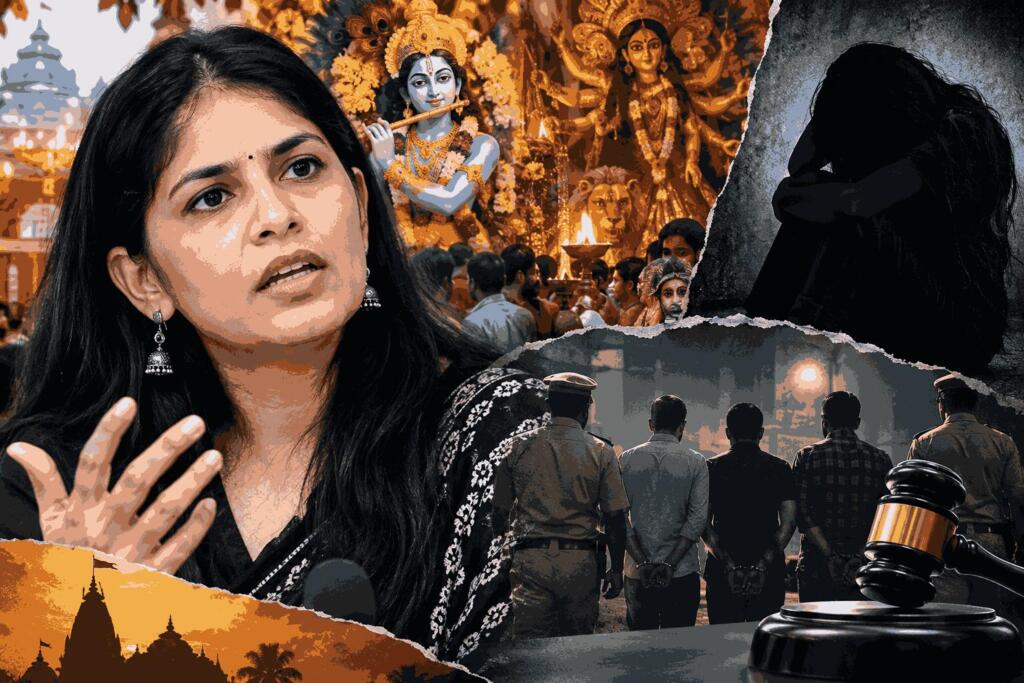
Chinmayi Sripaada has come under criticism after a social-media post in which she referred to an alleged rape of a teenage girl on Janmashtami and connected the incident to the upcoming Navaratri celebrations. Her remarks have triggered a political and social-media controversy, with critics accusing her of using a serious crime to make a broader point about Hindu festivals, while supporters argue that her post was intended to highlight concerns about women’s safety during religious gatherings.
According to The Commune, the controversy followed a post circulating on social media about an alleged incident in Chhapar, Muzaffarnagar, Uttar Pradesh. The report stated that a 15-year-old girl was allegedly abducted while travelling towards a temple on Janmashtami night and subsequently sexually assaulted. Three men were reportedly arrested in connection with the case. The details cited by the publication identify the accused as Sameer Ali, Waleen and Salman, although allegations against individuals remain matters for the criminal justice process and must be distinguished from convictions.
The Chinmayi post questioned whether rape cases would occur during Navaratri as well, while drawing a comparison with the 2012 Delhi bus gang-rape case and its delayed reporting. The reference immediately generated a heated response online because critics believed that placing Janmashtami and Navaratri at the centre of the discussion shifted attention away from the alleged perpetrators and the circumstances of the crime.
At the heart of the dispute is the question of whether religious festivals should be invoked when discussing crimes against women. Chinmayi appeared to use the timing of the alleged assault to raise a wider concern about women’s safety, but opponents argued that the formulation created an association between Hindu festivals and sexual violence without establishing any causal connection. That distinction has become central to the backlash surrounding the post.
The criticism intensified after users on social media circulated information identifying the three accused named in reports. The Commune alleged that Chinmayi did not subsequently delete the post or issue a clarification. Whether or not a social-media user chooses to identify accused persons, however, raises another important issue: allegations made during an ongoing criminal investigation must be handled carefully, particularly when the victim is a minor and the legal process is still underway.
For Chinmayi, the episode has also revived an older debate over the role of celebrities and public personalities in discussions involving sexual violence. Public figures can draw attention to crimes that might otherwise receive limited scrutiny, but their choice of language can equally influence how millions of people interpret an incident. When a crime involving a child becomes part of a larger ideological argument, there is a risk that the victim’s experience may be overshadowed by the political battle that follows.
The controversy also illustrates the increasingly combative nature of India’s social-media discourse. Chinmayi has previously attracted strong reactions for comments concerning religion, gender and social issues, and the latest dispute has once again placed her at the centre of competing narratives. Critics see a pattern of disproportionate scrutiny of Hindu customs, while those defending her position say criticism of social practices should not be dismissed simply because a religious festival is involved.
At the same time, Chinmayi‘s critics face their own responsibility to distinguish legitimate criticism from personal abuse. A discussion about the wording or implications of a public statement should not become an excuse for harassment, threats or communal hostility. The alleged assault itself should remain the primary concern, and the accused should be judged through evidence and due process rather than through social-media campaigns.
Ultimately, the Chinmayi controversy has become larger than the original post. It has brought together questions about women’s safety, religious sensitivity, responsible online commentary and the manner in which crimes are discussed in an increasingly polarised public sphere. The alleged rape of a minor is a grave matter that deserves serious investigation and justice, regardless of the date on which it occurred or the religious festival taking place at the time.
The Chinmayi episode serves as a reminder that public commentary surrounding crimes involving minors carries a particularly heavy responsibility. Strong opinions may generate attention, but accuracy, context and sensitivity remain essential. As the legal process surrounding the alleged assault proceeds, the most important task is to establish the facts, protect the victim’s privacy and ensure that accountability is determined by evidence rather than by the competing narratives of social media.