
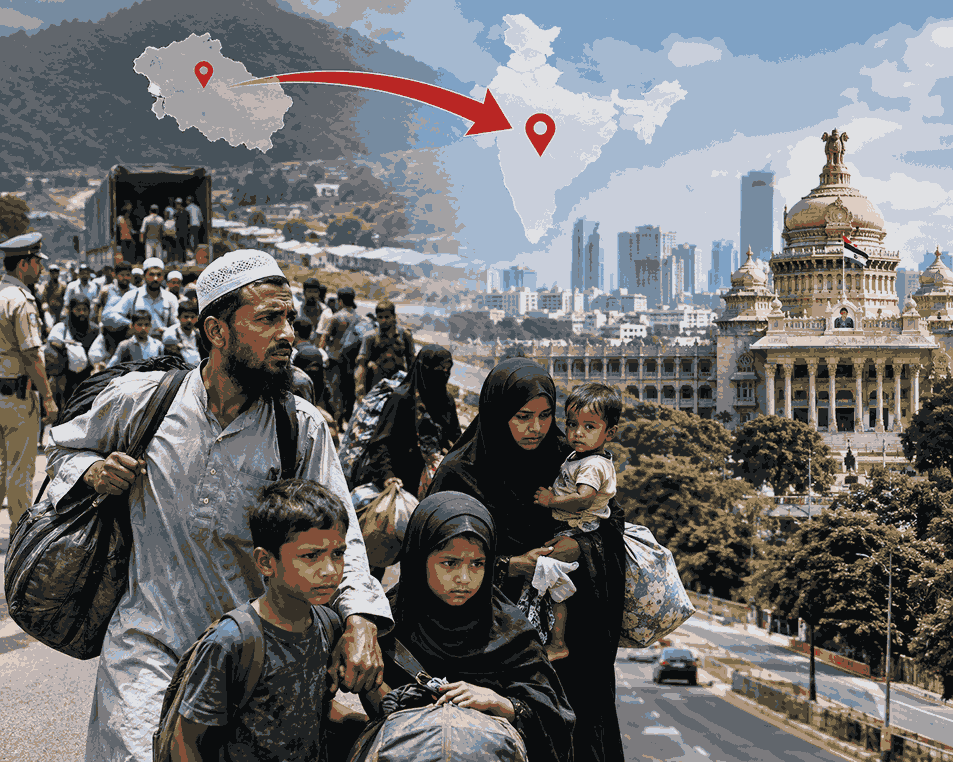
Bengaluru is emerging as a possible destination for Rohingya families leaving Jammu following an intensified administrative drive against settlements in several parts of the Union Territory. According to a report published by OpIndia on September 24, Dr Hashim Rifai, a former University of Calicut coordinator and principal of Al-Azhar Training College in Thodupuzha, has said that five Rohingya families have already reached the city, while several more are expected to arrive.
The development comes amid heightened attention from authorities in Jammu over where families displaced by the recent action will go next. Rifai reportedly stated on Facebook that around 50 additional families could arrive and that he was looking for land where temporary or permanent accommodation could be arranged for as many as 100 Rohingya families. His appeal has brought renewed focus on the movement of displaced families across state borders and on the legal and administrative questions surrounding their resettlement.
According to the report, Rifai has sought assistance from people in Bengaluru for providing shelter to the families. His social-media posts reportedly express sympathy for Rohingyas affected by the Jammu administration’s actions and question the measures taken against their settlements. The claims concerning the proposed accommodation effort are based on Rifai’s own public statements, rather than on an official announcement by the Karnataka government.
The reported movement follows a significant enforcement drive in Jammu. Authorities have recently taken action in areas including Narwal, Bathindi, Sunjwan and Chowadi, with officials stating that more than 40 kanals of land were cleared and thousands of Rohingyas were removed from settlements there. The administration has also instructed police stations to monitor the movement of families leaving the affected areas and warned against facilitating new settlements without appropriate verification.
The Jammu administration’s concern is not limited to the removal of existing structures. Officials have also been monitoring the possibility that families could move to other parts of India and establish new settlements. Earlier reports indicated that some displaced Rohingyas had mentioned Punjab, Haryana, Hyderabad and Bengaluru as possible destinations. Authorities in neighbouring districts and states were consequently alerted to possible movement following the Jammu operation.
Government data cited in reports on the Jammu situation identified 7,656 Rohingyas across Jammu and Kashmir, including 6,737 in ten districts of the Jammu region and 919 in the Kashmir Valley. These figures form part of an official assessment of the population and its distribution. Separately, authorities have recorded individual criminal cases involving some Rohingya residents; however, such cases do not establish criminal conduct by the wider Rohingya population.
The issue has also acquired a broader national-security dimension because Indian investigative agencies have previously examined networks allegedly involved in bringing Rohingyas into India using forged or discreetly obtained documents. In 2024, the National Investigation Agency reported action against an international human-trafficking network allegedly connected with the illegal movement of Rohingyas into India. Such investigations have contributed to the Centre’s broader scrutiny of undocumented immigration and trafficking networks.
For Bengaluru, the latest development raises practical questions about verification, accommodation, documentation and the responsibility of local authorities if displaced families arrive in significant numbers. The city has previously experienced migration from across India, but any organised effort to establish shelters for people whose immigration status is disputed would inevitably involve questions of legal compliance and administrative oversight.
The reported plan also illustrates a larger challenge created when enforcement in one region triggers movement to another. Removing an unauthorised settlement does not necessarily determine where affected families will go next. That is why authorities in Jammu have sought greater coordination with officials elsewhere, while organisations and individuals offering assistance are likely to face questions about documentation and the legal status of those being accommodated.
As reports of new arrivals continue to circulate, the situation in Bengaluru remains dependent on verification by local authorities and on the actual scale of migration from Jammu. Rifai’s statement about accommodating up to 100 families represents an intended shelter effort, not confirmation that such a settlement has already been formally established. The immediate issue, therefore, is likely to remain one of monitoring movement, determining legal status and ensuring that any humanitarian assistance operates within Indian law.
The developments in Jammu and the reported arrival of families in Bengaluru highlight the increasingly complicated intersection of immigration enforcement, humanitarian assistance and internal migration. How Karnataka authorities respond, and whether additional families actually arrive, will determine whether the reported movement develops into a larger resettlement issue or remains a limited response to the Jammu evictions.