
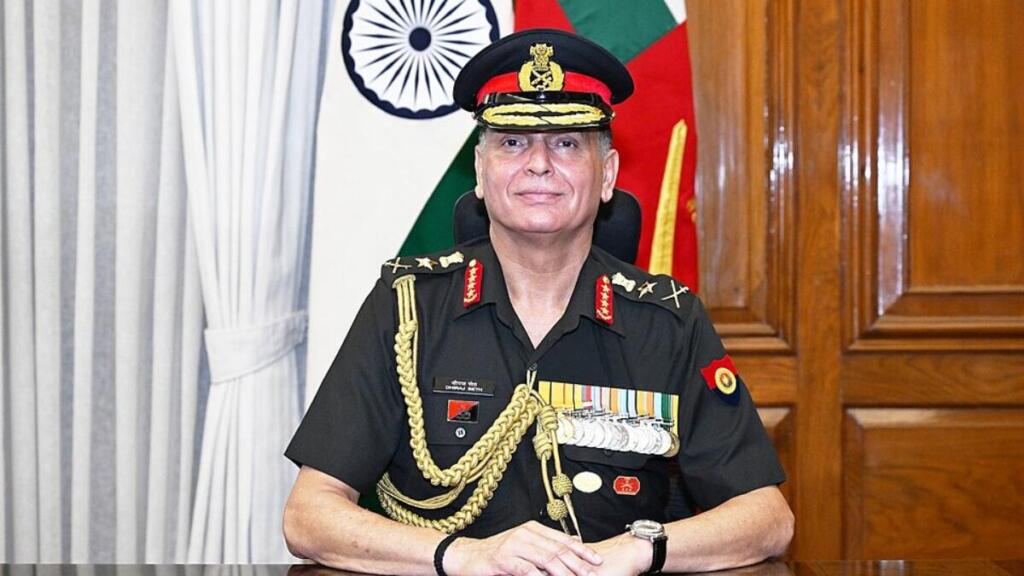
Army Chief General Dhiraj Seth said on Sunday that an army should be able to endure long-drawn conflicts, and that technology must make soldiers faster and better informed. He was speaking at the NDTV Defence Summit, where he put forward a vision called SAMARTH to raise the operational readiness of the force.
Seth explained that the word means “capable” in Hindi, and that it is also an acronym. Its seven letters stand for sustainability, adaptation, modernisation, acceleration, resilience, technology and human-machine teaming. Sustainability, he said, is the ability to endure long-drawn conflicts, adaptation is the ability to upgrade capabilities faster than threats evolve, and modernisation means being mission-ready. Acceleration refers to integrating capabilities that directly improve the effectiveness of legacy systems. Resilience needs little explanation. Technology covers AI, autonomous systems, robotics and drones, and human-machine teaming completes the list.
The thinking behind the framework is that the character of war is changing faster than institutions can respond. Seth said the “capability clock” runs slower than the “technology clock,” and that capability development therefore has to be “capable,” or SAMARTH. Procurement, training and doctrine move at a bureaucratic pace, while drones and AI advance at the pace of the commercial market. SAMARTH is an attempt to close that gap.
He described contemporary conflicts as “wars with pause.” Technology shortens individual engagements, he observed, but wars often lack a clear end and continue through shifts in intensity. That argument explains why endurance comes first in the acronym. A force built for a short, decisive campaign may find itself poorly placed in a conflict that stretches on for months or years.
Self-reliance ran through the address, which was titled “Atmanirbharta in an Era of Transformative Wars.” When a crisis becomes prolonged, Seth said, Atmanirbharta will make the difference between the victor and the vanquished. The point is a practical one. In a long war, a force that depends on imported supplies and spares is exposed to disruption in a way that a force with domestic production is not.
The chief also made clear that technology is meant to support soldiers rather than replace them. “Technology must make our soldiers faster, better informed and more effective,” he said, adding that it should allow them to make better judgements. The stress on human-machine teaming points the same way. The soldier remains the decision-maker, and the machine sharpens what he sees and how quickly he acts.
For now, SAMARTH is a statement of direction, not a programme. The reports of the address do not mention budgets, timelines or specific acquisitions tied to it, and it remains to be seen how the vision will shape procurement and doctrine. Seth took charge as the 31st Army Chief on June 30, 2026, so the framework is one of the first clear indications of the priorities he intends to set for the force.