
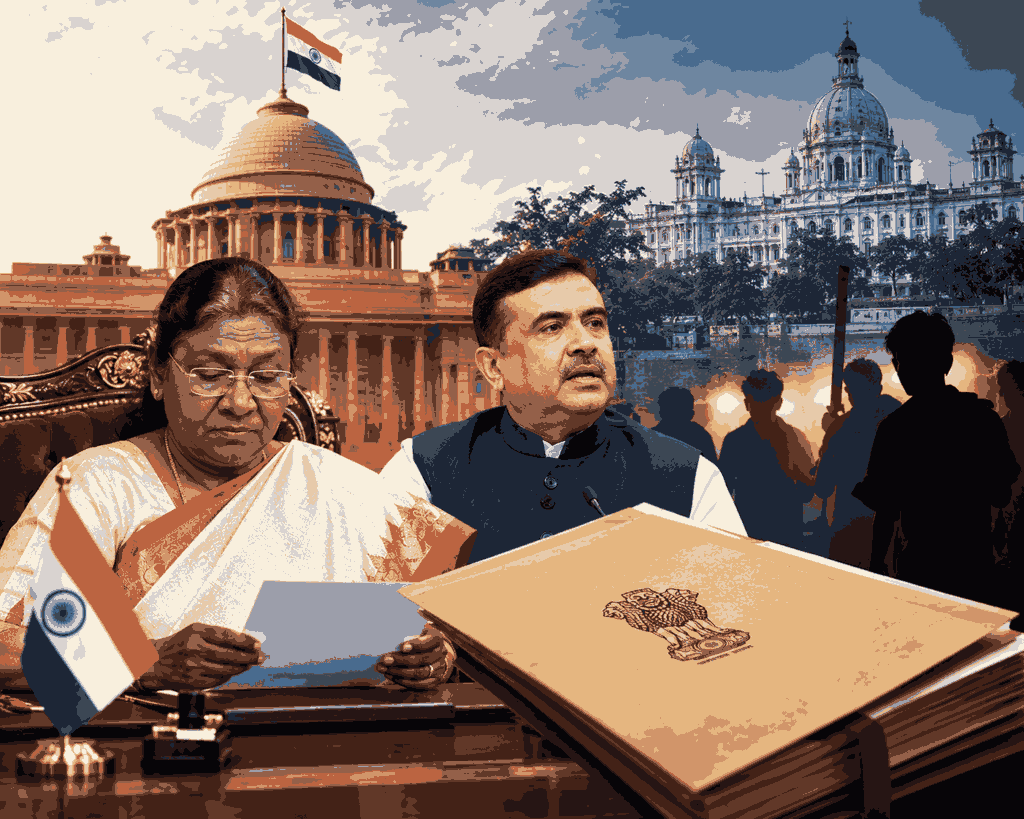
A controversy over the status of West Bengal’s Anti-Goonda Bill has intensified after the Union government and Chief Minister Suvendu Adhikari rejected reports that President Droupadi Murmu had returned the legislation without granting assent. The clarification puts the Anti-Goonda Bill at the examination stage, rather than at a completed presidential rejection or return.
The legislation, formally titled the West Bengal Public Safety and Control of Anti-Social Activities Bill, 2026, was passed by the West Bengal Assembly in June. It seeks to give the state additional powers to prevent organised criminal and anti-social activity, including provisions concerning preventive detention and restrictions on the movement of persons considered a threat to public order.
The confusion began on September 25, when several media reports stated that the President had returned the legislation to the state for reconsideration. Those reports attributed the development to concerns over a possible overlap between provisions dealing with narcotics-related offences and existing central legislation. The Anti-Goonda Bill consequently became the focus of a political and media dispute.
Chief Minister Suvendu Adhikari subsequently denied that the President had returned the Bill. At a press conference in Kolkata, he said the legislation was still with the Union Home Ministry and had not reached the President for a decision. He described reports suggesting otherwise as baseless and said the state government remained hopeful of obtaining presidential assent.
The Centre later issued a clarification providing a more precise account of the Bill’s status. According to the Ministry of Home Affairs, the West Bengal government had sent the legislation, after it was reserved by the Governor, for consideration and presidential assent. The Bill was circulated among concerned ministries and departments for examination and comments and, according to the ministry, remains under examination.
The clarification is important because the Anti-Goonda Bill cannot be treated as a law that has received presidential approval while the assent process remains incomplete. The Calcutta High Court had earlier noted that challenges to the legislation were premature because the Bill had not yet received presidential assent and had therefore not become an enforceable law.
The proposed legislation has attracted attention because of the breadth of its preventive provisions. It seeks to address activities that create fear, danger or insecurity among the public and covers conduct associated with organised crime, illegal mining, unauthorised quarrying, damage to public or private property and other activities affecting public order.
A particularly significant provision concerns preventive detention. The legislation provides for detention of certain individuals for up to 12 months without trial, subject to safeguards and review mechanisms specified in the Bill. It also allows authorities, in specified circumstances, to direct individuals to leave an area or district and restrict their return for a prescribed period. The Anti-Goonda Bill therefore proposes a substantial preventive framework, although its final legal status depends on the constitutional process still underway.
Another point of contention involves the definition of persons who could fall within the legislation’s ambit. The Bill covers individuals alleged to habitually engage in, attempt, support, finance or facilitate specified anti-social activities. Its provisions also refer to organised and petty organised crime under the Bharatiya Nyaya Sanhita.
The dispute over the presidential status also brought the interaction between state and central laws into sharper focus. Reports that the President had returned the Bill cited concerns about provisions relating to offences under the Narcotic Drugs and Psychotropic Substances Act, 1985, and the Prevention of Illicit Traffic in Narcotic Drugs and Psychotropic Substances Act, 1988. The concern was that overlapping preventive-detention provisions could raise questions under Article 254 of the Constitution.
For the state government, the Anti-Goonda Bill is part of a broader effort to strengthen mechanisms for dealing with public disorder and organised criminal activity. Adhikari has argued that the legislation was framed within the constitutional powers available to the state and has expressed confidence that the required assent will be obtained.
The latest clarification does not settle whether the Bill will receive assent in its present form. Instead, it establishes that the legislative process remains active and that the Union government is still examining the measure. Any amendments, objections or further communication between the Centre and West Bengal will determine the next stage.
For now, the Anti-Goonda Bill remains a Bill awaiting completion of the presidential assent process. The conflicting reports have highlighted how quickly uncertainty over the status of legislation can become a political controversy. The Ministry of Home Affairs’ clarification provides a clear position: the measure is under examination, and no final presidential decision has been announced.