
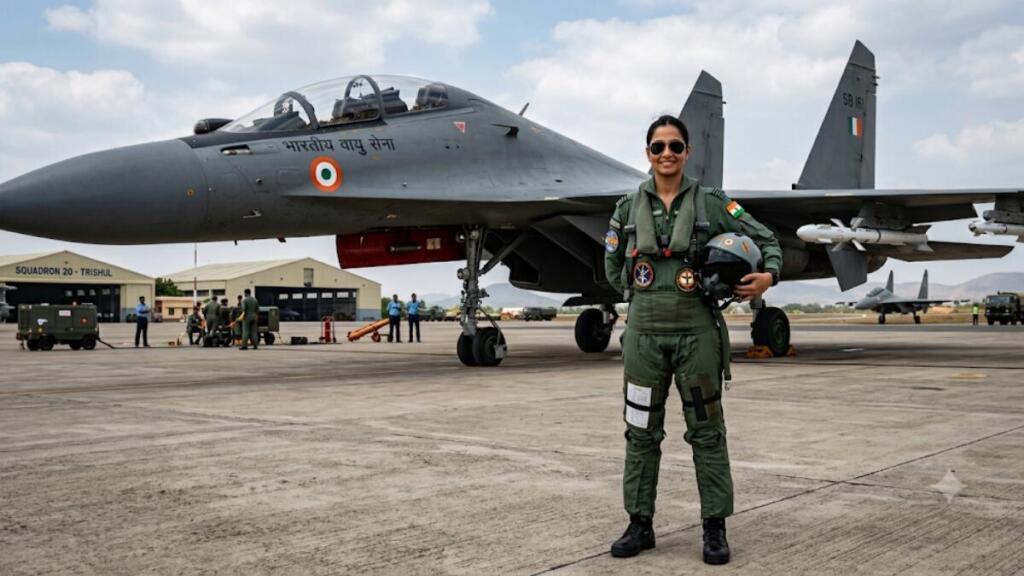
More than a year after India launched Operation Sindoor, new details continue to emerge about the role women fighter pilots played in the country’s most significant cross-border air campaign in decades — details that had, until recently, remained classified.
According to defence and security sources to The Print, a woman Flight Lieutenant of the Indian Air Force flew a Su-30MKI as part of the strike package that hit the Lashkar-e-Taiba headquarters at Markaz Taiba in Muridke, Pakistan, on May 7, 2025. The Su-30MKI she flew is a twin-engine, multi-role air-superiority fighter capable of carrying long-range stand-off weapons, including the BrahMos and Rampage air-to-ground missiles. Sources declined to confirm which specific weapon was used, saying the precise weapon used during the strike remains classified.
The Muridke facility was one of two high-value Pakistan Air Force–struck targets that night, alongside the Jaish-e-Mohammed headquarters in Bahawalpur; the remaining seven of the nine designated sites were engaged by the Indian Army using loitering munitions and long-range artillery.
Sources emphasized that gender distinctions effectively disappear once officers enter the fighter stream: pilots undergo the same training, meet the same operational standards and undertake the same responsibilities regardless of sex.
More Than One Pilot, More Than One Role
The Muridke revelation is not an isolated case. According to subsequent reporting, more than one woman fighter pilot took part in the operation, with women flying both Su-30MKIs and Rafale jets. In some missions, women served as pilots, while in others they worked as Weapon System Operators.
As is standard operational security practice, the identities of the women who flew combat sorties during the operation have largely not been disclosed. Renewed public attention followed the release of Discovery Channel’s two-part documentary series Declassified: Operation Sindoor, which features a woman officer whose identity has been concealed.
The Public Face: Qureshi and Singh
While pilots flying combat missions stayed anonymous for operational security reasons, two women officers became the public face of Operation Sindoor within hours of the strikes. Wing Commander Vyomika Singh of the Indian Air Force and Colonel Sofiya Qureshi of the Indian Army jointly led the media briefing on the operation on the morning of May 7, 2025, alongside Foreign Secretary Vikram Misri.
Wing Commander Singh is a decorated IAF helicopter pilot — she was commissioned as a helicopter pilot in the Air Force on December 18, 2019, with a permanent commission granted in the flying branch, and has since logged more than 2,500 flying hours. Colonel Qureshi, meanwhile, holds her own set of firsts: she was the first woman officer of the Corps of Signals, commissioned in 1990, with extensive experience in international peacekeeping — including India’s 2006 mission to Congo — and was the first woman to lead an Indian army contingent at a multinational field exercise.
Analysts noted the symbolic weight of the choice. By fielding two women officers to detail strikes conducted deep inside Pakistani territory, India’s briefing was widely read as a pointed rebuttal to remarks by Pakistan’s Army Chief, Asim Munir, who had days earlier described Hindus and Muslims as belonging to different nations — language read as an echo of the two-nation theory underlying Partition.
Shivangi Singh and the Disinformation Battle
Operation Sindoor also became a target of disinformation, some of it aimed specifically at a woman pilot. Pro-Pakistan social media accounts circulated claims that Squadron Leader Shivangi Singh — the first female Indian pilot to fly the Rafale — had been shot down and captured during the operation. India’s Press Information Bureau fact-check unit confirmed the claim was false, and that Pakistan’s assertion of having downed six Indian jets, including Singh’s, was untrue; videos purporting to show her “grief-stricken family” circulating online were later found to depict an unrelated family.
The episode had a coda five months later: in late October 2025, President Droupadi Murmu took a sortie in a Rafale fighter jet at Air Force Station Ambala, with Squadron Leader Singh giving her a hands-on tour of the aircraft — a very public rebuttal, in photographs, of the earlier capture claims.
The government has repeatedly and publicly credited women officers for the operation’s execution. In July 2025, Defence Minister Rajnath Singh lauded the vital role of women soldiers and pilots in Operation Sindoor, saying their participation was central to the destruction of nine terror camps in Pakistan.
Background
Operation Sindoor was launched in the early hours of May 7, 2025, targeting nine sites across Pakistan and Pakistan-administered Kashmir, in retaliation for the April 22 attack in Pahalgam that killed 26 civilians, most of them Indian tourists. Military officials later said the strikes killed more than 100 terrorists, including individuals linked to the hijacking of Indian Airlines flight IC814 and the 2019 Pulwama attack. The confrontation escalated over several days before an understanding on halting military action was reached on May 10.