
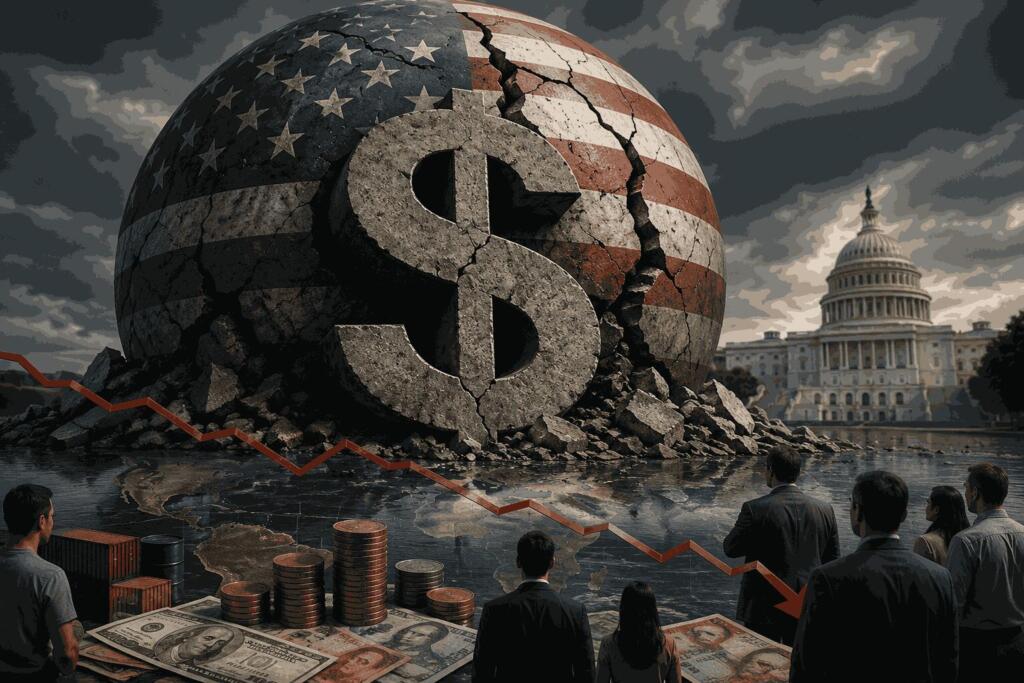
The US debt has crossed the staggering $40 trillion mark, a milestone that would once have seemed almost unimaginable. According to US Treasury data, the national debt reached about $40.047 trillion in August 2026, having more than doubled from roughly $20 trillion in 2017. What makes this development particularly significant for India is that America’s financial decisions rarely remain confined within its borders. Through the dollar, global bond markets, trade, investment and currency movements, an increasingly expensive American borrowing cycle can eventually touch the everyday finances of Indians.
The sheer scale of the US debt is only one part of the story. The more immediate concern is the rising cost of servicing it. Interest payments have become one of the largest items in the US federal budget, even exceeding spending on some major government programmes. Investors are demanding higher returns on long-term US Treasury securities, with the 30-year yield recently reaching levels not seen in many years. Higher yields mean that Washington must pay more to borrow, creating a potentially uncomfortable cycle in which existing obligations generate still more borrowing requirements.
For Indians, the first visible channel could be the rupee-dollar exchange rate. When global investors become nervous about fiscal conditions in the United States, money can move rapidly between currencies and asset classes. A weaker rupee raises the domestic cost of imported crude oil, machinery, electronics, components and several other goods priced in dollars. Even when the underlying cause lies thousands of kilometres away in Washington, the impact can eventually appear in household budgets through higher transportation, manufacturing and consumer prices. The US debt problem therefore has the potential to become an indirect Indian inflation issue.
Indian investors are also exposed through global financial markets. US Treasury securities have traditionally been regarded as among the safest assets in the world, and their yields influence borrowing costs across international markets. When American yields rise sharply, global investors may find dollar assets more attractive, pulling capital away from emerging markets. India, despite possessing strong domestic economic fundamentals, is not insulated from such movements. Equity markets can become more volatile, foreign portfolio flows can reverse and companies dependent on overseas financing may face higher costs. The expanding US debt burden could thus create financial turbulence far beyond America’s borders.
There is another important connection: India’s exporters and technology companies. A major deterioration in American financial conditions could weaken demand, increase uncertainty and make businesses more cautious about investment. Indian IT firms, pharmaceutical companies, manufacturers and other exporters with substantial US exposure could feel the effects if American consumers or corporations reduce spending. At the same time, fluctuations in the dollar can alter the rupee value of revenues earned by Indian companies abroad. The US debt issue is consequently relevant not merely to economists but also to businesses, employees and investors whose livelihoods are linked to the American market.
The concern becomes more serious when borrowing continues faster than the economy can comfortably support. Persistent budget deficits, mandatory spending commitments, defence expenditure and growing interest costs are all contributing to Washington’s financing needs. Reuters reported that the debt has more than doubled since 2017, with pandemic-era borrowing accounting for a substantial portion of the increase. Meanwhile, the US Treasury has expanded its programme of buying back longer-term bonds in an attempt to ease pressure in the bond market. Such interventions may provide temporary relief, but they do not remove the underlying fiscal imbalance.
For India, however, the rise in US debt should not automatically be interpreted as a prediction of an imminent American economic collapse. The United States retains enormous economic strength, deep capital markets and the unique advantage of issuing the world’s dominant reserve currency. That gives Washington considerable room to manage its obligations. Yet the greater the borrowing burden becomes, the more sensitive markets may become to interest rates, inflation and investor confidence. The danger lies less in the headline number itself than in what happens if confidence begins to weaken.
Ultimately, the US debt crossing $40 trillion is a warning about the interconnected nature of the modern economy. India cannot control America’s fiscal policy, but it can strengthen its own defences by maintaining macroeconomic stability, encouraging domestic investment, diversifying trade and reducing excessive dependence on imported energy. For ordinary Indians, the lesson is equally simple: a financial storm that begins in Washington can travel through currencies, markets and prices before eventually reaching Mumbai, Delhi, Kolkata or Bengaluru. America’s debt may be accumulated in dollars, but its consequences can increasingly be felt around the world.