
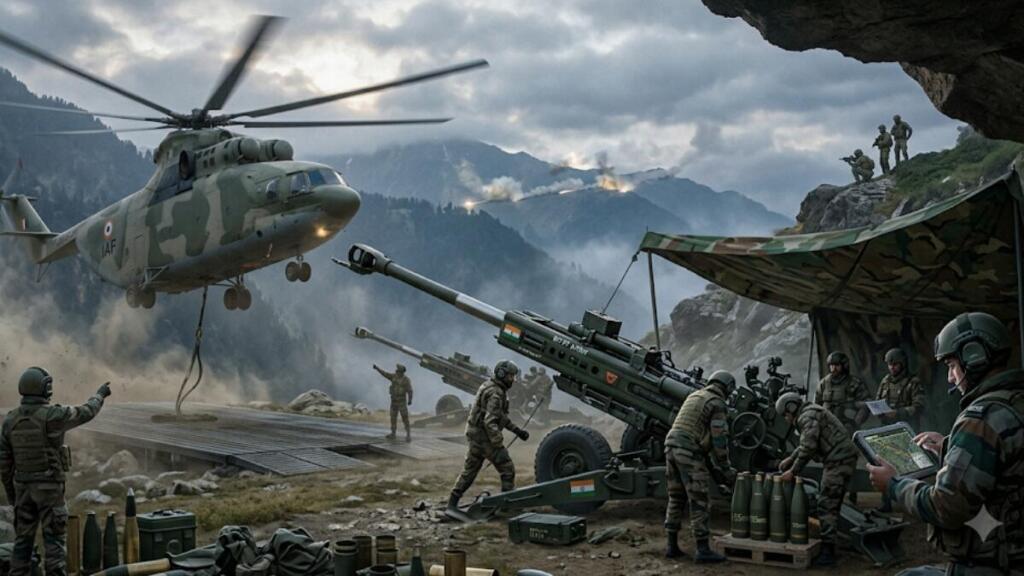
When Operation Sindoor is discussed, the conversation tends to gravitate toward fighter jets, cruise missiles, and air defence systems. But a full year after the operation, official citations and defence reporting have filled in a quieter, less-publicised chapter: the Indian Army’s artillery arm carried out precision offensive strikes of its own — including a first-of-its-kind secret air mobilisation of a howitzer regiment — that formed a core part of India’s response to the Pahalgam terror attack.
Nine Targets, Two Domains
Operation Sindoor was launched in the early hours of May 7, 2025, striking nine designated terror sites across Pakistan and Pakistan-occupied Jammu and Kashmir in retaliation for the April 22 attack in Pahalgam that killed 26 civilians. Of those nine targets, the Indian Air Force struck two high-value sites deep inside Pakistani territory — the Lashkar-e-Taiba headquarters at Muridke and the Jaish-e-Mohammed headquarters at Bahawalpur. The remaining seven were engaged by the Indian Army, using loitering munitions and long-range artillery, along the International Border and the Line of Control in Jammu and Kashmir.
While missiles and drones handled the deeper strikes into Pakistan’s hinterland, artillery was tasked with offensive action closer to the border — a role that has received comparatively little attention until the release of official Gazette citations for gallantry awards over the past year.
A Secret Air Mobilisation
The most striking artillery story to emerge from Operation Sindoor involves the Indian Army’s 302 Medium Regiment, which executed what defence officials describe as the Army’s first-ever air mobilisation of a specialised artillery unit for offensive operations. The regiment was stationed far from its intended area of deployment and was tasked at short notice — under conditions of “utter secrecy” — to be inducted into the Northern Command’s area of responsibility in time for the operation.
The unit is equipped with the British-made M-777 ultra-light howitzer, a 155mm gun weighing roughly 4,200 kg, far lighter than comparable systems like the Bofors (11,500 kg) or the indigenous Dhanush (13,000 kg). That light weight is precisely what made air mobilisation possible: the guns were airlifted as underslung cargo by Indian Air Force CH-47 Chinook and Mi-17 V5 helicopters, along with ammunition, communication equipment, target-acquisition systems, and camouflage gear.
Once in position, the regiment fired US-made M-982 Excalibur precision-guided munitions — rounds capable of striking targets up to 40 km away with an accuracy margin as tight as two metres. The Army began inducting the M-777 in 2017 and first acquired Excalibur ammunition in 2019; it now fields 145 such guns across seven artillery regiments. Since Operation Sindoor, additional orders for Excalibur munitions have reportedly been placed.
The regiment’s commanding officer, Colonel Koshank Lamba, was awarded the Vir Chakra for his role. According to his official citation, he was moved to the unit at short notice and made it mission-capable within five days through intensive training. When Pakistani forces retaliated with heavy bombardment during the operation, Lamba reportedly moved from gun to gun under fire to keep his troops motivated, actions the citation credits with the destruction of multiple terrorist camps and the neutralisation of a large number of terrorists.
Planning Under Pressure
A second unit, the 1988 (Independent) Medium Battery, was responsible for much of the precision planning behind the strikes — using satellite imagery to fix exact target coordinates and briefing the chain of command on execution methodology. Its commanding officer, Lieutenant Colonel Sushil Bisht, also received the Vir Chakra. His unit deployed under cover of darkness, struck its targets, and extracted safely despite the threat of enemy counter-bombardment. He was reportedly tasked with a second strike mission on short notice and again led his unit to complete it under sustained enemy shelling.
At the smaller unit level, Naib Subedar Satish Kumar, a mortar position controller with the 4th Battalion of the Dogra Regiment, was awarded the Vir Chakra after his post along the Line of Control came under intense Pakistani artillery and mortar fire. He directed accurate retaliatory fire that destroyed enemy positions and two surveillance cameras, while his counter-bombardment operations suppressed Pakistani fire and prevented any casualties on his side.
Artillery Along the Broader Front
Beyond these individual units, artillery and air defence gunners more broadly played a defensive role once Pakistan began retaliating on May 8–10 with drone incursions and border shelling. Soldiers involved in these actions later described their mission as targeting Pakistani forward posts that were supporting terrorist infrastructure and infiltration, and said the accuracy of their fire caused Pakistan to shift toward targeting Indian civilian areas in what they characterised as an attempt to divert attention. India said its own counter-battery systems ensured minimal losses on its side.
The head of the Army’s Artillery Division, Lieutenant General Adosh Kumar, later said Indian forces were able to “neutralise” Pakistan’s imported weapons and equipment during the operation, and called for continued investment in indigenous artillery research and development. Other systems credited with playing a role in the wider fires and air-defence effort included the DRDO-developed Pinaka multi-barrel rocket system — capable of firing 12 rockets in 44 seconds out to a range of 90 km — which the Army says was used against Pakistani missile launchers, artillery positions, and supply routes.
The Bigger Picture
The Ministry of Defence has described Operation Sindoor as a marker of “tri-services synergy,” combining Air Force strikes, Navy carrier-group posturing, and Army-BSF coordination on the ground. The artillery component — much of it disclosed only gradually through gallantry citations and retrospective reporting rather than the initial military briefings — has emerged as an important, if lower-profile, part of that picture: precision, air-mobile, and increasingly built around indigenous or India-assembled systems that the Army has continued investing in since the operation concluded.