
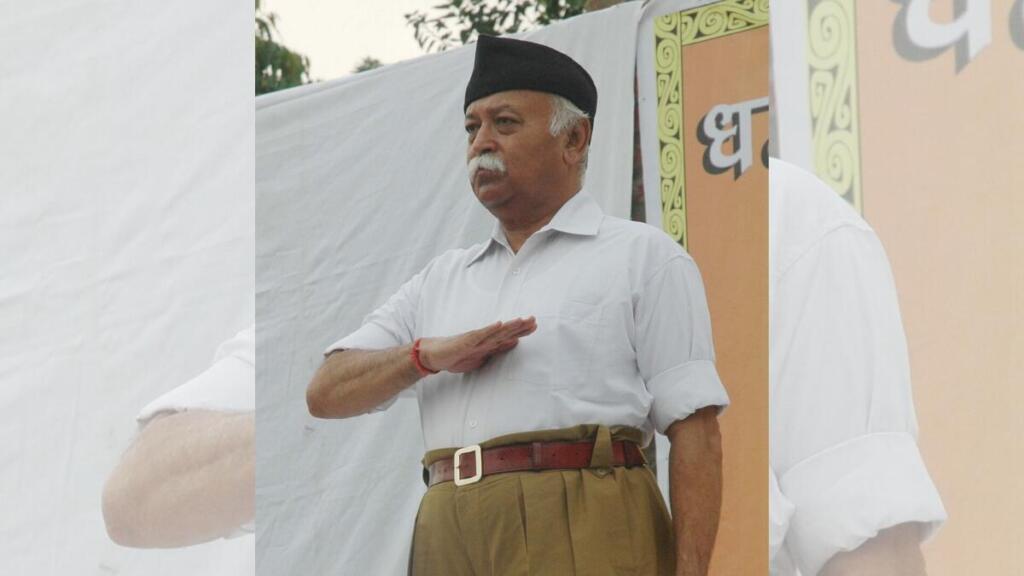
Standing before thousands at Madison Square Garden on August 29, RSS Sarsanghchalak Dr. Mohan Bhagwat used his highest-profile American platform to date to press a single, recurring theme: that diversity is not a fault line to be managed, but the very decoration of an underlying human oneness.
Bhagwat opened by drawing a contrast between two vocabularies. America, he said, speaks the language of pluralism; Bharat speaks the language of unity in diversity — and for Bharat, both strands, unity and diversity, are woven into its very nature. He argued that every nation carries a destiny to fulfil, invoking Swami Vivekananda’s idea that each nation has a message to deliver and a mission to accomplish. Bharat’s destiny, he said, is to realize this unity-in-diversity for itself and, from time to time, to remind the rest of the world of it.
“We are one, and due to diversity, that oneness is decorated,” he told the gathering — a line he returned to later that day at a separate interfaith dialogue, where he said diversity must be accepted, respected and protected, just as one protects one’s own nature while also protecting that of others.
Extending the message to religious coexistence
Bhagwat went further than abstract philosophy, applying the unity-in-diversity idea directly to the question of religious identity. He stated plainly that a Hindu who believes there should be no Muslims in Bharat “will not remain Hindu” — asserting that authentic Hindu thought holds that different religious paths converge on the same goal, and that every human being carries inherent dignity. Coming from the head of the RSS, the remark was a pointed articulation of inclusion delivered on foreign soil, at an event explicitly built around the Sanskrit concept of Vasudhaiva Kutumbakam — “the world is one family.”
Duty over doctrine
Bhagwat closed his address by grounding the unity theme in everyday conduct rather than doctrine. He described Dharma as the sustaining middle path by which people manage the quality of life, and argued that a person’s true contribution to society is measured not by what they earn, but by how much they give back. He urged the diaspora to live this ethos rather than simply talk about it — framing unity in diversity less as a slogan and more as a lived, civic discipline of duty, mutual respect and selfless distribution.
Organisers described the event, held under the banner “Universal Oneness Celebration,” as reflecting an inclusive Bharatiya ethos rooted in open dialogue and mutual respect, and pointed to the interfaith character of the gathering as proof of the message in practice. The visit was not without controversy — it drew public opposition from figures including New York Mayor Zohran Mamdani and protests outside the venue — but supporters argued that Bhagwat’s remarks, particularly his explicit rejection of religious exclusion, were intended to directly answer critics who cast the RSS’s ideology as majoritarian, by restating unity-in-diversity as the movement’s own stated first principle.