
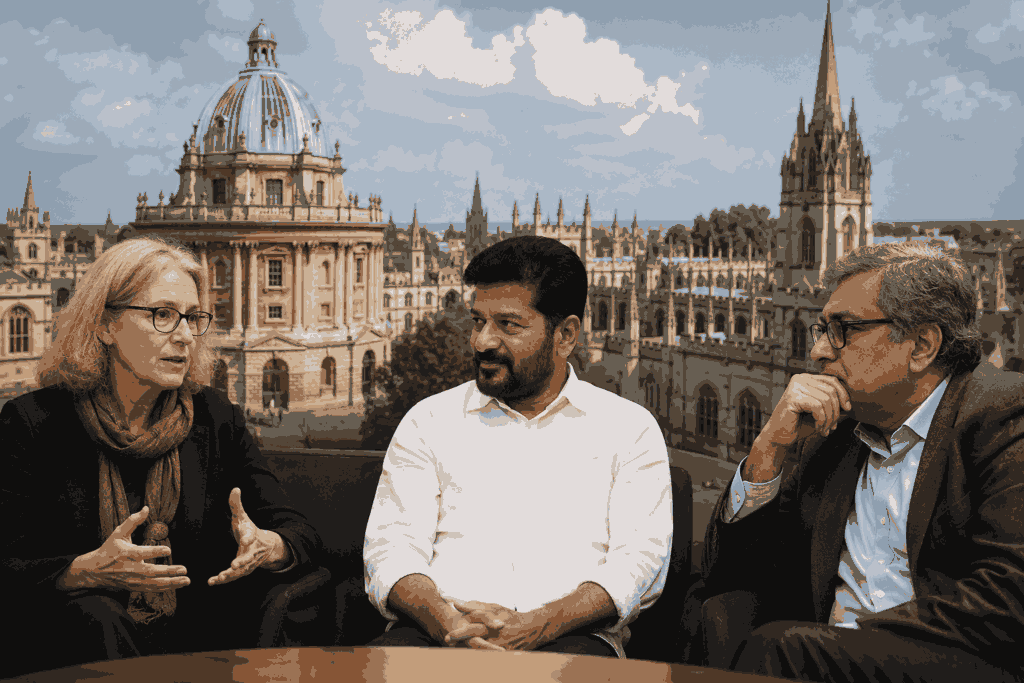
Telangana Chief Minister A Revanth Reddy’s meeting with Oxford academics Maya Tudor and Faisal Devji during his United Kingdom visit has triggered a political controversy, with critics questioning the decision to engage scholars whom they accuse of displaying an anti-Hindu bias in their writings and public commentary. The meeting took place at Oxford as part of Reddy’s efforts to attract international educational partnerships and promote Hyderabad as a global education hub.
According to the Telangana Chief Minister’s Office, Reddy visited the Blavatnik School of Government and held discussions with Tudor, a professor of Politics and Public Policy, and Devji, a professor of Global and Imperial History at Balliol College. The delegation presented the Telangana Rising vision and discussed possibilities involving international education, research, executive programmes and skill development. Reddy also invited Oxford to explore establishing a presence in Hyderabad.
The political controversy centres primarily on Tudor’s published assessments of Indian democracy. Tudor has written extensively on the political development of India and South Asia and has described what she regards as a democratic decline under Prime Minister Narendra Modi. Critics argue that her analysis reflects an anti-Hindu bias, particularly because of its focus on Hindu nationalism as a central factor in India’s contemporary political trajectory. Tudor, however, presents her work as academic research into democratic institutions and political change rather than as an attack on any religious community.
Tudor’s 2023 article, “India’s Democracy Is Dying”, argued that India represented an important example of the global democratic recession. She compared the present period with earlier democratic deterioration, including the Emergency imposed by the Indira Gandhi government between 1975 and 1977. Her assessment drew on democracy-monitoring organisations including Freedom House and V-Dem, both of which have classified India’s democratic performance negatively in recent years. Supporters of the government have strongly disputed those assessments and questioned the methodology behind such international rankings.
Devji has generated a separate controversy because of his longstanding commentary on Indian nationalism, terrorism and Muslim politics. His writings have frequently examined the relationship between Hindu nationalism, minority politics and the modern Indian state. BJP leaders have previously criticised his views, and his association with a 2013 open letter opposing Narendra Modi’s proposed visit to Britain has resurfaced following Reddy’s Oxford meeting. The episode has consequently revived accusations of anti-Hindu bias, although Devji’s academic work encompasses a much wider range of historical and political subjects.
One of the most contentious aspects of Devji’s commentary concerns his treatment of terrorism and India’s position in the global counterterrorism landscape. In a 2015 article published by The Hindu, he questioned the extent to which India should be viewed as a major target of international jihadist organisations and criticised what he saw as an Indian desire to be recognised as a victim of global terrorism. Critics have interpreted such arguments as dismissive of India’s long experience with terrorism, while his broader academic record reflects an attempt to analyse terrorism through historical and geopolitical frameworks.
The controversy has also acquired a partisan dimension. BJP leaders have accused Reddy of associating with individuals they regard as hostile to India’s political and cultural outlook. Telangana BJP MP Arvind Dharmapuri publicly criticised the meeting and highlighted Devji’s earlier opposition to Modi’s UK visit. The BJP has portrayed the episode as evidence that Congress leaders are willing to engage figures accused of advancing an anti-Hindu bias because of their opposition to the Modi government. The Congress and Reddy’s office, meanwhile, have presented the Oxford engagement as part of a legitimate international education and investment outreach programme.
There is an important distinction between the political accusations and the stated purpose of the visit. Reddy’s Oxford discussions were officially focused on education, research and collaboration. The Telangana government said the delegation explained opportunities available to foreign universities under India’s National Education Policy and highlighted Hyderabad’s growing academic ecosystem. The meeting therefore had a practical diplomatic and educational objective, even though the identities and previous writings of the academics involved have generated controversy.
The episode comes at a particularly political moment for Reddy. His overseas tour was originally planned to include the United States, where he was expected to visit universities and meet members of the Indian diaspora. However, the Centre subsequently denied political clearance for the US leg of the trip, forcing the chief minister to return to Hyderabad after completing his UK engagements. The decision has itself become another point of friction between the Telangana government and the Centre.
For critics of the Oxford meeting, the larger concern is whether Indian political leaders should engage academics whose writings they believe demonstrate anti-Hindu bias without publicly challenging those positions. Supporters of Reddy can counter that international academic engagement necessarily involves interaction with scholars holding diverse and sometimes sharply critical views. Neither side’s interpretation automatically determines the academic validity of the scholars’ work.
The controversy ultimately reflects a wider debate over how India is portrayed in international academic and policy circles. Questions surrounding democracy, nationalism, minority rights and secularism have become intensely contested, with supporters and critics of the Modi government often relying on very different evidence and interpretations. Reddy’s Oxford meeting has therefore become a political story far larger than the educational discussions officially announced by his government.
As Telangana seeks to attract foreign universities and research institutions, the episode also highlights the challenge of separating academic collaboration from political controversy. Hyderabad’s ambition to become a global education hub requires engagement with international institutions, but such engagement can inevitably bring Indian political disputes into the international arena. For Reddy, the immediate controversy is likely to continue, particularly as opponents use the meeting to reinforce their allegations of anti-Hindu bias among sections of the international academic establishment.